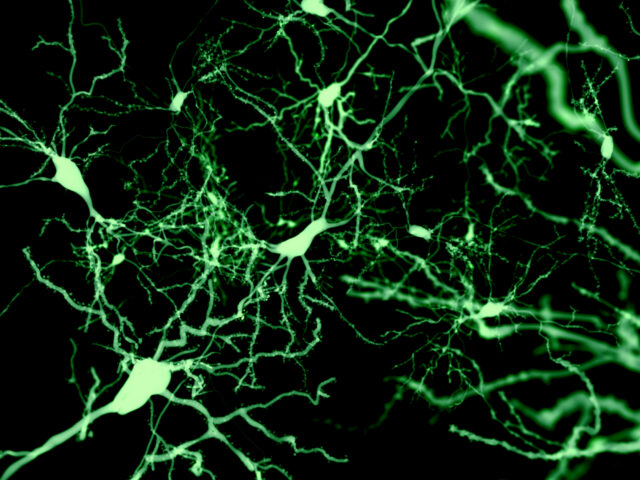
Finding the cells that put our brain to sleep
For a long time, sleep research has treated the cerebral cortex as a passive follower reacting to signals from the deep brain. “Usually, sleep is associated with being controlled by subcortical regions,” said Geoffrey Terral, a neuroscientist at the Albert Einstein College of Medicine in New York. The cortex is where the slow rhythms of deep sleep can be seen, but researchers assumed the signals that triggered them originated elsewhere. In a recent Nature study, Terral and Renata Batista-Brito, who runs the lab, report a population of cortical cells that challenges that assumption. These cortical cells make up only around one percent of the cortex’s inhibitory neurons, and switching them on in a mouse puts the animal to sleep. “What our work shows is that the cortex can not only see this rhythm but also initiate it by itself, and this is sufficient to promote sleep,” Terral said. The 1 percent The cells are called Sst-Chodl neurons, after two genes that are active in them. Long-range inhibitory neurons marked by the activity of these genes have been known for some time, based on studies in monkeys, but researchers couldn’t figure out how to manipulate them using these genes. Aiming at either one of these genes captures a huge, heterogeneous family of different neurons. “A single gene is not able to target these cells,” Batista-Brito said. Inhibitory neurons account for about a fifth of all cortical neurons, so Sst-Chodl cells amount to roughly one neuron in a thousand in the cortex. “If you’re not really specific, the contaminants are going to be much more dominant than the specific cells,” Batista-Brito said. Building a strategy that labels a cell only when both genes are on took her team years.
Comments
No comments yet. Start the discussion.