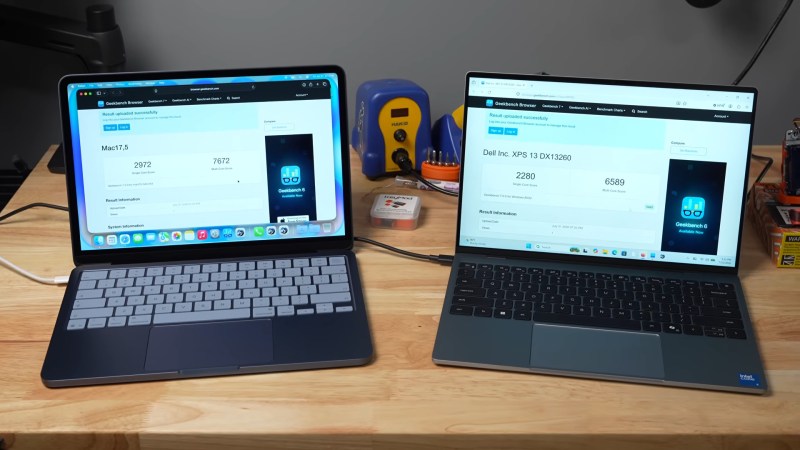
Can Intel finally beat ARM on performance per Watt?
With a title like “Intel Just Matched Apple Silicon. Seriously.“, the latest video from [Jeff Geerling] makes some pretty bold claims. But as we’d expect from [Jeff], he’s got the benchmarks up on GitHub for both the MacBook Neo and Dell’s latest XPS 13 to back it up. We’ve embedded the full video below, which has [Jeff]’s comparative review of the two laptops. The Mac wins on iGPU, sound, and not shipping Windows, while the Dell gets points for being able to load Linux and having a backlit keyboard. But the figure we were hoping to see is the efficiency. After all, it’s ARM’s ability to crank out gigaflops on fewer watts that won them the mobile market and got Apple interested in that architecture in the first place. If Intel is catching up, that’s news. On [Jeff]’s version of the Top500 benchmark - the same HPL Linpak test used for Supercomputers - the MacBook cranked out 57.012 Gflops at 10.6W, for 5.38 Gflops/W while the Dell managed 127.91 Gflops at 20.6W, for 6.21 Gflops/W. That’s just astounding, considering the historical data all goes the other way. This Dell also beats out both M4 and M3 Mac Studios, only failing to the M4 Mac Mini at 7.57 Gflops/W. Even when not crunching big numbers, say at idle or web browsing, the XPS matches the MacBook sip for sip in energy efficiency. Some people have been saying for a few years now that ARM’s observed advantages in power consumption have more to do with the chips themselves than the instruction architecture, and it looks like the Core 5 320 chip in this Dell proves them right when it comes to x86. While you might think you need to code in Assembly or C to maximize those efficiency gains, your choice of language may not be as important as you think. Have to say having recently changed from an M1 MBP 16″ to an M5 MBP 16″ (both with the base CPU but with 32 GB then 48 GB) I was expecting a marginal increase in battery life given the 4 years that have passed. Oddly, comparing my experience with the previous machine’s now 4 year old battery directly with the new machine I only feel that the new machine drains faster. This being a case of coming home from work then doing the same stuff as usual. Previously I’d more often than not survive a regular evening without needing power. Now most evenings I need to reach for power before I’m done for the night. Not impressed… Screens have got brighter, which has a big impact. I’ve got auto brightness disabled and the brightness level isn’t any different to what I had previously(although yes it can go brighter). I leave my new macbookpro plugged in all the time when I use it now. My previous macbookpro stopped working after the magic 1,000 recharges mark and for my convenience apple started to auto-shutdown at 99% battery life even plugged in…made it unusable. That’s one reason I’ve been happy sticking with the M1, even if it’s getting a bit long in the tooth for some of my work. If all else is identical between the machines, I bet the problem is that the efficiency/performance tradeoff decisions that Apple made are just a bad fit for what you do. Apple claims the m5 battery should last about 3 hours longer in their movie watching and web browsing tests, but those aren’t stressing the CPU or GPU too much. If they tested max battery life on something CPU/GPU intensive, the M1 would probably win handily. That’s because the among other things, the m5 has almost twice as many CPU cores and a bigger, slightly more power hungry GPU. Unofficial estimates suggest the m5 may be able to pull 15-20 watts more at peak load than the m1. That said, the base model m5 pro is a more power efficient chip than the m1 per core. I don’t know how much of that is improved architecture If nothing else, there are significant gains from moving fabrication to the latest & smallest process node. Of course, the idea is that both sides are a win - you’ll see more battery life for the less-demanding tasks, and still get more usable battery life for a lot of the demanding ones, since your code compiles faster, video renders faster, LLM can answer faster, etc. .. but in reality, there are plenty of random things that just use more CPU/GPU power because they can for reasons that don’t make anything meaningfully faster. Interestingly, the power consumption differences between the Neo and XPS 13 actually have a similar tradeoff, but in the other direction: the m5 has a lower TDP and the system is slightly more efficient at idle. The XPS 13 may be much more efficient per watt when the CPU is getting a workout, but it also consumes more watts overall. But the XPS 13 also has a much larger battery which presumably mitigates these concerns. I think the Dell is available with Ubuntu pre-installed so you don’t have to pay for Windows if you don’t want it. But both laptops rule me out as a customer because of the little tiny arrow keys - I have adult male sized fingers. It’s a real concentration breaker when you hit the wrong one during some high-concentration coding. Perhaps you should learn the Vi style of navigation on the letter keys unless you have hit one of the text editing modes, or something similar. I can’t say I’m actually good at VIM for lack of persistent enough practice for it to really stick, but it is a really functional way to use a keyboard with text that means you don’t really have to take your fingers off the home row ever. And seems popular enough I’d bet your IDE of choice has it as either a plugin or built in option. I do agree though tiddly little keys for shift/tab/arrows/backspace are infuriating. I think the Dell is available with Ubuntu pre-installed so you don’t have to pay for Windows if you don’t want it. But both laptops rule me out as a customer because of the little tiny arrow keys - I have adult male sized fingers. It’s a real concentration breaker when you hit the wrong one during some high-concentration coding. Panther Lake (and the cut-down version tested here, Wildcat Lake) is available in things other than Dells. Odd that the claim is that Dell did this, and no mention anywhere of the architecture that made it possible. Ugh. “bbshkr” Uuuuugh… Linux still not support wifi out of the box in 2026? :D Well that says it all Er… Fedora does support WiFi after the first update, which any sane person is going to do as part of the installation (which is out of the box as far as I am concerned). Nonsense. I am currently sitting in front of five very different Linux machines, one being a brand new AMD-based Dell 16. They all have different WiFi cards that worked “out of the box”. Zero issues, solid as a rock. I have an old Dell XPS of my own, and a work HP, and I like the HP keyboard better because it has dedicated Home, End, PgUp, PgDn keys, while these need Fn-Arrow combinations in the Dell. I don’t need or want or like a separate numeric area, but these keys are very practical for coding, and switching from the HP to the XPS is painful. After these endless decades of Intel (i.e. x86/ x64), I just want it to die. I think that there are, inevitably architectural advantages with RISC designs, so all other things being equal, it would win. But all other things aren’t equal in that Intel could always throw far more engineers into an implementation. However, I suspect that if Apple feel they’re losing the MIPS/W battle, they’d put more of an effort into addressing it.
Comments
No comments yet. Start the discussion.