Qualcomm's Oryon 3 Reaches the Top
Qualcomm's Laptop Journey
Qualcomm's laptop effort had humble beginnings. Their early Arm-based laptops used cell phone SoCs, and suffered from noticeably poor performance even against lower end Intel chips.
But breaking into the PC market was going to be a marathon rather than a sprint, and Qualcomm has been persistent. Qualcomm created higher performance Snapdragon variants targeted at laptops, which became increasingly competent with each generation.
Now, Qualcomm's Snapdragon X2 Elite Extreme can deliver CPU performance that challenges the best of its x86-64 competition. To deliver that performance, Qualcomm relies on the third generation of their in-house Oryon architecture, which I'll call Oryon 3 for short.
Oryon 3 Overview
The Snapdragon X2 Elite deploys Oryon 3 in both E-Core and P-Core variants, which Qualcomm confusingly calls "performance" and "prime" cores, respectively.
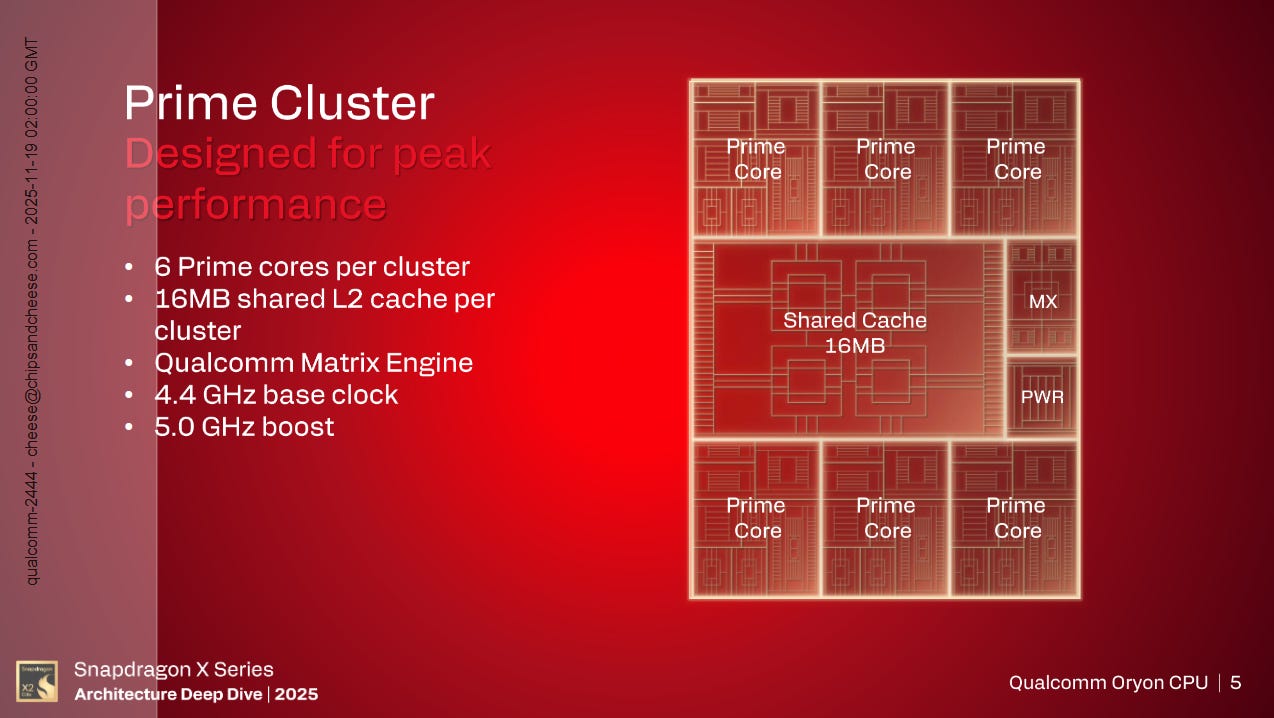
P-Cores are the star of the show in the Snapdragon X2 Elite, where they provide both maximum single threaded performance while also providing the bulk of multithreaded throughput. That's because Qualcomm has P-Cores outnumber their E-Cores by a factor of two, creating an inverted hybrid strategy compared to Intel's.
Thanks to this strategy, Qualcomm's Oryon 3 P-Core variant shoulders most of the burden when it comes to Qualcomm's PC market ambitions. Oryon 3 takes on this burden by deploying an architecture with a strong resemblance to the first Oryon generation.
Qualcomm technically has a second generation Oryon core, but only used it in phones. Their website also suggests it's a very minor change over the first generation, so I'll be treating first generation Oryon as Oryon 3's direct predecessor.
Similarity to Oryon 1 is a good thing, because that gives Oryon 3 just about everything you could ask for from a 2026-era high performance design. From Oryon 1, Oryon 3 inherits an out-of-order window in excess of 600 micro-ops. Qualcomm has also carried forward a two-level cache setup that emphasizes speed over capacity.
Compared to its predecessor, Oryon 3 takes things up a notch by pushing clock speeds to 5 GHz. It's a huge 16% increase over the 4.3 GHz speed that Oryon 1 could reach, and is enough to offer a generational performance gain on its own.
But Qualcomm doesn't stop there. Oryon 3 increases core width to 9 micro-ops, up from 8 in its predecessor, and makes a number of improvements throughout the pipeline. Qualcomm brings SVE2 and SME support to the new core as well, keeping it up-to-date with the evolving aarch64 architecture and opening up new software optimization opportunities.
In its role as a maximum performance architecture, Oryon 3 faces off against the likes of AMD's Zen 5 and Intel's Lion Cove. Arm's Cortex X925 is another competitor, thanks to Nvidia's laptop push with N1X.
A Faster Frontend
Setting aside clock speed, Oryon 3's headline architectural improvement is a core width increase from 8 to 9 ups. At the frontend, Qualcomm supports this by adding another decode slot. The fetch and decode pipeline otherwise looks mostly unchanged.
Oryon 1 already had over-provisioned instruction cache bandwidth at 64 bytes per cycle, which is more than sufficient to feed a 8-wide or 9-wide aarch64 decoder. Qualcomm has also kept a 192 KB, 6-way instruction cache with hardware coherency, as well as a 256 entry 8-way instruction TLB.
These large structures should help the core use its fastest instruction delivery path more often than its peers, which have smaller instruction caches and instruction TLBs. Impressively, Qualcomm managed to keep these large structures and add an extra decode slot while keeping a 13 cycle branch mispredict penalty.
Clock speed increases often come with compromises like longer pipelines or smaller structures, but here Qualcomm is able to have their cake and eat it too.
Testing instruction bandwidth with a stream of NOPs validates the increased decoder width when the test loop fits within the instruction cache. Improvements continue at larger instruction footprints. Oryon 3 is able to sustain about 4 NOPs/cycle from L2, compared to 2 per cycle on Oryon 1.
Qualcomm might have changed something with instruction prefetching from L2, or they might have widened datapaths between the instruction cache and L2. Whatever the case, Oryon 3 now matches the likes of AMD's Zen 5 and Intel's Lion Coves in terms of streaming code from L2, while boasting a much larger L2.
AMD and Intel's cores do have a L3 that provides more capacity than Qualcomm's L2, but fetching code from that L3 will cause another drop in instruction throughput.
High core throughput places pressure on the branch predictor, which must follow the instruction stream fast enough to keep the core fed. Oryon 3 improves by expanding its predecessor's ability to handle taken branches back-to-back. Oryon 1 could only do "zero-bubble" taken branches within a 8 KB instruction footprint. Oryon 3 can do so within a 2048 branch footprint, regardless of branch spacing and code footprint.
Perhaps Qualcomm switched to using a fully decoupled 2048 entry BTB. Realistically, that means Oryon 3 should be able to do zero-bubble taken branches over a branch footprint 2x to 4x larger than its predecessor, considering typical branch spacing.
Compared to AMD and Intel's latest cores, Qualcomm lacks any ability to handle more than one taken branch per cycle. Arm's newer cores are also capable of doing two taken branches per cycle. I suspect AMD, Arm, and Intel decided that handling multiple taken branches per cycle became more profitable once their cores got wide enough, so seeing Qualcomm build a very wide core without that ability is surprising.
Perhaps clock speed factors into that decision, because going from 4.3 to 5 GHz is a huge jump. If so, Qualcomm's choice would be justified because a clock speed increase of that magnitude probably offers a larger performance increase than going for two taken branches per cycle. Of course, it's impossible to know if branch predictor paths presented a timing challenge for Oryon.
For branches with dynamic taken/not-taken behavior, Oryon 3 has a 2-cycle conditional predictor. Testing with branches whose outcomes correlate with increasingly long history lengths shows an average 0.5 cycle increase in time per branch over an always-taken reference run, as long as the test stays within the conditional predictor's capabilities.
Because I randomly generate patterns so that each branch is taken roughly 50% of the time, a 0.5 cycle average penalty suggests Qualcomm only incurs the 2-cycle timing if the direction predictor disagrees with a base prediction. Direction prediction starts falling apart with more than 32K patterns in play, which is an improvement over the approximately 24K patterns that first generation Oryon could handle in this test.
For comparison, Zen 5's conditional predictor can handle roughly 48K patterns before falling apart. Unlike Oryon 3, and unlike some older Zen generations, Zen 5 does not show an increase in branch latency compared to an always-taken pattern.
Indirect branches can go to multiple targets, and present another level of difficulty because the branch predictor has to select between previously seen targets, and must store more than one target per branch. Oryon 3 has a 2-cycle indirect predictor that can track 2048 indirect targets, matching its predecessor.
A single branch can jump to 256 targets without incurring a significant penalty. This could mean at least eight of the bits that Oryon 3 uses to index into its indirect target array are influenced by branch history.
A 50 entry return stack handles return predictions, just as on Oryon 1. However, testing shows that Oryon 3 can use all 50 entries before hitting a performance degradation. When call depth exceeds return stack capacity, Oryon 3 degrades gracefully rather than immediately taking a drastic penalty as Oryon 1 does.
Oryon 1's performance drop is heavy enough to suggest it's mispredicting every return after the return stack overflows. Perhaps Qualcomm implemented a new mechanism to keep a single overflow from messing up the entire return stack, and lets Oryon 3 only mispredict returns whose addresses get forced out on an overflow.
Whatever this optimization is, it gives Oryon 3 return prediction behavior in-line with many other cores, including AMD's Zen 5 and Intel's Skymont. In capacity terms, AMD's Zen 5 has a slightly larger 52 entry return stack.
Rename/Allocate Optimizations
Optimizations at the rename and allocate stage on Qualcomm's big core are remarkably similar to those on its little core counterpart. Both cores can eliminate up to two register-to-register MOVs per cycle. They can also eliminate up to two add-immediate instructions, as long as their immediates sum to 255 or less.
It's slightly strange that Qualcomm has kept the same optimization capability even though the big core is more than twice as wide as its little core companion. That results in degraded microbenchmark figures when I chain dependent MOVs or add-immediate instructions without a break, because the wider core can get more of those instructions into the same rename group, which means the two-per-cycle restriction causes more missed optimization opportunities.
Backend: Large, and Largely Unchanged
One of the best strategies in CPU architecture is to avoid changing something that isn't broken. Oryon 3's backend at a high level is basically identical to the one in its predecessor. That makes sense because if Oryon 1 encountered performance issues, they likely had little to do with its backend strategy.
Qualcomm specifies a reorder buffer capacity of over 650 micro-ops for both Oryon 1 and Oryon 3. Microbenchmarking puts capacity at 675 micro-ops for Oryon 3, and 680 on Oryon 1. Register files and memory ordering queues see little to no movement in size as well.
Qualcomm's choice to avoid major backend changes is justified, because Oryon 3's backend structures remain competitively sized even against emerging competition like AMD's Zen 6. Execution throughput also remains competitive. Oryon 3 does have slightly smaller memory ordering queues, and weaker vector execution throughput compared to its x86-64 counterparts.
The latter comes down to having a smaller 128-bit vector width, which is especially a disadvantage against Zen 5. However, that should only affect a small minority of applications.
Even though Oryon 3's backend is similar to its predecessor, there's still plenty of change under the hood. Predication is a central feature in SVE2 and SME, so Oryon 3 gets a new 120 entry predicate register file. The predicate registers themselves only have to be 16 bits wide because of Oryon 3's 128-bit vector length.
But while the predicate register file doesn't need a lot of storage, it does need to be hooked up to every major execution unit block. Predicate generation can happen from both the scalar and vector side. All four vector pipes and four load/store pipes support predication, meaning a lot of reads from the predicate register file.
New SVE2 and SME instructions also require changes to backend logic. SVE's vector length agnostic design rides heavily on predicate generation instructions like those of the WHILE* variety (like WHILELO). Oryon 3 breaks WHILE* instructions into two micro-ops, which execute through the integer pipes to deliver a throughput of one WHILE* instruction per cycle.
Predicate generation instructions that don't require a GPR input, like PTRUE and CMPEQ, execute through two FP/vector pipes. Besides predication focused changes, SVE2 adds new math instructions like CDOT, meaning more execution unit functionality behind the vector/FP ports.
Load/Store
Like Oryon 1, Oryon 3 has a four-pipe load/store unit. Memory dependencies are handled by a robust store forwarding mechanism, which can do fast forwarding for all cases where a load overlaps a prior store.
Oryon 3 is able to do thai even when the load isn't contained within the older store, meaning the load/store unit is able to combine data from both an in-flight store and data fetched from the L1 data cache. A dependent store+load pair has a latency of 6 cycles on the integer side, or 8 cycles on the vector/FP side.
While Oryon 3 can't do zero-latency store forwarding the way AMD's Zen 5 and Intel's Lion Cove can, the ability to avoid the 14 or 19 cycle penalty those cores take in partial overlap cases is quite nice. Arm's Cortex X925 has the weakest store forwarding capabilities of the bunch, with no zero-cycle capability and a 12-13 cycle partial overlap penalty.
For independent accesses, Oryon 3 prefers 16B alignment for stores. Stores that cross a 16B boundary take a slight penalty, though curiously there's no penalty for crossing a 64B cacheline boundary. Perhaps Oryon 3 has a special optimization for speeding up line-crossing stores. The same characteristics apply on the vector side.
SVE introduces scatter and gather functionality to the load/store unit, forcing it to handle possibly non-contiguous accesses from a single instruction. Testing with LD1W gathers (32-bit elements) achieves a core-wide throughput of 1-2 elements per cycle.
Gathers therefore have lower throughput not just compared to contiguous loads, but also equivalent scalar loads. However, Oryon 3 has an optimization that allows repeated gather loads to the same address to execute at 4/cycle. Gathers therefore seem capable of using all four LSU pipes, and don't go down a smaller subset of specialized pipes. However, the general case seems to rely on a complex flow that involves several micro-ops, resulting in lower throughput.
Dependent gathers have 14 cycle latency, which is acceptable for a non-contiguous load operation. Zen 5 handles vaguely equivalent AVX2 gathers with 19 cycle latency.
The load/store unit also has to translate program-visible virtual addresses to physical addresses that correspond to DRAM locations (or possibly MMIO). Qualcomm sized up the L1 DTLB from a 224 e
Comments
No comments yet. Start the discussion.