Splunk Open Sources Token Meter Tool for Application Developers
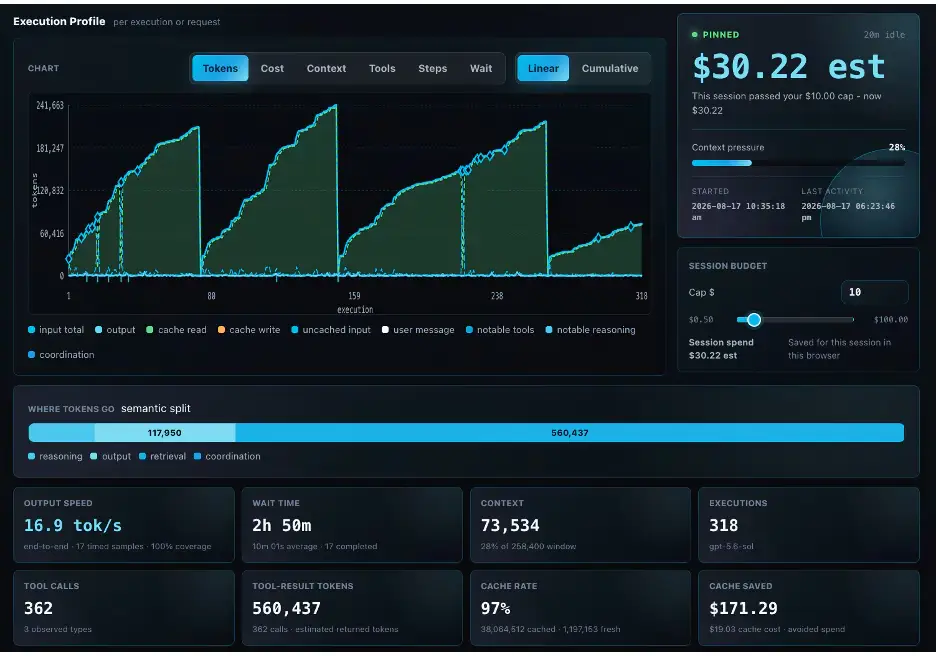
TL;DR - Key Takeaways - Splunk’s open-source Token Meter reads local AI coding-agent logs to show live token consumption, estimated costs, output speed, tool activity and session performance. - Developers can compare costs and activity across agents, models, sessions and tools while setting alerts for budget thresholds or unexpected spending spikes. - As AI coding usage grows, DevOps teams will increasingly need to balance model capability with token efficiency and ensure AI spending delivers measurable business value. The Splunk arm of Cisco has made available an open-source tool that reads local Claude Code and Codex logs on a local machine to surface the live cost and activity of an artificial intelligence (AI) agent session. Dubbed Token Meter, the tool reads the trace files an AI agent writes to disk and prices them against public model rates to help application developers become more aware of the cost of long-running sessions or tasks that could be performed using a less expensive AI model alternative. Designed to run on Linux, macOS and Linux machines running Claude, Codex, Cursor, OpenCode, Kiro or Pi coding agents. Specifically, the tool surfaces output speed in tokens per second, the time the run spends waiting on the model, the split between fresh input and generated output and how much an AI agent handed back after a tool call. Developers can also identify current, completed, or historical sessions using runtime, model, state and time filters in addition to tracing executions, events, tool activity, context growth, retries, failures, coverage, and warnings about session statistics. They can also compare tokens, estimated cost, timing, context, executions, and tool activity across agents, models, days, sessions, and tools. A dashboard also keeps a timeline of raw events, a tools tab for stats on usage, an insights tab for derived signals, and an alerts tab for budget state. Token Meter will send a notification when a run crosses a threshold or the cost spikes. A read-only Model Context Protocol (MCP) server then makes it possible to pull that data directly into an AI coding agent. In general, application development teams are trying to strike a balance between tasks that should be assigned to an AI model versus relying on some type of context engine to help reduce the number of tokens that an AI agent is likely to consume. Hao Yang, vice president and head of AI for Splunk, said that as AI continues to advance, DevOps teams should be able to strike a better balance between consuming tokens and relying on platforms from, for example, Splunk to minimize consumption of tokens. Eventually, how AI agents access and process data will become much more federated as providers of AI model services look for ways to help organizations keep costs under control, he added. While the cost of an individual token continues to decline, the volume of tokens being consumed has been exponentially increasing. As such, many organizations are now spending significantly more on AI than they initially intended. In fact, a recent Futurum Group survey finds that just under half of organizations are over their AI budgets. In the meantime, DevOps teams will be tasked with reducing AI costs as application developers rely more on AI coding tools. The challenge, as always, is not solely reducing costs so much as it is ensuring the funds allocated to AI are actually being spent in the way that provides the most business value to the organization. Frequently Asked Questions What is Splunk Token Meter? Token Meter is an open-source tool that reads local logs from AI coding agents and surfaces information such as token usage, estimated costs, model activity, tool calls, session duration and performance. Which AI coding tools does Token Meter support? The tool is designed to work with coding agents including Claude Code, Codex, Cursor, OpenCode, Kiro and Pi, allowing developers to compare activity and costs across different models and sessions. How can Token Meter help DevOps teams control AI costs? Token Meter provides visibility into where tokens are being consumed, highlights expensive or inefficient sessions and can issue alerts when spending crosses defined thresholds, helping teams decide when a cheaper model or different workflow may be more appropriate.
Comments
No comments yet. Start the discussion.