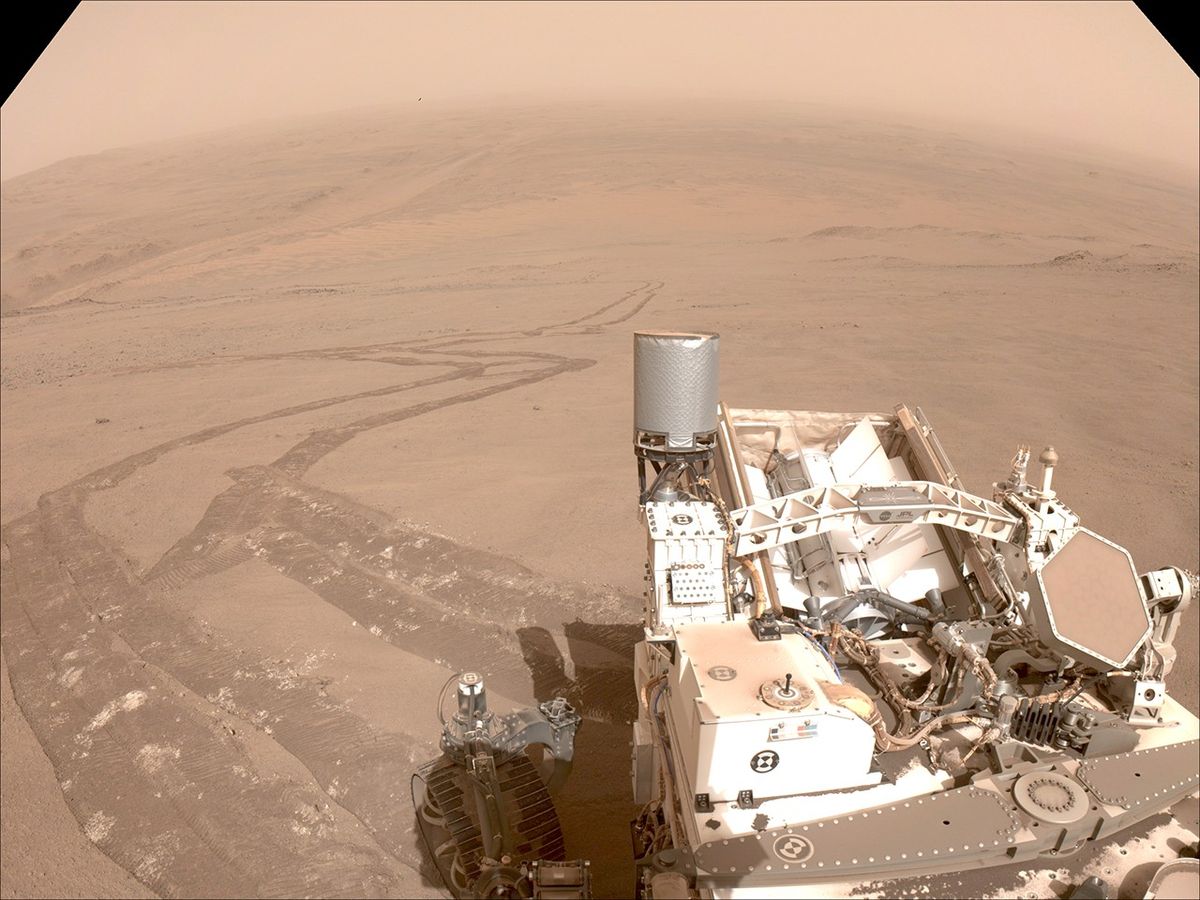
The first self-driving vehicle on Mars has proven to be a smashing success
NASA’s newest rover on Mars, Perseverance, will set a record for the most distance driven by any vehicle on another world sometime next week. The automobile-sized rover, which landed on Mars in February 2021, will traverse beyond 45.16 km (28.06 miles) across the Martian surface. In doing so, it will break the previous distance record held by the long-lived Opportunity rover, which ceased communications with NASA in 2018.
About 90 percent of the distance driven by Perseverance has been autonomous. So how did it reach this record-setting distance in just a third of the time?
A rover that drives itself
“The real enabling technology has been its auto navigation system,” said Steven Lee, the project manager for the Perseverance rover at NASA’s Jet Propulsion Laboratory, in an interview.
Much like self-driving cars on Earth, Perseverance has sophisticated onboard cameras that image the surrounding terrain. These images are then processed algorithmically by an onboard computer to calculate the safest route.
Terrestrial vehicles have some advantages, of course, like clearly defined maps, street signs, lanes, and more. There are also plenty of “road” hazards on Mars, from large boulders to sandy slopes. But at least Perseverance does not have to contend with other traffic and bad drivers.
The limits of Curiosity
The Curiosity rover, largely a twin of Perseverance that launched nine years earlier, had similar imaging capability and algorithms. But its onboard computer was a generation older, and some of its chipset dated back to the 1990s, Lee said.
As a result, only about 10 percent of Curiosity’s driving is autonomous because its processing capabilities are too slow. In its decade and a half on Mars, Curiosity has driven 38.6 km.
Comments
No comments yet. Start the discussion.