The World Would Be Psychedelic as Hell If the Speed of Light Was Way Slower
"Replicator, give me tea, psilocybin mushroom, hot."
One of the reasons it took several hundred years to get from Newtonian mechanics to general relativity is that dramatic relativistic effects predicted by Albert Einstein’s equations only manifest noticeably at significant fractions of the speed of light-and the speed of light is very, very fast. In everyday life, the only thing that moves anywhere near as fast as light is, well, light, so we simply don’t notice the infinitesimal differences between the predictions of Einstein’s theory and those of Newton’s. To be clear, those differences can and do affect our lives-famously, for instance, GPS wouldn’t work if we didn’t take relativity into account. But for the most part, we move through our lives without noticing things like time dilation or the relativistic Doppler effect.
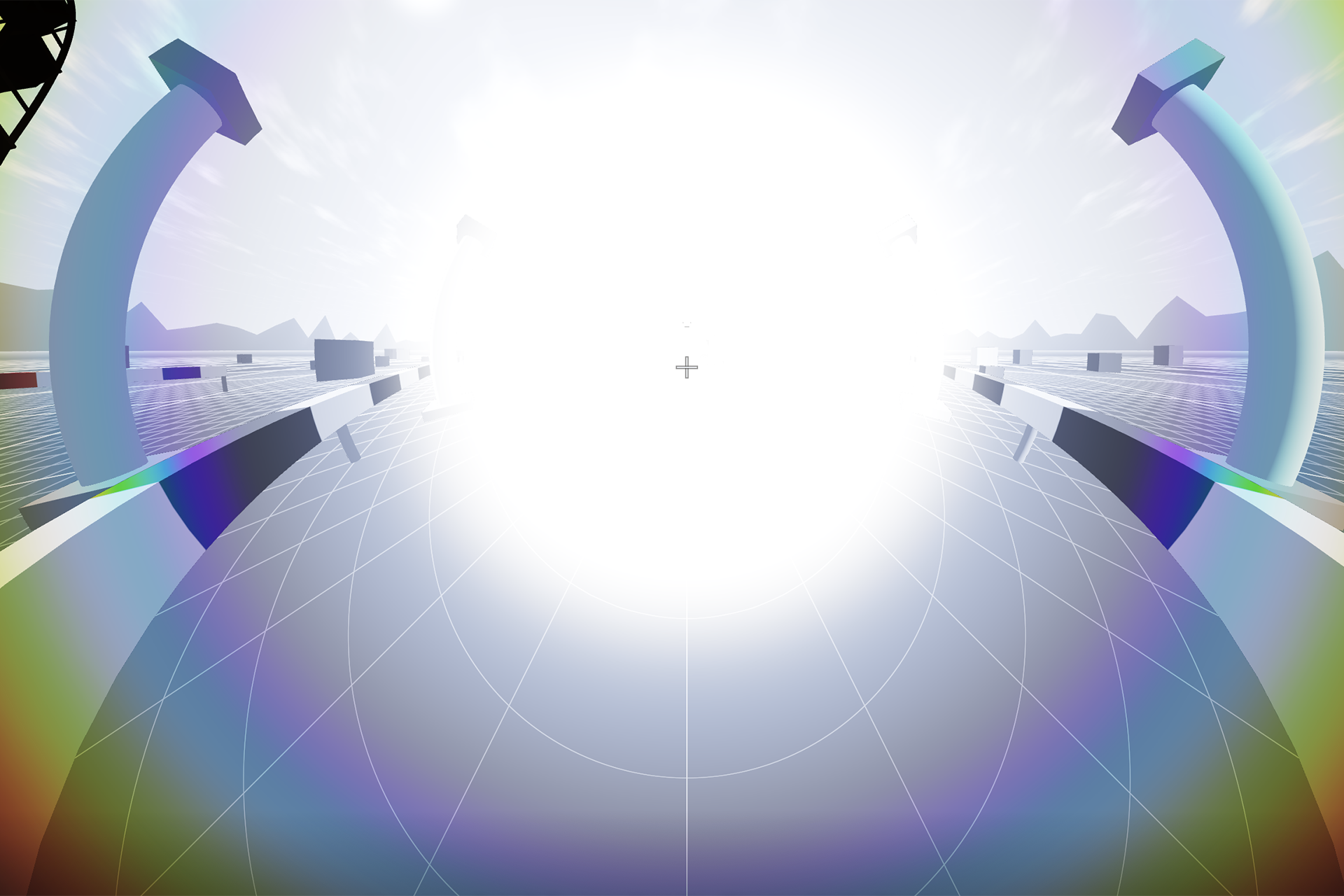
But what if c-the speed of light-was slower? What if instead of 299,792,458 meters per second, it was… say, 1.38 meters per second? That’s exactly 5 km (3.11 miles) per hour, and it’s the value chosen by developer Dmitry Brant for a project he’s called Relativity Park. The project simulates walking around an environment where the speed of light is slow enough for relativistic effects to become noticeable the moment you begin moving.
The simulation defaults to setting c at 5 km/h-a value Brant chose because it is, as he puts it, a “brisk walking speed”-but you can increase it as far as 40 km/h or drop it right down to 1 km/h, which is faster than a sloth, but not much else. Whatever value you choose for c, you’ll find that your own speed can never reach that value-that’s the nature of our universe, after all.
Visual Effects
The first thing you’ll notice as soon as you begin to move is that the lighting of the scene changes. This is because of an optical version of the Doppler effect. If you move forwards, you’ll start catching up to the light ahead of you. From your perspective, this will result in the light’s wavelength being compressed and the light appearing to be shifted toward the blue end of the spectrum, in the same way that an ambulance’s siren sounds higher as it approaches you. If you move backward, the opposite is true; light ahead of you now has trouble catching up with you, making its wavelength appear stretched and its color more red. Both effects become more extreme as your speed gets closer and closer to c.
As you accelerate, you’ll also notice other visual distortion-while you’re accelerating, you don’t actually seem to move toward the objects in the distance. It’s not until you stop accelerating and coast that you actually appear to be moving. This is due to length contraction, a phenomenon whereby objects traveling at significant proportions of the speed of light appear to be contracted to inertial observers, while to those traveling at relativistic speeds, the opposite is true. (There are excellent explanations of this to be found at Minute Physics and The Science Asylum.)
Time Dilation
Finally, the bottom right corner of the screen provides two clocks: your own, and a “world clock” that functions as the perspective of someone observing you from an inertial frame of reference. These demonstrate perhaps the most famous relativistic effect: time dilation. You’ll notice that as you move faster and faster, there’s an increasing discrepancy between your clock and the world clock; from your perspective, time continues to pass at its “normal” speed, but the observer’s clock ticks faster and faster. If you book it to, say, the train tracks in the distance then turn around and travel at the same speed back again, you’ll find that significantly more time has passed on the world clock than on yours.
(As an aside: is it fascinating that our brains can see similar sorts of effects on psychedelics? Why yes. Yes, indeed it is.)
Background and Development
Relativity Park isn’t the first project to play with this idea; in 2012, MIT’s Game Lab released a game called A Slower Speed of Light based around the same concept. Brant acknowledges the influence of this project, but explains that he wanted to “make something much more lightweight: plain javascript and WebGL, usable in a web app.” And because this is 2026, the project is largely vibe coded-but if you’re going to use Claude for something, well, you could do worse than an accessible demonstration of one of the crown jewels of the human intellect.
Comments
No comments yet. Start the discussion.