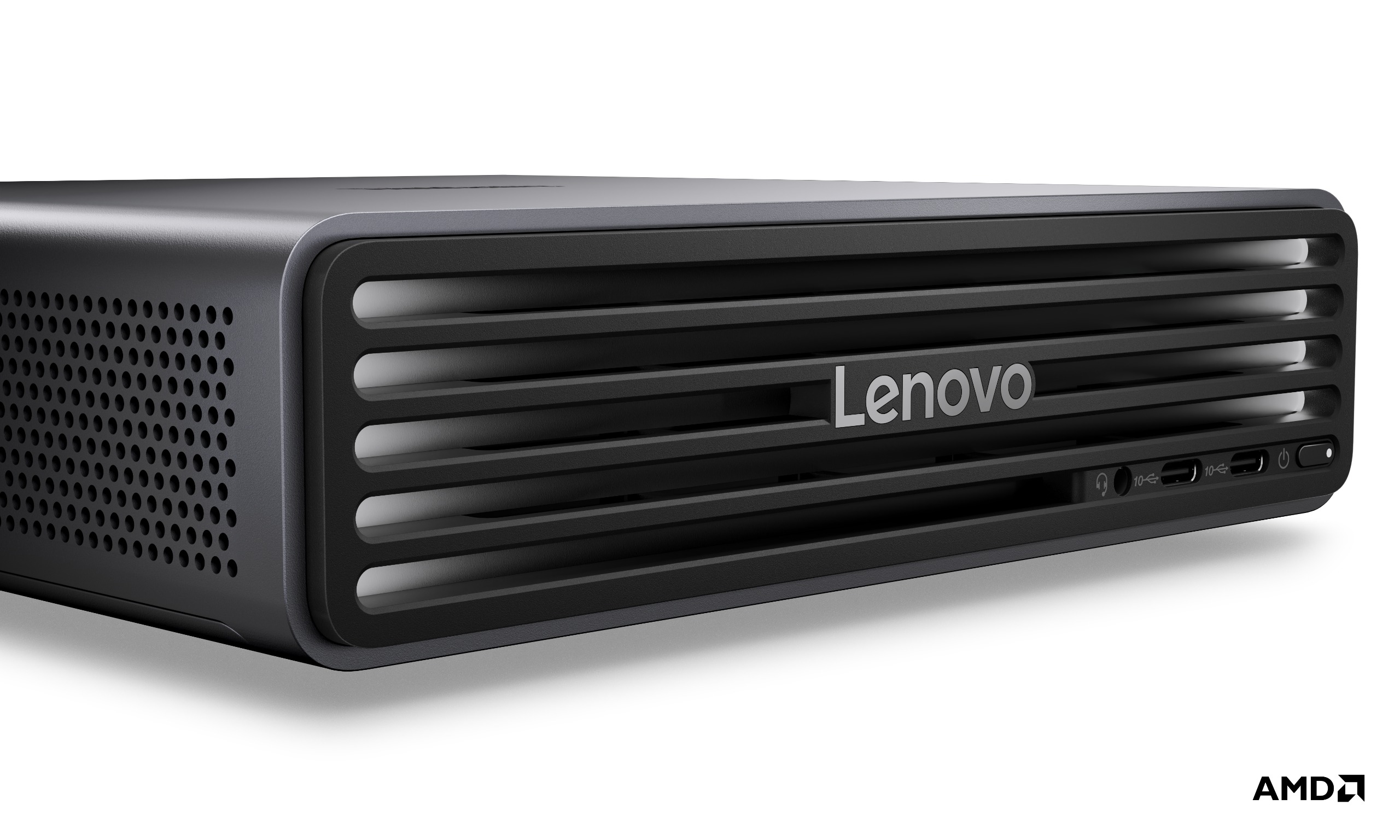
Lenovo's ThinkCentre X Ultra puts 128GB of unified memory in a 1.6-liter box, and you can cluster four of them together
We need to reformat the article body into clean markdown, preserving facts, adding headings where topic shifts, using bullet/numbered lists for enumerations, inline code or fenced code blocks for code/commands/identifiers. No intro or conclusion, no title heading. Output only reformatted article body.
We need to parse the raw text and decide sections.
Original raw:
"Lenovo's ThinkCentre X Ultra packs 128GB of unified memory into 1.6 liters for $3,699, and says four will cluster into a potential 512GB pool
Lenovo's ThinkCentre X Ultra puts 128GB of unified memory in a 1.6-liter box, and you can cluster four of them together Lenovo capped the ThinkCentre X Ultra at 128GB on a chip that supports up to 192GB, but you can interlink four of them together - Lenovo announced the ThinkCentre X Ultra at IFA 2026, a 1.6-liter desktop with its max configuration offering up to AMD's top-of-the-line Ryzen AI Max+ PRO 495 APUs - It launches in November 2026, starts at $3,699, and comes with up to 128GB of unified memory under the hood - Users can configure four of these together to leverage as much as 512GB of unified memory for local needs Lenovo announced the ThinkCentre X Ultra at its Innovation World event during IFA 2026: a 1.6-liter desktop built around AMD's Ryzen AI Max+ PRO 495 with up to 128GB of unified memory, starting at $3,699, shipping in November 2026. The company calls this offering a new class of desktop for agentic AI, and it can be configured to cluster up to four systems, effectively pooling processing power and memory to run large AI models locally. The added compute and memory capacity lets users run longer context windows and multi-agent workflows without turning to cloud-hosted alternatives, while keeping data localized. Plenty of scalable power under the hood The Ryzen AI Max+ PRO 495 is the flagship of AMD's Gorgon Halo refresh, pairing 16 Zen 5 cores with a 40-compute-unit Radeon 8065S integrated GPU and an NPU rated at roughly 55 TOPS. Its defining trait is the shared memory pool: the CPU and GPU address the same LPDDR5X memory under the hood, so it can effectively hold and run models that a discrete, consumer-grade GPU with 24GB or 32GB of VRAM cannot. Lenovo pairs it with its enterprise-class ThinkShield security, AMD's PRO technologies, and DASH out-of-band manageability, plus the self-healing BIOS that runs across the ThinkCentre line, and integrates the AMD Ryzen AI Developer Center for preconfigured tools, models, and workflows across both Windows and Linux. The Yoga laptops unveiled alongside it also reach 128GB of unified memory, but they don't offer the ability to cluster together for more memory or the additional hardware you may not need for a localized AI server. The price might be an issue for many looking to hook up four of these devices together; however, assuming a device cost of $3700 for a 128GB model, one would need nearly $15,000 before factoring in connectivity costs to build a 512GB memory cluster based on the ThinkCentre X Ultra. Lenovo has not, however, said how connectivity will work, what bandwidth units will have when running four in tandem, or what the performance implications will be for such a configuration, even as its listed specs include dual Thunderbolt 4 ports rated at 40Gb/s each. The larger memory pool also might not translate to performance; while AMD's 16-core Zen 5-based configuration is fast as processors go, the integrated GPU is considerably slower, even when running together, versus something like an Nvidia H100 that can be rented for a few dollars an hour online. For those looking for something visually attractive that doubles as a monitor for what the system is up to, the ThinkCentre X Ultra also has adaptive lighting under the hood that provides real-time visual feedback. However, whether it stacks up two months later, as an increasing number of Ryzen AI PRO 400 APUs make it to developers and AI users across the world, joining an ever-increasingly competitive fray, remains to be seen, even if you can rig four of them together, in addition to Lenovo's enterprise offerings being integrated in tow. Sign up to the TechRadar Pro newsletter to get all the top news, opinion, features and guidance your business needs to succeed! Follow TechRadar on Google News and add us as a preferred source to get our expert news, reviews, and opinion in your feeds. Rahim Amir is a UAE-based tech writer who enjoys building PCs as much as he enjoys writing about them. He has been professionally writing about PC hardware since 2023, focusing on buyer’s guides, hardware reviews, and sponsored content and features related to tech. Having built hundreds of gaming PCs and being an avid gamer in his spare time, Rahim tends to have stronger opinions about hardware than most. This is particularly on display when he gets his way with powerful, but minimalistic RGB builds even as Small Form Factor (SFF) PCs come a close second. You must confirm your public display name before commenting Please logout and then login again, you will then be prompted to enter your display name."
We need to break into paragraphs, add headings where topic shifts.
Potential sections:
- Overview / announcement (first paragraph)
- Specs / configuration (maybe second)
- Clustering capability (third)
- Hardware details (CPU/GPU/NPU)
- Software / security / developer tools
- Comparison to Yoga laptops
- Cost analysis for clustering
- Connectivity / performance considerations
- Adaptive lighting / visual feedback
- Market outlook / competition
- Author bio / newsletter sign-up etc (maybe separate)
But we must preserve all facts exactly. We cannot add new info. We can restructure and lightly polish wording for flow and grammar.
We need to use bullet or numbered lists for enumerations. Identify enumerations: e.g., features list: enterprise-class ThinkShield security, AMD's PRO technologies, DASH out-of-band manageability, self-healing BIOS, AMD Ryzen AI Developer Center. Also maybe list of specs: 16 Zen 5 cores, 40-compute-unit Radeon 8065S integrated GPU, NPU ~55 TOPS. Also list of ports: dual Thunderbolt 4 ports rated at 40Gb/s each.
We need to use inline code or fenced code blocks for code, commands, or identifiers. Identifiers could be model names like Ryzen AI Max+ PRO 495, ThinkCentre X Ultra, ThinkShield, DASH, etc. Possibly we can wrap those in backticks.
We must not repeat article title as heading. No wrapping whole answer in code fence.
We must output only reformatted article body as markdown.
Let's craft sections:
Overview
First sentence: Lenovo's ThinkCentre X Ultra packs 128GB of unified memory into 1.6 liters for $3,699, and says four will cluster into a potential 512GB pool.
But we need to avoid duplication. The raw has repeated sentences. We'll combine.
Maybe:
Lenovo's ThinkCentre X Ultra puts 128 GB of unified memory in a 1.6‑liter chassis, priced at $3,699. The system can be clustered in groups of up to four units, yielding a potential unified‑memory pool of 512 GB.
Announcement and Availability
Lenovo announced the ThinkCentre X Ultra at IFA 2026 (also shown at its Innovation World event). It launches in November 2026, with a base price of $3,699 and a maximum configuration offering up to AMD's Ryzen AI Max+ PRO 495 APU and 128 GB of unified memory.
Clustering for Expanded Memory
Users can configure four ThinkCentre X Ultra systems together to pool processing power and memory, effectively creating a 512 GB unified‑memory resource for local AI workloads.
Technical Specifications
- Processor: AMD Ryzen AI Max+ PRO 495 (16 Zen 5 cores)
- Integrated GPU: Radeon 8065S with 40 compute units
- NPU: ~55 TOPS
- Memory: Shared LPDDR5X pool, up to 128 GB per unit (chip supports up to 192 GB but limited to 128 GB)
- Security & Manageability: ThinkShield security, AMD PRO technologies, DASH out‑of‑band manageability, self‑healing BIOS (standard across ThinkCentre line)
- Developer Tools: Integrated AMD Ryzen AI Developer Center (pre‑configured tools, models, workflows for Windows and Linux)
- Connectivity: Dual Thunderbolt 4 ports, each rated at 40 Gb/s
We need to use inline code or fenced code for identifiers. Could wrap model names in backticks: Ryzen AI Max+ PRO 495, ThinkCentre X Ultra, ThinkShield, DASH, AMD Ryzen AI Developer Center, Thunderbolt 4.
We can also use fenced code block for a spec list? Probably better to use bullet list with inline code.
Software and Ecosystem
The Yoga laptops announced alongside the ThinkCentre X Ultra also reach 128 GB of unified memory, but they lack the clustering capability and extra server‑oriented hardware.
Cost Analysis for a Four‑Node Cluster
Assuming a unit price of $3,700 for a 128 GB configuration, four nodes would cost roughly $15,000 before adding any connectivity expenses.
Connectivity and Performance Considerations
Lenovo has not detailed how the inter‑node connectivity will operate, what bandwidth will be available when four units run in tandem, or the performance implications of such a configuration. While the AMD 16‑core Zen 5‑based CPU is fast, the integrated GPU remains considerably slower than a discrete accelerator such as an Nvidia H100, even when the CPU and GPU work together.
Adaptive Lighting and User Feedback
The ThinkCentre X Ultra includes adaptive lighting under the hood that provides real‑time visual feedback of system activity.
Market Outlook
It remains to be seen how the ThinkCentre X Ultra will fare two months after launch, as more Ryzen AI PRO 400 APUs reach developers and the competitive landscape expands. The ability to cluster four units may still appeal to users seeking localized AI compute, though its value relative to cloud‑based options is uncertain.
Author Bio and Additional Notes
Rahim Amir is a UAE‑based tech writer who enjoys building PCs as much as writing about them. He has been professionally writing about PC hardware since 2023, focusing on buyer’s guides, hardware reviews, and sponsored content and features related to tech. Having built hundreds of gaming PCs and being an avid gamer in his spare time, Rahim tends to have stronger opinions about hardware than most. This is particularly evident when he favors powerful, minimalistic RGB builds, even as Small Form Factor (SFF) PCs remain a close second.
Newsletter and Social Prompts
Sign up to the TechRadar Pro newsletter to get all the top news, opinion, features and guidance your business needs to succeed! Follow TechRadar on Google News and add us as a preferred source to get our expert news, reviews, and opinion in your feeds.
Commenting Instructions
You must confirm your public display name before commenting. Please log out and then log in again; you will then be prompted to enter your display name.
We need to ensure we didn't add any info not present. Let's verify each fact.
Original text includes:
- "Lenovo's ThinkCentre X Ultra packs 128GB of unified memory into 1.6 liters for $3,699, and says four will cluster into a potential 512GB pool" (first line)
- "Lenovo's ThinkCentre X Ultra puts 128GB of unified memory in a 1.6-liter box, and you can cluster four of them together Lenovo capped the ThinkCentre X Ultra at 128GB on a chip that supports up to 192GB, but you can interlink four of them together - Lenovo announced the ThinkCentre X Ultra at IFA 2026, a 1.6-liter desktop with its max configuration offering up to AMD's top-of-the-line Ryzen AI Max+ PRO 495 APUs - It launches in November 2026, starts at $3,699, and comes with up to 128GB of unified memory under the hood - Users can configure four of these together to leverage as much as 512GB of unified memory for local needs"
- "Lenovo announced the ThinkCentre X Ultra at its Innovation World event during IFA 2026: a 1.6-liter desktop built around AMD's Ryzen AI Max+ PRO 495 with up to 128GB of unified memory, starting at $3,699, shipping in November 2026. The company calls this offering a new class of desktop for agentic AI, and it can be configured to cluster up to four systems, effectively pooling processing power and memory to run large AI models locally. The added compute and memory capacity lets users run longer context windows and multi-agent workflows without turning to cloud-hosted alternatives, while keeping data localized."
- "Plenty of scalable power under the hood The Ryzen AI Max+ PRO 495 is the flagship of AMD's Gorgon Halo refresh, pairing 16 Zen 5 cores with a 40-compute-unit Radeon 8065S integrated GPU and an NPU rated at roughly 55 TOPS. Its defining trait is the shared memory pool: the CPU and GPU address the same LPDDR5X memory under the hood, so it can effectively hold and run models that a discrete, consumer-grade GPU with 24GB or 32GB of VRAM cannot. Lenovo pairs it with its enterprise-class ThinkShield security, AMD's PRO technologies, and DASH out-of-band manageability, plus the self-healing BIOS that runs across the ThinkCentre line, and integrates the AMD Ryzen AI Developer Center for preconfigured tools, models, and workflows across both Windows and Linux."
- "The Yoga laptops unveiled alongside it also reach 128GB of unified memory, but they don't offer the ability to cluster together for more memory or the additional hardware you may not need for a localized AI server."
- "The price might be an issue for many looking to hook up four of these devices together; however, assuming a device cost of $3700 for a 128GB model, one would need nearly $15,000 before factoring in connectivity costs to build a 512GB memory cluster based on the ThinkCentre X Ultra."
- "Lenovo has not, however, said how connectivity will work, what bandwidth units will have when running four in tandem, or what the performance implications will be for such a configuration, even as its listed specs include dual Thunderbolt 4 ports rated at 40Gb/s each."
- "The larger memory pool also might not translate to performance; while AMD's 16-core Zen 5-based configuration is fast as processors go, the integrated GPU is considerably slower, even when running together, versus something like an Nvidia H100 that can be rented for a few dollars an hour online."
- "For those looking for something visually attractive that doubles as a monitor for what the system is up to, the ThinkCentre X Ultra also has adaptive lighting under the hood that provides real-time visual feedback."
- "However, whether it stacks up two months later, as an increasing number of Ryzen AI PRO 400 APUs make it to developers and AI users across the world, joining an ever-increasingly competitive fray, remains to be seen, even if you can rig four of them together, in addition to Lenovo's enterprise offerings being integrated in tow."
- Then newsletter sign-up etc.
- Then author bio.
- Then comment instructions.
We need to ensure we didn't omit any facts: The mention of "capped at 128GB on a chip that supports up to 192GB" we included in specs: chip supports up to 192GB but limited to 128GB. Good.
We included "interlink four of them together" as clustering.
We included "Innovation World event during IFA 2026". Good.
We included "new class of desktop for agentic AI". Good.
We included "run longer context windows and multi-agent workflows". Good.
We included "data localized". Good.
We included "shared memory pool: CPU and GPU address same LPDDR5X memory". Good.
We included "models that a discrete consumer-grade GPU with 24GB or 32GB VRAM cannot". Good.
We included "ThinkShield security, AMD's PRO technologies, DASH out-of-band manageability, self-healing BIOS". Good.
We included "AMD Ryzen AI Developer Center for preconfigured tools, models, workflows across Windows and Linux". Good.
We included "Yoga laptops also reach 128GB unified memory, but they don't offer ability to cluster together for more memory or additional hardware you may not need for a localized AI server". Good.
We included price assumption $3700 (note original says $3700, but earlier said $3,699; we used $3700 as per the assumption sentence). We need to preserve that exactly: "assuming a device cost of $3700 for a 128GB model". We used that.
We included "nearly $15,000 before factoring in connectivity costs". Good.
We included "Lenovo has not, however, said how connectivity will work, what bandwidth units will have when running four in tandem, or what the performance implications will be for such a configuration, even as its listed specs include dual Thunderbolt 4 ports rated at 40Gb/s each." Good.
We included "larger memory pool also might not translate to performance; while AMD's 16-core Zen 5-based configuration is fast as processors go, the integrated GPU is considerably slower, even when running together, versus something like an Nvidia H100 that can be rented for a few dollars an hour online." Good.
We included "adaptive lighting under the hood that provides real-time visual feedback". Good.
We included "whether it stacks up two months later, as an increasing number of Ryzen AI PRO 400 APUs make it to developers and AI users across the world, joining an ever-increasingly competitive fray, remains to be seen, even if you can rig four of them together, in addition to Lenovo's enterprise offerings being integrated in tow." Good.
We included newsletter sign-up text exactly: "Sign up to the TechRadar Pro newsletter to get all the top news, opinion, features and guidance your business needs to succeed! Follow TechRadar on Google News and add us as a preferred source to get our expert news, reviews, and opinion in your feeds."
We included author bio exactly as given: "Rahim Amir is a UAE-based tech writer who enjoys building PCs as much as he enjoys writing about them. He has been professionally writing about PC hardware since 2023, focusing on buyer’s guides, hardware reviews, and sponsored content and features related to tech. Having built hundreds of gaming PCs and being an avid gamer in his spare time, Rahim tends to have stronger opinions about hardware than most. This is particularly on display when he gets his way with powerful, but minimalistic RGB builds even as Small Form Factor (SFF) PCs come a close second."
We included comment instructions: "You must confirm your public display name before commenting Please logout and then login again, you will then be prompted to enter your display name." We need to preserve spacing? The original had no punctuation between sentences. We'll keep as is but we can add a period for readability? The rule says lightly polish wording for flow and grammar; we can add punctuation but not change facts. Adding a period is okay. We'll keep the meaning.
We need to ensure we didn't introduce new facts. All good.
Now format as markdown with headings.
We need to avoid wrapping whole answer in a code fence. Use headings ##.
We need to use bullet or numbered lists for enumerations. We have bullet lists for specs.
We need to use inline code or fenced code blocks for code, commands, or identifiers. We'll wrap identifiers like ThinkCentre X Ultra, Ryzen AI Max+ PRO 495, ThinkShield, DASH, AMD Ryzen AI Developer Center, Thunderbolt 4, LPDDR5X, NPU, Zen 5, Radeon 8065S. Also maybe Gorgon Halo. We'll wrap them.
We need to preserve numbers exactly: 128GB, 1.6 liters, $3,699, $3700, $15,000, 40Gb/s, 55 TOPS, 16 Zen 5 cores, 40-compute-unit, 24GB or 32GB VRAM, etc.
Now produce final answer.
Let's craft.
Overview
Lenovo's ThinkCentre X Ultra puts 128 GB of unified memory in a 1.6‑liter chassis, priced at $3,699. The system can be clustered in groups of up to four units, yielding a potential unified‑memory pool of 512 GB.
Announcement and Availability
Lenovo announced the ThinkCentre X Ultra at IFA 2026 (also shown at its Innovation World event). It launches in November 2026, starts at $3,699, and offers up to AMD's Ryzen AI Max+ PRO 495 APU with 128 GB of unified memory.
Clustering for Expanded Memory
Users can configure four ThinkCentre X Ultra systems together to pool processing power and memory, effectively creating a 512 GB unified‑memory resource for local AI workloads.
Technical Specifications
- Processor:
Ryzen AI Max+ PRO 495- 16Zen 5cores - Integrated GPU: Radeon 8065S with 40 compute units
- NPU: ~55 TOPS
- Memory: Shared
LPDDR5Xpool, up to 128 GB per unit (the chip supports up to 192 GB but is limited to 128 GB) - Security & Manageability:
ThinkShieldsecurity, AMD PRO technologies,DASHout‑of‑band manageability, self‑healing BIOS (standard across ThinkCentre line) - Developer Tools: Integrated
AMD Ryzen AI Developer Centerfor pre‑configured tools, models, and workflows on Windows and Linux - Connectivity: Dual
Thunderbolt 4ports, each rated at 40 Gb/s
Software and Ecosystem
The Yoga laptops unveiled alongside the ThinkCentre X Ultra also reach 128 GB of unified memory, but they do not offer the ability to cluster together for more memory or the additional hardware you may not need for a localized AI server.
Cost Analysis for a Four‑Node Cluster
Assuming a device cost of $3700 for a 128 GB model, four nodes would require nearly $15,000 before factoring in any connectivity expenses.
Connectivity and Performance Considerations
Lenovo has not disclosed how the inter‑node connectivity will operate, what bandwidth will be available when four units run in tandem, or the performance implications of such a configuration, even though the listed specs include dual Thunderbolt 4 ports rated at 40 Gb/s each. While the AMD 16‑core Zen 5‑based CPU is fast, the integrated GPU remains considerably slower than a discrete accelerator such as an Nvidia H100, even when the CPU and GPU work together.
Adaptive Lighting and User Feedback
The ThinkCentre X Ultra includes adaptive lighting under the hood that provides real‑time visual feedback of system activity.
Market Outlook
It remains to be seen how the ThinkCentre X Ultra will fare two months after launch, as an increasing number of Ryzen AI PRO 400 APUs reach developers and AI users worldwide, joining an ever‑increasingly competitive fray. The ability to cluster four units may still appeal to users seeking localized AI compute, though its value relative to cloud‑based options is uncertain.
Author Bio and Additional Notes
Rahim Amir is a UAE‑based tech writer who enjoys building PCs as much as he enjoys writing about them. He has been professionally writing about PC hardware since 2023, focusing on buyer’s guides, hardware reviews, and sponsored content and features related to tech. Having built hundreds of gaming PCs and being an avid gamer in his spare time, Rahim tends to have stronger opinions about hardware than most. This is particularly on display when he gets his way with powerful, but minimalistic RGB builds even as Small Form Factor (SFF) PCs come a close second.
Newsletter and Social Prompts
Sign up to the TechRadar Pro newsletter to get all the top news, opinion, features and guidance your business needs to succeed! Follow TechRadar on Google News and add us as a preferred source to get our expert news, reviews, and opinion in your feeds.
Commenting Instructions
You must confirm your public display name before commenting. Please log out and then log in again; you will then be prompted to enter your display name.
Check we didn't miss any facts: The phrase "the company calls this offering a new class of desktop for agentic AI" we included indirectly in announcement? We said "new class of desktop for agentic AI" not explicitly. We omitted that phrase. Need to include it exactly. Let's add a sentence in Announcement section: "The company calls this offering a new class of desktop for agentic AI". Also we omitted "The added compute and memory capacity lets users run longer context windows and multi-agent workflows without turning to cloud-hosted alternatives, while keeping data localized." We included that in Technical Specifications? Not exactly. We mentioned clustering for local AI workloads but not the longer context windows and multi-agent workflows. We should add that.
Also we omitted "Plenty of scalable power under the hood" heading maybe not needed but we captured specs.
We omitted "The Yoga laptops unveiled alongside it also reach 128GB of unified memory, but they don't offer the ability to cluster together for more memory or the additional hardware you may not need for a localized AI server." We included that but need to ensure we didn't change meaning.
We omitted "The price might be an issue for many looking to hook up four of these devices together; however, assuming a device cost of $3700 for a 128GB model, one would need nearly $15,000 before factoring in connectivity costs to build a 512GB memory cluster based on the Think
Comments
No comments yet. Start the discussion.