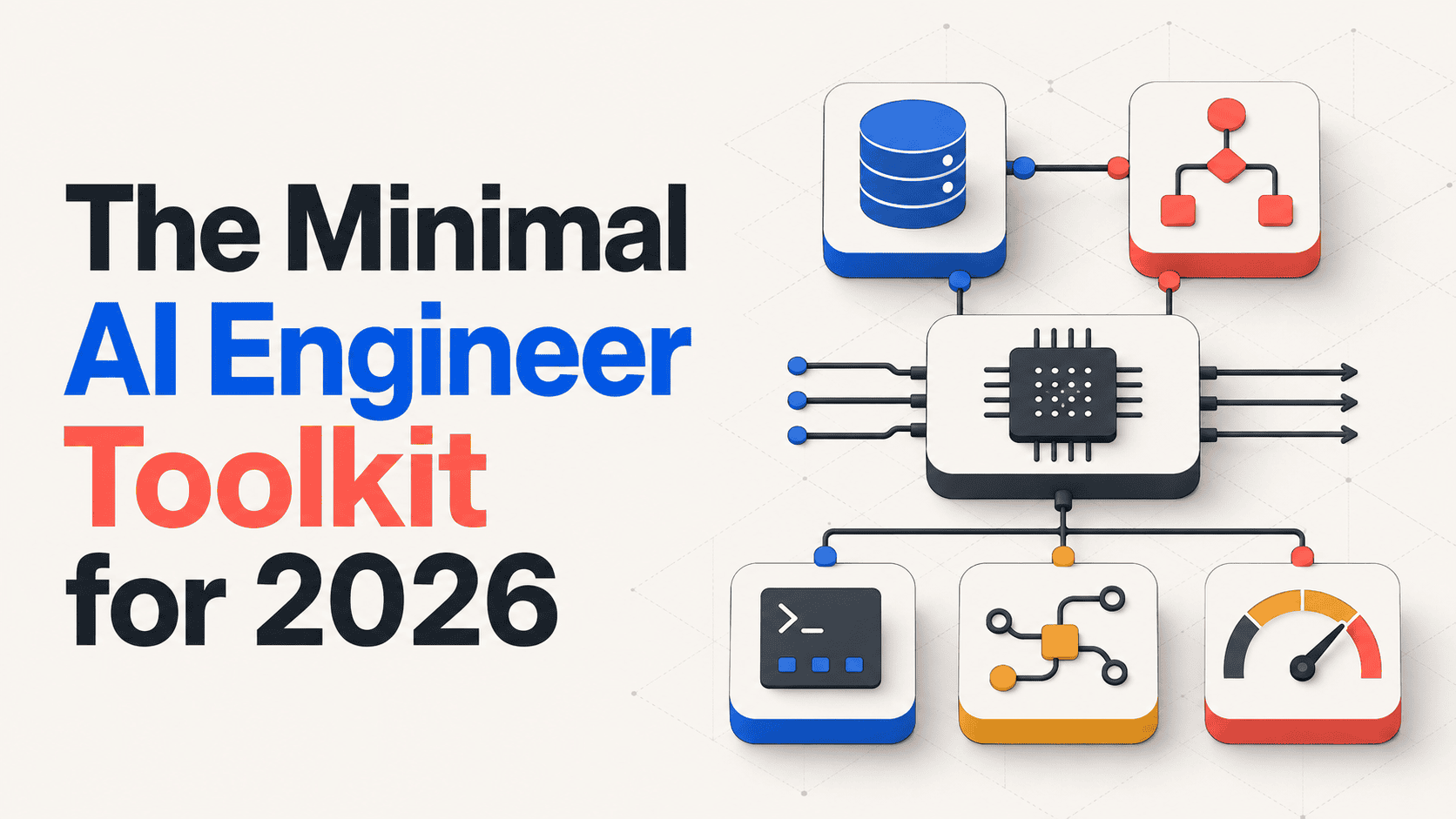
The Minimal AI Engineer Toolkit for 2026
Discover the six essential tools AI engineers need in 2026 to build and deploy production-grade autonomous systems.
The AI Engineering Toolkit
Look at the architecture diagrams for generative AI (GenAI) applications built just two years ago, and they resemble a tangled web of dependencies. The standard stack required a massive vector database, complex chunking algorithms, a heavily abstracted orchestration framework, custom API wrappers for every tool, and direct reliance on expensive frontier models for even the simplest tasks. It was a stack built for prototyping, not production.
Today, as mapped out in From Python to AI Engineer: A Self-Study Roadmap, the role of the AI Engineer has matured. We're no longer frantically wiring APIs together to see if a language model can summarize a PDF. We're building deterministic systems around non-deterministic engines.
Because foundation models have integrated native reasoning and state management, the tooling required to build around them has actually shrunk. The bloated "kitchen sink" approach has been replaced by a lean, standardized set of primitives. Here's the minimal, production-grade toolkit an AI Engineer needs in mid-2026 to build, evaluate, and deploy autonomous systems. Each layer addresses a distinct problem, and together they form a coherent stack.
Orchestration: Graphs and Event Loops
Everything begins with orchestration. Without reliable control over how your agent reasons and routes, nothing else in the stack matters.
For production agentic systems, you need visibility into the execution graph, state transitions, and error handling. Frameworks that obscure the underlying prompts or make it difficult to intercept a tool call belong in a prototype, not a deployed system.
As detailed in The Complete AI Agent Decision Framework, the industry has converged on two primary paradigms.
Code-First Graph Frameworks
For complex, stateful applications, cyclical graphs are the standard. Instead of writing brittle while loops to manage agent reasoning, you define nodes (agents or tools) and edges (conditional routing logic). State is maintained automatically across the graph, letting you pause execution, request human-in-the-loop approval, and resume computation without losing context. Tools like LangGraph and Burr exemplify this paradigm.
Recommending LangGraph here isn't a contradiction of the earlier point about reasoning-loop abstractions. LangGraph is a low-level, code-first graph framework that gives you explicit control over state and transitions. The concern with heavily abstracted frameworks is about opaque orchestration that prevents you from seeing or intercepting what the model is doing.
Visual Event-Driven Orchestration
For workflow automation and data pipelining, visual orchestration has proven far more maintainable than thousands of lines of boilerplate Python. As explored in Automations with n8n: A Self-Study Roadmap, modern visual builders treat AI
Comments
No comments yet. Start the discussion.