
How I Set Up OpenCode: A Real Agent OS (Config, Skills, MCPs, Memory)
⚡ TL;DR
OpenCode becomes a real agent OS once you wire config, subagents, skills, MCP servers, commands, and a plain-file memory pipeline together.
This post is my actual setup, so you can copy the shape rather than guess it.
Everything is a plain file: no database, no proprietary format, no vendor lock-in.
The interesting part isn't the component count. It's the decisions behind them: what should be reusable, what should be persistent, where responsibilities should live, how much autonomy to allow, and how to keep the whole thing understandable as it grows.
🎉 Fun Things You Can Do
- Talk to 31 specialized agents - code reviewer, security reviewer, planner, architect, and more
- Watch your agent remember decisions across sessions (plain files, no database)
- Run 123 skills that fire automatically based on what you're doing
- Connect 8 MCP servers for web search, file access, memory, and more
- The whole thing is a folder of text files - open any one in a text editor
🤔 The Problem
Out of the box, an AI coding tool is a chat window. It forgets your conventions between sessions, has no idea which model is cheap enough for bulk work, and re-learns your repo every morning.
I wanted an agent OS: config that loads my rules into every tool, a roster of cheap and quality subagents, installed skills with real workflows, MCP servers for docs/search/filesystem, and a memory pipeline that survives compaction.
Two constraints shaped everything:
Plain files, not a database. Everything is Markdown, JSONL, and JSON. Human-readable, version-controllable, portable. No vendor lock-in.
Cost-aware routing. 40+ agents split by cost and purpose. A 200-file summarisation runs on a cheap model; an auth change goes to a security reviewer.
🎁 What You Inherit
A fully configured OpenCode environment. It includes one config file (model, instructions, plugins, MCP servers, formatter, LSP, permissions), 40+ subagents, 123 skills under the agents skills directory, and 20 commands.
There is also a two-layer plain-file memory pipeline (global + project) with compaction duty, plus a separate learning file that tracks patterns with evidence and confidence scores.
Stack: OpenCode, superpowers plugin, a learning-memory plugin, MCP (web research, data extraction, neural search, docs lookup, filesystem, fetch, memory, sequential thinking), and a CLI config for the terminal interface.
🏗️ Architecture
flowchart TB OC["OpenCode"] --> CFG["config file"] CFG --> INS["instructions:<br/>rules + agents protocol + personality + learning file"] CFG --> PLG["plugins: superpowers + learning-memory"] CFG --> MCP["mcp.servers (8)"] CFG --> EXP["experimental:<br/>todo + background_compaction"] CFG --> PERM["permissions:<br/>path- and command-scoped allow/ask"] CFG --> COMP["compaction:<br/>auto, keep 20k tokens, 20% buffer"] INS --> AG["agents (40+)<br/>config + agent files"] INS --> SK["skills (123)<br/>agents/skills"] INS --> CM["commands (20)"] INS --> MEM["memory pipeline"] MEM --> G["global: agents/memory<br/>state · topics · sessions · compactions.log"] MEM --> P["project: repo/.memory<br/>index · state · topics"] MEM --> L["learning file:<br/>patterns · AARs · evidence · confidence"]
Notice what is not in the config: agent definitions, skills, and memory. Those are file-system conventions, which is why they work with any tool that can read a file.
📁 Project Layout
config/opencode/ ├── config file # the only config file ├── cli config# terminal interface settings ├── service config ├── agents/ # 12 subagent definitions (.md) │ ├── cheap-* (8) # bulk, code, fast, general, nano, quality, reason, vision │ └── code-reviewer, planner, security-reviewer, tdd-guide ├── commands/ # 20 slash commands └── package.json# plugin deps agents/ ├── AGENTS.md # universal operating protocol ├── rules/CORE.md # always-on rules ├── skills/ # 123 skills ├── agents/commands/workflows/templates/ ├── memory/ │ ├── state.md │ ├── topics/decisions/learning/sessions/YYYY/MM/DD.md │ └── compactions.log ├── .memory/# project-scoped memory │ └── state.md └── kanban/BOARD.md
💡 Core Ideas
(  )
The memory pipeline is the actual OS
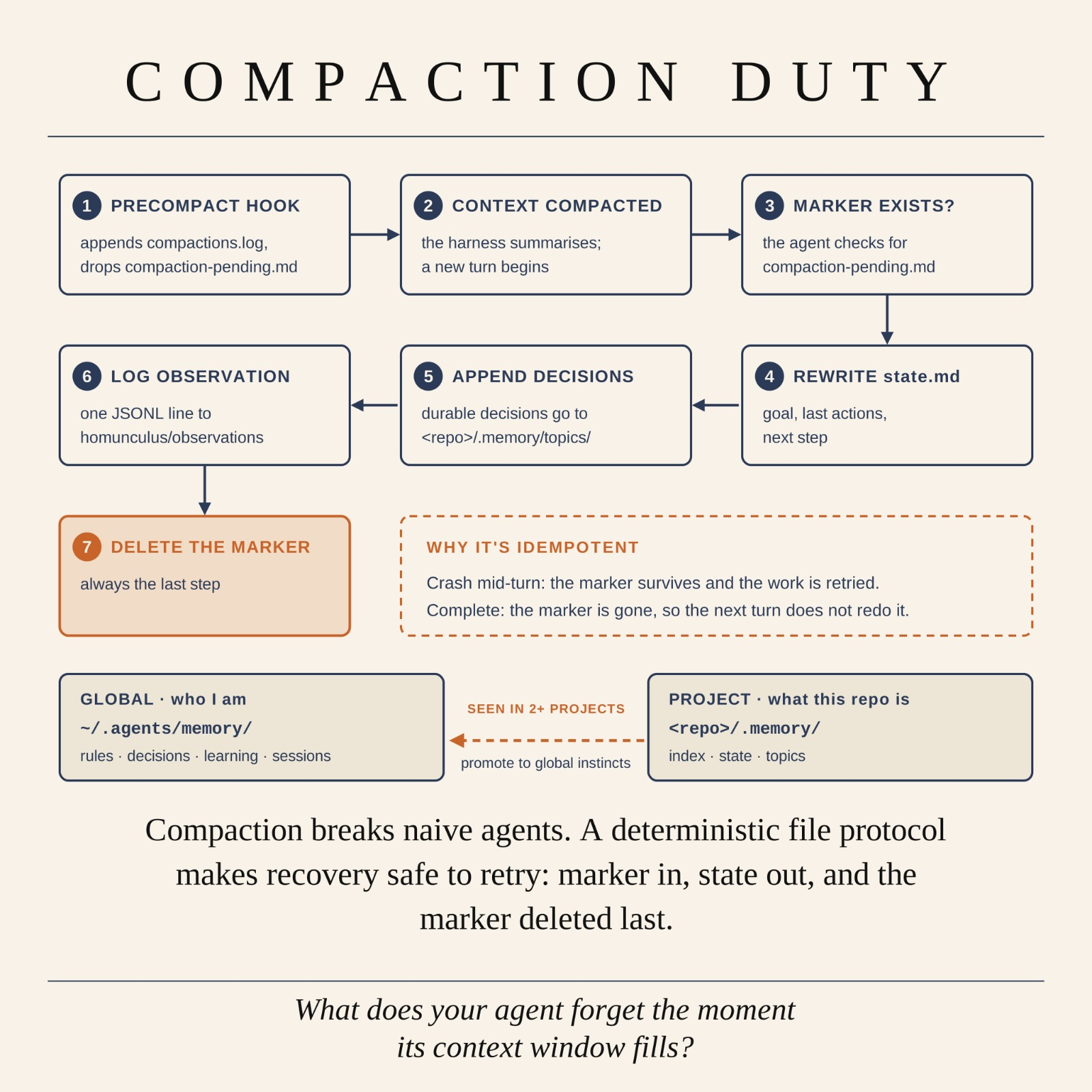
Compaction is the event that breaks naive agent setups: the context window fills, the harness summarises, and the agent forgets the decision it made an hour ago. The fix is a deterministic file protocol, not a bigger context window.
sequenceDiagram participant H as Harness participant M as compaction marker participant A as Agent participant S as .memory/state.md participant T as .memory/topics/ participant L as learning file H->>M: PreCompact hook appends compactions.log + drops compaction-pending.md H->>A: context compacted, new turn A->>M: marker exists? A->>S: rewrite goal / last actions / next step A->>T: append durable decisions A->>L: append observation or pattern A->>M: DELETE marker
The DELETE marker step is what makes it idempotent. If the turn crashes halfway, the marker survives and the work is retried; if it completes, the marker is gone and the next turn does not redo it.
Two layers, because they answer different questions: Global (agents/memory/) - who I am across projects: operating rules, decisions, learning, daily session logs. Project (repo/.memory/) - what this repo is: index, state, topics.
And one promotion rule: a pattern observed in 2+ projects gets promoted from observations to global. That is the difference between a journal and a learning system.
Why plain files instead of a database?
I chose Markdown, JSONL, and JSON over a database for four reasons:
Human-readable. I can open any file in a text editor and understand the state. No query language, no ORM, no migration scripts.
Version-controllable. Plain files diff cleanly in Git. I can see exactly what changed between sessions.
Portable. Any agent that can read a file can use this memory. No vendor lock-in, no proprietary format.
Easy to modify without specialised tooling. A text editor is enough.
Trade-offs I accept:
Concurrency. Two agents writing to the same file simultaneously can corrupt it. I mitigate this with atomic writes and by keeping writes at task boundaries, not mid-task.
Transactional integrity. No rollback if a write fails halfway. The compaction marker protocol compensates by making the recovery path explicit.
Retrieval. No indexing, no full-text search beyond grep. For the volume of data I generate, grep is fast enough. If it weren't, I'd add a lightweight search index.
Scaling. This works for one person's workflow. It would not work for a team of 50 sharing state.
Alternatives I considered and rejected:
SQLite. Good for structured queries, but adds a dependency, a schema migration path, and a binary format that doesn't diff in Git. For my volume, the cost outweighs the benefit.
Redis / in-memory store. Fast, but ephemeral. The whole point of this memory is that it survives session restarts and compaction events.
Vector database (embeddings). Tempting for semantic retrieval, but overkill for state files that are read in full, not queried. I'd reconsider if the knowledge base grew past a few thousand entries.
Cloud-synced notes (Notion, Obsidian). Adds a network dependency and a vendor. Plain files in a Git repo give me sync, history, and offline access for free.
At what point does filesystem memory stop being sufficient? I don't know yet. If retrieval latency becomes a problem, the first thing I'd try is a local SQLite index over the Markdown files, not a migration away from plain text.
Two-tier subagents
Forty-plus agents, split by cost and purpose:
Tier Agents Use Cheap (8) cheap-bulk , cheap-code , cheap-fast , cheap-general , cheap-nano , cheap-quality , cheap-reason , cheap-vision bulk transforms, lookups, small edits, screenshot review Review (12+) code-reviewer , python-reviewer , typescript-reviewer , go-reviewer , rust-reviewer , cpp-reviewer , java-reviewer , kotlin-reviewer , flutter-reviewer , security-reviewer , database-reviewer language-specific and security review Build resolvers (7) build-error-resolver , cpp-build-resolver , go-build-resolver , java-build-resolver , kotlin-build-resolver , rust-build-resolver , pytorch-build-resolver diagnose and fix build errors Quality (4+) planner , architect , tdd-guide , refactor-cleaner , doc-updater , docs-lookup , e2e-runner , harness-optimizer , loop-operator , chief-of-staff planning, architecture, testing, docs, orchestration Autonomous (1) autonomous full-autonomy mode: reads, writes, runs commands without prompts. Destructive actions still gated by core rules.
The routing rule is simple: route by cost, escalate by risk. A 200-file summarisation runs on cheap-bulk ; an auth change goes to security-reviewer before merge.
How many agents are useful before orchestration becomes overhead? I don't have a clean answer. The 40+ count includes many language-specific reviewers that I added because a generic reviewer kept missing language-specific issues. If I were starting over, I'd begin with 4 and add only when a real gap appears.
Skills are files with front-matter
A skill is a directory under the skills folder with a SKILL.md containing name and description . The description is not documentation - it is the trigger. The agent matches the task against it, so a vague description means the skill never fires.
That wording is deliberate: it names the situation ("encountering a bug"), not the capability ("debugging help"). Situation-shaped descriptions fire reliably; capability-shaped ones get ignored.
What belongs in a skill versus an agent instruction? My current split: skills are reusable workflows that apply across projects (debugging, planning, TDD). Agent instructions are identity and scope ("you are a security reviewer; do not edit files"). If a skill grows to include identity, it probably should be an agent. If an agent accumulates workflow steps, those steps should be extracted into a skill.
The learning system
The memory pipeline evolved. The original design used a separate observations-to-instincts pipeline. That was retired in favour of a single learning file that is the source of truth for preferences, patterns, and durable decisions.
The learning file carries:
Patterns with trigger, action, domain, scope, confidence (0.3-0.9), evidence arrays, applied/confirmed counts, and last-confirmed date. Confidence only rises after a pattern is applied and checked against real output.
After-action reviews (AARs) that record what happened, what was learned, and what changed.
Learned entries for durable preferences and decisions.
Patterns are treated as hypotheses, not rules. A pattern starts at low confidence and earns trust through application and verification. Promotion into a rule or skill requires 2+ confirmed applications plus explicit approval.
The capture is manual, at task boundaries - not automated. No hooks, no observers, no background writers. This was a deliberate decision: automated capture without verification produces noise, not learning.
🔄 Pipeline / Flow
Read state (global + project). Check the kanban board. Invoke relevant skills before any action (1% rule: if a skill might apply, load it). Use docs lookup for library questions - not training data. Research → plan → execute → verify for anything touching 3+ files. Update memory at the task boundary, not only at compaction.
🧭 Key Decisions
Why OpenCode over the alternatives
I evaluated Cursor, Copilot, Codex CLI, and Gemini CLI before settling on OpenCode.
The deciding factors:
Config as files, not UI. OpenCode reads a JSONC config file. No settings panel, no proprietary database. I can diff, version, and copy my entire setup.
Subagent definitions as files. Each agent is a Markdown file with front-matter. I can create, edit, and delete agents with a text editor - no plugin SDK, no marketplace.
MCP support out of the box. Remote and local MCP servers work without a separate bridge or proxy.
Open source. If something breaks, I can read the source. The reference repo is even linked in my config for source-level lookups.
Trade-off: OpenCode has a smaller community than Copilot or Cursor. Fewer tutorials, fewer pre-built integrations. I accept this because the file-based model gives me control that UI-based tools don't.
Why Python for the learning tooling
The learning system's CLI and test suite are written in Python. Alternatives I considered:
Node.js/TypeScript. Consistent with the OpenCode ecosystem, but I'm more productive in Python for CLI tools and data processing. The learning logic is pure functions with no I/O - language choice matters less than testability.
Shell scripts. Tempting for simplicity, but JSON parsing and atomic file writes in bash are fragile. Python's json module and pathlib make this reliable.
Go/Rust. Overkill for a single-user CLI tool. The compile step adds friction to iteration.
The learning tooling has no runtime dependency on OpenCode itself. It operates on plain files. This means I can test it independently, version it separately, and replace the runtime without losing the learning data.
Why JSONC for config
Comments. JSONC allows // comments, which I use to document why each block exists. Plain JSON doesn't.
Trailing commas. Small quality-of-life improvement when editing by hand.
Schema validation. The $schema field gives me autocomplete and validation in my editor.
Alternative: TOML or YAML. Both are more readable for deeply nested config, but OpenCode's schema is JSON-based and the ecosystem expects JSON. Using JSONC is the path of least resistance.
One protocol file works across every tool. Plain files, no vendor lock-in. The same AGENTS.md serves OpenCode, Copilot, Codex, Gemini CLI, Cline, Cursor, Windsurf. Plain-file memory beats a DB for cros
Comments
No comments yet. Start the discussion.