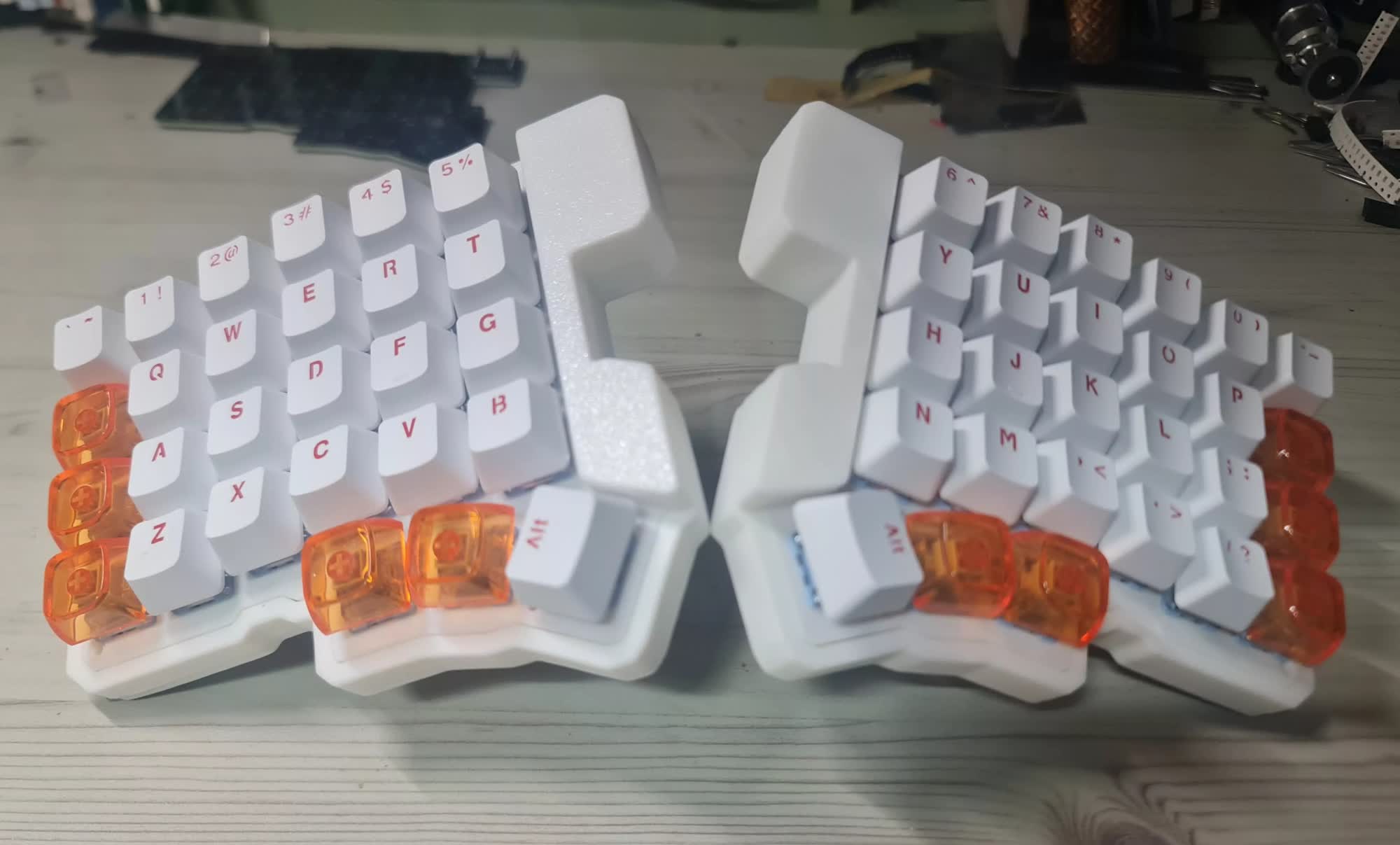
This popular open-source split keyboard just got a Hall-effect upgrade
Recap: While popular manufacturer Keychron offers partially open-source keyboards and is working to open-source its mouse firmware, modder Juho T's fully open-source Silakka54 design has been inspiring affordable ergonomic split keyboards for some time. A new fork from another tinkerer adds Hall-effect switches. Fans of minimalist ergonomic split keyboards and users familiar with the Silakka54 might be interested in a new Hall-effect variant. If it catches on with resellers, it could become one of the more affordable Hall-effect keyboards available, while its open-source hardware and firmware allow for unrestricted modding. Juho T's original Silakka54 design first emerged on GitHub in late 2024. The 54-key split keyboard draws inspiration from the REVIUNG41 and Corne, supports 5-pin MX-style switches, and uses firmware based on the open-source QMK and VIA standards. While the project's GitHub repository includes instructions for building the PCB and firmware from scratch, pre-built models from unaffiliated resellers are available on stores such as AliExpress for as little as $50. As a fully open-source project, forks were to be expected, and a recent creation from modder Hanthebot introduces a useful Hall-effect option. The Silakka54-HE mostly retains the original design and firmware support. However, in addition to adding Hall-effect switches, it supports Wooting cases and features a reversible design, with its firmware and PCB schematics based on Choi Byungyoon's TrueStrike42. Other features include adjustable actuation points (APC), rapid trigger, full-duplex communication, and much more. Currently available only as a DIY project, the Silakka54-HE requires the following off-the-shelf components: - PCB x2 - SOT-23 SS49E x54 - 0805 0.1uf capacitor x62 (0.1~1uf) - PJ320A TRRS socket x2 - RP2040 Zero x2 If the Hall-effect model proves popular with resellers, budget-friendly pre-built models might emerge for those unaccustomed to building keyboards. DIY keyboards like the Silakka54 take customization much further than Keychron's partially open-source offerings. Like the Silakka54, the popular manufacturer has long supported the open-source QMK and VIA firmware. Keychron also recently open-sourced its cases, plates, and keycaps, but only for use with its PCBs, stopping just short of allowing users to build its designs from scratch. Open-sourcing mouse firmware is the next step for Keychron. The company's upcoming ZGM firmware aims to do for mouse sensor tuning, polling behavior, and click processing what QMK did for keyboard firmware. Set to arrive in the first quarter of 2027, ZGM will feature a modular architecture designed to facilitate deep customization. Perhaps it could lead to unique, affordable mouse designs that fill a role similar to the Silakka54.
Comments
No comments yet. Start the discussion.