Designing AI Agents That Can Self-Correct
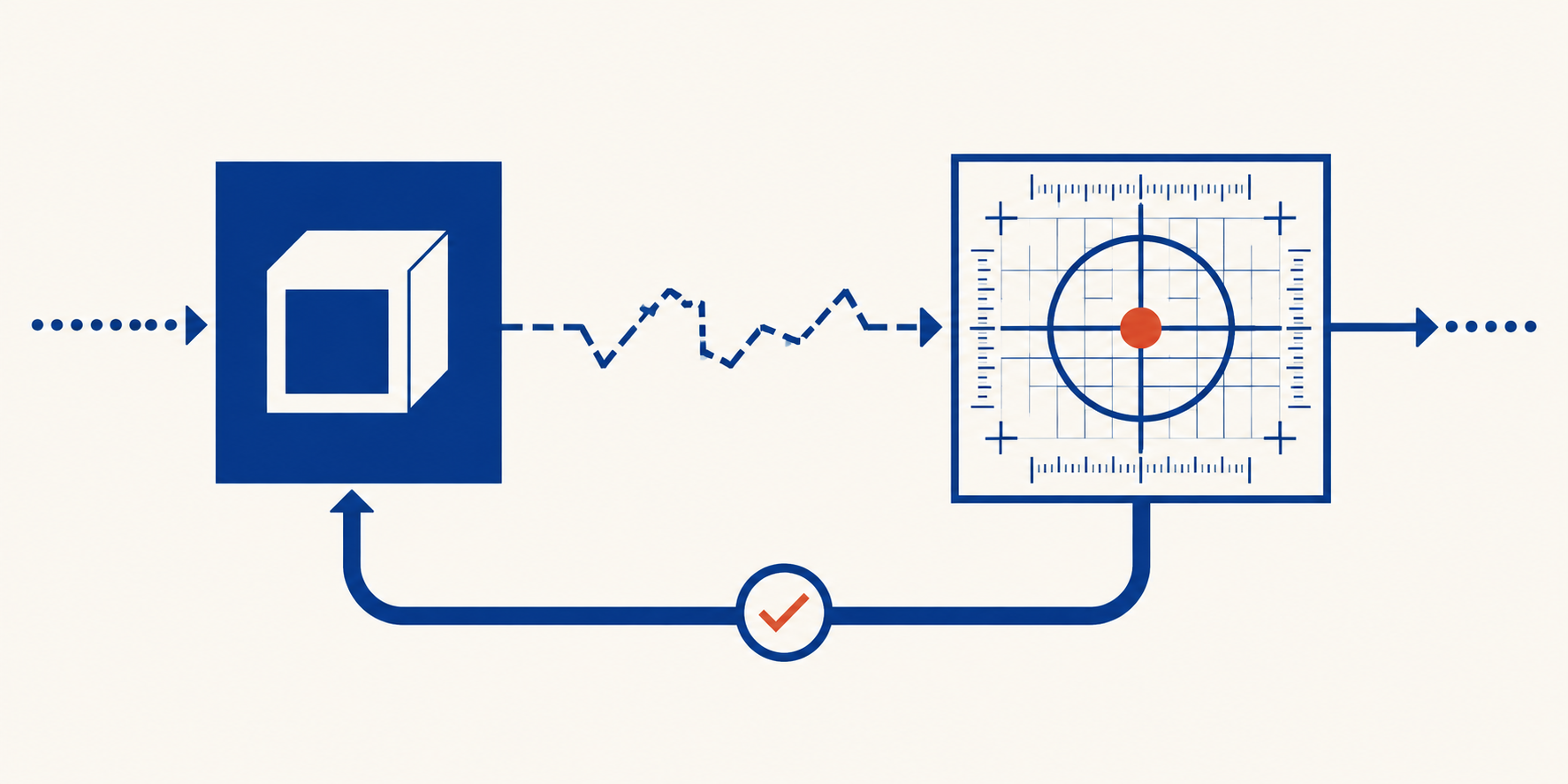
In this article, you will learn how to design AI agents that can reliably self-correct by grounding their feedback loops in external verification rather than the model’s own judgment. Topics we will cover include: - Why self-correction in language models only works when the agent has an external signal to check against, and when it isn’t worth the cost. - How to build a code-generation agent with a real test-based verifier, a bounded retry loop, and a structured escalation path. - How to add a consistency-based confidence gate that generates an independent second solution to confirm correctness before shipping. Introduction In 2024, a team of researchers published a paper with a blunt title: “Large Language Models Cannot Self-Correct Reasoning Yet.” Their finding was uncomfortable for anyone building agents at the time. When you ask a model to check its own reasoning with no outside input, it doesn’t reliably catch its mistakes. Sometimes it does the opposite: it talks itself into believing a wrong answer is right, and the “corrected” version comes out worse than the first draft, a pattern later work has confirmed and built on. That finding sits at the center of everything in this article. Self-correction in AI agents is real; it isn’t a trick or a marketing term, but it only works under a specific condition: the agent needs something outside its own opinion to check against. Give it that, and the loop catches real mistakes. Skip it, and you’ve built an elaborate way for the model to agree with itself. This tutorial builds one complete example so that the condition stays concrete rather than abstract: a code-generation agent that writes a Python function, actually runs the function’s tests, fixes what fails, and knows when to stop trying and hand the problem to a person instead. Prerequisites: - Python 3.10 or newer - An Anthropic API key - 1pip install langgraph langchain-anthropic pytest python-dotenv Why Asking a Model to Check Its Own Work Usually Fails Picture asking a student to grade their own exam with no answer key. They’ll fix the mistakes they notice, but the mistakes they don’t notice are exactly the ones they’ll approve again on a second look. That’s the coherence trap: a language model’s critique of its own output is generated by the same weights, trained on the same patterns, that produced the output in the first place. It’s not an independent check. It’s the same judgment asked twice, and the two answers tend to agree, whether or not either is correct. This doesn’t mean reflection is worthless; it means reflection only works when it’s grounded in something the generator didn’t produce. The original Reflexion paper out of Stanford showed agents with verbal self-reflection reaching 91% pass@1 on HumanEval, up from an 80% baseline, and a 20-point absolute gain on HotpotQA question answering over a standard ReAct agent. Madaan et al.’s Self-Refine paper found a similar 20% average improvement across seven different tasks. Those are real gains, and what they have in common is that the tasks gave the model something to check against: code has tests that either pass or fail, and multi-step retrieval has documents that either answer the question or don’t. Where reflection stops paying its way is simpler tasks with nothing external to check. The 2025 CorrectBench study found self-correction adds roughly 5% on hard reasoning benchmarks like MATH, but on easy tasks, plain chain-of-thought reasoning does just as well using 40% less compute. Reflection isn’t free. It costs tokens, latency, and money every time the loop runs, so the question worth asking before you build one isn’t “would reflection help,” it’s “do I have something external for the critic to check against, and is the task hard enough to justify the extra calls?” That’s the rule the rest of this article follows: ground the critic in something the generator didn’t write. For code, that’s running the tests. For research, that’s a retrieved source. For a form-filling agent, that’s schema validation. Whatever your project is, find that external signal before you write a single line of correction logic, because without it, you’re building a more expensive version of the same mistake. The Building Blocks, Before You Write Any Code Five pieces show up in almost every production self-correction system, and it’s worth knowing what each one is actually for before wiring them together. - Reflection loops are the generate-critique-revise cycle itself. The loop only works if it’s bounded. An unbounded reflection loop isn’t a safety feature; it’s a liability, and a widely shared 2026 postmortem described a document-processing agent that entered a retry loop overnight and ran up a $437 bill in eight hours before anyone noticed. Every loop in this article carries a hard cap. - Verifiers check the generator’s output. The important distinction is between a verifier and a calibration model: a verifier scores output quality in a way that’s independent of which model produced it, while a calibration model estimates how confident the specific generating model should be in its own output, which is a subtly different and weaker signal, as a 2025 paper on fine-grained confidence estimation lays out. In production, the strongest and cheapest verifiers are usually the simplest: run the code, check the schema, query the database. Save trained process reward models, which score intermediate reasoning steps rather than only the final answer, for cases where you genuinely can’t execute or check the output directly. - Confidence scoring sounds like it should solve the “how sure is the agent” question cheaply, but current research is direct about its limits. A 2026 ACL paper on uncertainty quantification tested three common approaches (log-probability, self-consistency sampling, and verbalized confidence) on agent tasks and found all three scored close to a random guess for predicting failure, with AUROC values around 0.55 to 0.6 against a 0.5 baseline. Verbalized confidence, the cheapest option since it just means asking the model how sure it is, is also the least reliable once an agent’s context gets long and noisy. The more dependable version of confidence scoring in practice is consistency-based: generate a solution twice, independently, and check whether they agree. Disagreement is a real signal. Two independent attempts agreeing with each other are meaningfully stronger evidence than one attempt saying “I’m 95% sure.” - Retry policies govern what happens after a failure. The standard pattern is exponential backoff with jitter - wait a bit longer after each failure with some randomness added so a fleet of agents doesn’t all retry at the same moment - paired with a circuit breaker so a sustained outage trips the whole call site instead of hammering a struggling service for an hour. The detail that catches teams off guard is that this needs to be enforced outside the model’s own reasoning. An agent that decides on its own to “try a different approach” after a timeout is still retrying, just invisibly, and infrastructure-level rate limits can’t see a retry that’s happening inside the model’s chain of thought rather than as a distinct API call. - Recovery architecture is what happens once the retry budget is spent. A circuit breaker and a kill switch solve different problems: a kill switch is a person noticing something wrong and stopping it manually, while a circuit breaker is an automatic rule that trips before a person needs to notice anything. The end state of a good recovery path is not “crash,” it’s a clean escalation with the full failure trajectory logged somewhere a person can actually read it, which is the same idea behind dead-letter queues in traditional fault-tolerant systems, applied to agent failures instead of message queues. With the vocabulary and the failure modes in place, here’s the build. Build the Generator and the Grounded Verifier The project: an agent that receives a short function spec, writes the implementation, and checks it against a real test file rather than its own judgment of whether the code looks correct. Start with the project folder: | 1 2 3 4 | mkdir self-correcting-agent && cd self-correcting-agent python3 -m venv venv source venv/bin/activate pip install langgraph langchain-anthropic pytest python-dotenv | Create a .env file with your key: | 1 2 | # .env ANTHROPIC_API_KEY=your-anthropic-key-here | Now the generator, which asks Claude to write a function based on a spec, and includes the previous failure as feedback if this isn’t the first attempt: | 1 2 3 4 5 6 7 8 9 10 11 12 13 14 15 16 17 18 19 20 21 22 23 24 25 26 | # agent.py import os from dotenv import load_dotenv from langchain_anthropic import ChatAnthropic load_dotenv() model = ChatAnthropic(model="claude-sonnet-4-6", temperature=0.2, max_tokens=500) def generate_code(spec: str, feedback: str | None) -> str: """Asks the model to write a function matching the spec. If feedback from a failed test run is provided, it's included so the model isn't guessing blind on retries.""" prompt = f"Write a single Python function for this spec:\n{spec}\n" prompt += "Return only the function code, no explanation, no markdown fences." if feedback: prompt += f"\n\nThe previous attempt failed these tests:\n{feedback}\nFix it." response = model.invoke(prompt) # Strip markdown fences in case the model adds them despite instructions code = response.content.strip() if code.startswith(""): code = code.split("")[1] if code.startswith("python"): code = code[len("python"):] return code.strip() | What this does: the function builds a single prompt that includes the spec and, critically, the actual test failure output from the last attempt when there’s been one. That feedback is what separates this from a blind retry; the model isn’t generating a fresh guess each time, it’s responding to specific evidence of what broke. The markdown-stripping at the end handles a common annoyance: models often wrap
Comments
No comments yet. Start the discussion.