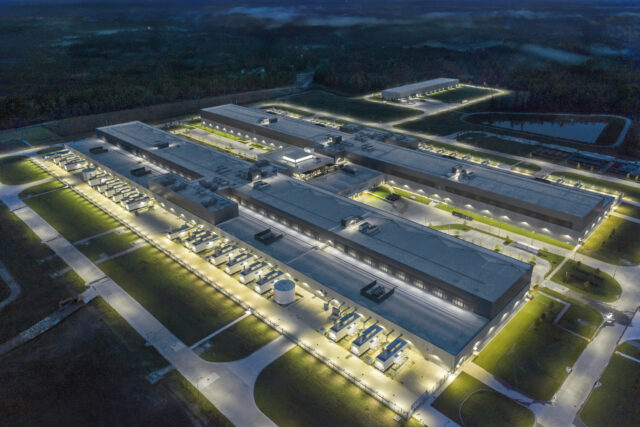
Hyperscale data centers use 2% of US electricity
Study attempts to tally hyperscalers’ energy use and emissions.
One flashpoint for the tech industry’s all-in push on Large Language Models has been the sudden rush to turn investment money into hyperscale data centers. The rush hasn’t allowed anyone to plan how to supply the required electricity cleanly or with minimal impact on ratepayers. Instead, it has been difficult to even collect information on what’s being built.
A new study has tallied up energy use and estimated emissions for hyperscalers operating between May 2024 and April 2025 in the United States. They weren’t able to differentiate between AI compute and more traditional data services, but it provides a clear point of reference that could be tracked moving forward.
Finding the centers
The team started with a list of 675 facilities from a commercial database based on news reports, company statements, and satellite imagery. They dropped any that didn’t have a reported electrical capacity or that they couldn’t verify was a suitably large building with the expected cooling and electrical connection equipment.
That reduced the list to 403 data centers with an average electrical capacity of about 40 megawatts.
In a way, that makes this a very conservative estimate, since 272 facilities believed to be large data centers were left out. But if you’re interested in AI data centers, specifically, it’s also true that some of the facilities included may not fall in that category.
That fact also introduces some uncertainty in the actual power usage of these data centers. Relying on other research, they use a range - some conventional data centers run at an average of about 48 percent of capacity, while AI training loads have been running higher, at around 70 percent.
Putting that together, the total power usage for the year by these 403 data centers was estimated at 68 to 99 terawatt-hours. That amounts to 1.5 to 2.2 percent of total US electricity use, on par with the total used by Wisconsin or Indiana.
Comments
No comments yet. Start the discussion.