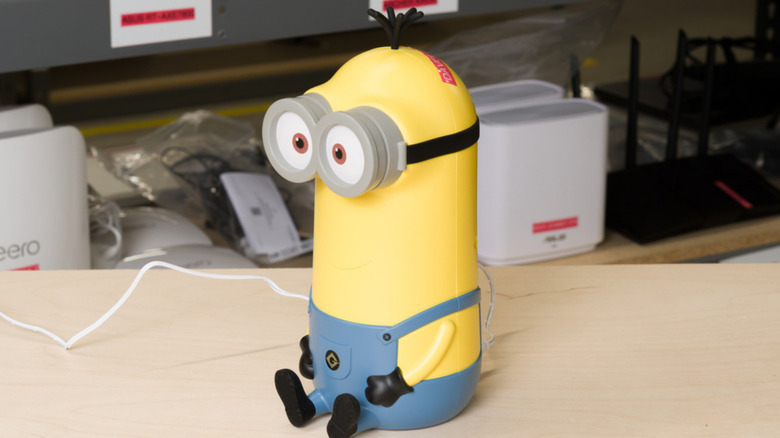
Why does the FCC hate Minions routers?
These themed routers are surprisingly (inexplicably) capable, but they are under threat by the FCC.
Why does the FCC hate Minions routers? The viral Minions-shaped routers are caught by the same ban as TP-Link.
Seen a Wi-Fi router in the form of a Minion in your feed lately? It isn't AI; it's a real product from the South Korean networking company Davolink. Kevin, the taller of its two Minions routers, went viral after an X post last month called it one of the best Wi-Fi 6E routers money can buy.
The post drew millions of impressions and Amazon's stock, priced at $62.99, was gone by the next day. Unfortunately for Minions fans, the FCC treats the router version of Kevin and Bob like every other overseas consumer router. Since March, the agency has banned all new foreign-made network routers from getting the authorization they need to go on sale in the US, unless the manufacturer has an exemption.
ASUS, Eero and Netgear all have exemptions, but Davolink isn't. So, while the two existing Minions routers stay legal to sell, we're not going to be seeing a Wi-Fi 7 Minion stateside anytime soon, and firmware updates for the duo are only guaranteed through the end of 2028.
Kevin vs. regular routers
Davolink first showed the routers at CES back in January 2023, under an exclusive design agreement with Universal and put them on sale in South Korea that summer.
Kevin, AKA DVW-632, is a tri-band Wi-Fi 6E router that stands at 9.6 inches tall, with a 2.5 Gbps WAN port, one gigabit LAN port, WPA3 security and mesh support. Its AXE5400 rating breaks down as 573 Mbps on the 2.4 GHz band and 2.4 Gbps each on 5 GHz and 6 GHz.
Bob, the DVW-642, is the smaller one, a dual-band Wi-Fi 6 router with a gigabit WAN port and a top rating of 1.77 Gbps.
Davolink's core business is supplying gateways and access points to the country's three big carriers, SK Broadband, KT and LG Uplus. The US government's vulnerability database has only one entry for a Davolink product: a weak password flaw in a DVW-3200N router from 2018. It was rated 9.8 out of 10 for severity and fixed with new firmware.
The taller Kevin's AXE5400 rating puts it in the same class as TP-Link's Archer AXE75. RTINGS, which has tested both, says the Minion comes out on top in terms of speed and range. But while the more traditional-looking Archer has four gigabit LAN ports, Kevin has only one, so anything beyond one wired device will need a network switch.
Wi-Fi 7, the generation after Kevin's, adds 320 MHz channels and lets a device use several bands at once.
How the FCC ban applies to Davolink
The FCC added "routers produced in a foreign country" to its Covered List on March 23. That addition was triggered by a national security determination it received three days earlier from an interagency body convened by the White House.
Equipment that makes it onto the Covered List can't get the FCC authorization a wireless device needs before it can be sold in the States. Law firm Wiley's interpretation is that "produced" covers any major stage of making a router, including design and development, regardless of the nationality of the company.
Routers authorized before the March listing can still be imported, sold and used, and the FCC authorized Kevin and Bob between November 2023 and February 2024.
Listing also bars changes to authorized devices, software updates included. The FCC has waived that for things like security patches and compatibility fixes until at least January 1, 2029, which is why banned drones and routers in the US will still get critical updates until 2029, and its engineering office has said it will recommend writing the waiver into the rules. If that doesn't happen, and the date doesn't change, Davolink will have to stop patching Kevin and Bob after 2028.
Exemptions, which the FCC calls Conditional Approvals, are granted by the Department of Defense or the Department of Homeland Security and last for up to 18 months. Applicants must disclose where every component and the firmware come from, justify building abroad and commit to a dated plan for US manufacturing, including spending figures and quarterly progress reports.
Netgear was approved on April 14, Eero on April 22 and ASUS on September 9. Davolink, which has reported operating losses since 2022, hasn't publicly said whether it has applied for a Conditional Approval.
Comments
No comments yet. Start the discussion.