China’s Tianwen-2 Reaches Earth’s Quasi-Moon and Prepares to Grab a Sample
China’s Tianwen-2 probe has reached Kamoʻoalewa, one of seven known quasi-satellites that orbit near Earth. Scientists suspect the asteroid may actually be a fragment of the Moon-and Tianwen-2 will soon take a bite out of it to find out.
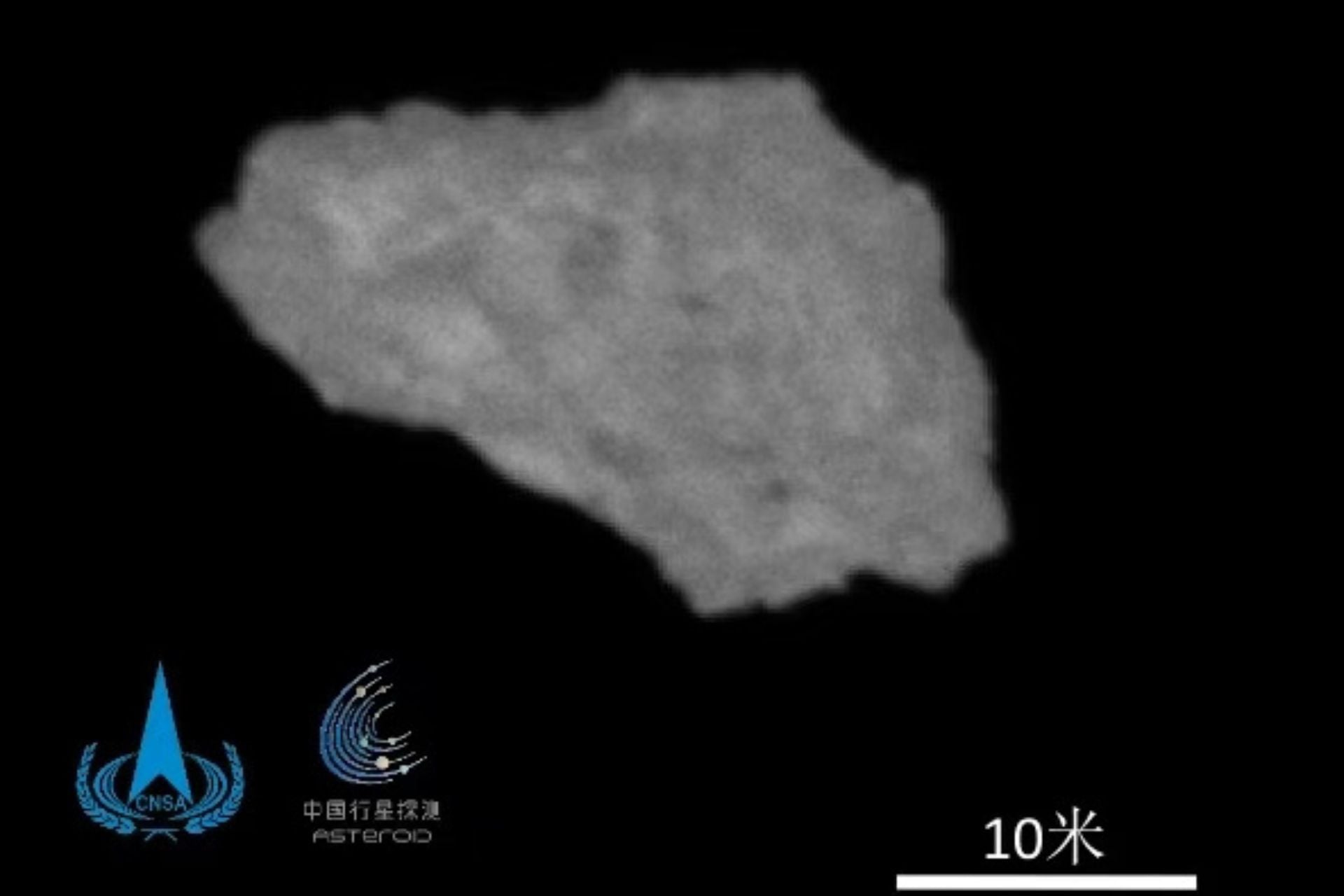
The China National Space Administration (CNSA) announced the spacecraft’s arrival at Kamoʻoalewa today, bringing an end to its 600-million-mile (1-billion-kilometer) journey. Tianwen-2 launched on May 29, 2025, and flew for 400 days to approach the asteroid at a distance of 12 miles (20 km) on Thursday, snapping the first close-up image of this small, oblong rocky body.
This marks the beginning of the probe’s scientific exploration of Kamoʻoalewa. Tianwen-2 will land on the asteroid, collect a sample of material from its surface, and spend several months conducting remote sensing observations to help scientists back on Earth piece together its composition and origin.
A Missing Piece of the Moon?
Astronomers using the Pan-STARRS 1 asteroid survey telescope on Haleakalā, Hawaii, discovered Kamoʻoalewa in 2016. Based on Tianwen-2’s close-up image, the space rock is just over 66 feet (20 meters) wide, which fits previous estimates based on observations from ground-based telescopes and the James Webb Space Telescope.
Kamoʻoalewa is not Moon-like in the sense that it actually orbits our planet. This asteroid orbits the Sun, but it does so in lock-step with Earth, maintaining a close average distance of just 9 million miles from our planet. That makes it one of Earth’s seven known quasi-moons.
In 2021, researchers analyzed Kamoʻoalewa’s spectra (the amount of light it reflects across different wavelengths) and found that its composition matched that of lunar rocks collected during NASA’s Apollo missions. Then, in 2024, a study suggested that the asteroid could have been liberated from the Moon by the same impact that created the Giordano Bruno crater between 1 million and 10 million years ago.
If Tianwen-2 achieves its objectives, scientists will finally confirm whether Kamoʻoalewa is, indeed, a missing piece of Earth’s one true natural satellite.
It’s Showtime, Tianwen-2
The Tianwen-2 spacecraft is equipped with 11 scientific instruments for studying and extracting samples from asteroids. Kamoʻoalewa is its primary target, and the mission will aim to collect between 20 and 100 milligrams of material from this quasi-moon.
Due to the unknown nature of the asteroid, Tianwen-2 is capable of three different sampling techniques, including:
- Hovering sampling
- Touch-and-go
- Anchoring and attachment sampling
This redundancy ensures that the probe will be able to extract a sample regardless of the asteroid’s surface mechanics. It’s not yet clear which technique the spacecraft will use at Kamoʻoalewa.
Tianwen-2’s remote sensing instruments include cameras, spectrometers, a magnetometer, sounding radar, particle analyzers, and laser navigation sensors. These will gather data on the asteroid’s shape, composition, and internal structure.
CNSA expects Tianwen-2 to return its samples to Earth in April 2027, dropping off a capsule filled with surface material on its way to its second target, the comet 311P/PANSTARRS. The spacecraft should reach that destination, located in the main asteroid belt, by 2035.
For now, we’ll await updates on Tianwen-2’s survey of Kamoʻoalewa. China’s first-ever asteroid return mission could finally reveal this asteroid’s origin, potentially giving scientists a pristine sample of lunar history.
Comments
No comments yet. Start the discussion.