Humanoid Robots Just Performed Surgery Using Standard Medical Tools
Humanoid Robots Just Performed Surgery Using Standard Medical Tools
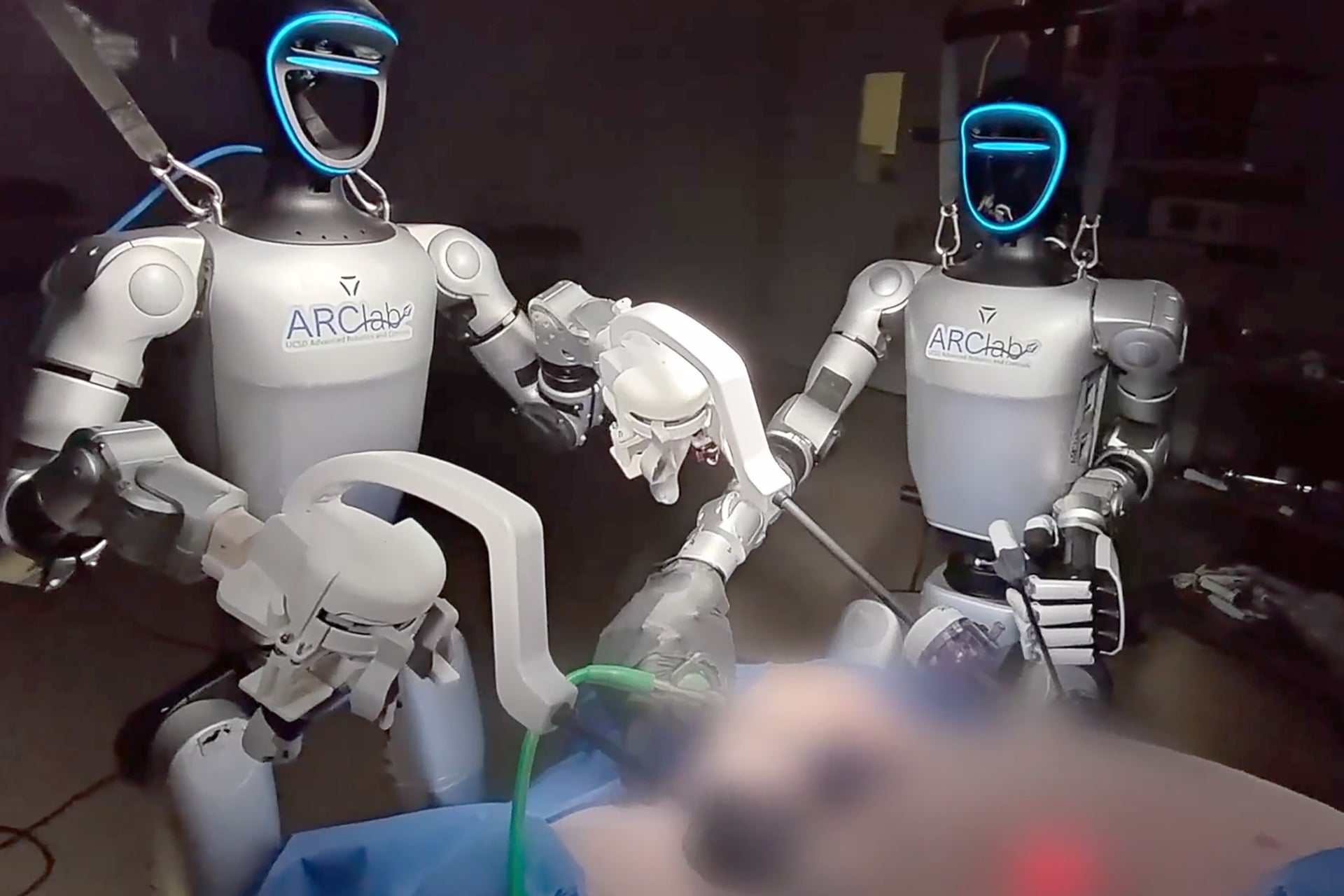
Two human-like robots just used regular surgical instruments and their bare android hands to competently operate on a living animal for the first time.
Specialist surgeons who tackle rare and frequently challenging operations report some of the highest burnout rates among physicians, according to the American Medical Association. You can imagine why: emergency globetrotting, difficult high-stakes work even when the patient comes to you, and all the usual miseries America’s for-profit healthcare system has foisted upon its medical professionals.
But a team of engineers and surgeons at the University of California, San Diego, just recently reported two successful pre-clinical trials that might help. Humanoid robots designed in collaboration with UC San Diego’s Jacobs School of Engineering performed two proof-of-concept surgeries using the typical, handheld surgical tools intended for human doctors.
While plenty of remote surgeries have already deployed custom-made robotic arms (even in space), UC San Diego’s team noted that its trials were the first to incorporate android-like automatons capable of handling these surgical instruments just like a flesh-and-blood doctor.
In one trial, UC San Diego’s robot surgeon worked with a human assistant to carefully remove the gallbladder of a living test animal (a pig) with a licensed veterinarian on call to supervise anesthesia and general welfare. In the second surgery, two of these robots worked together to conduct an identical gallbladder surgery.
“Remotely operated and autonomous humanoid robots have real potential for amplifying access to critical surgeries to which patients would otherwise not have access,” one of the study’s senior authors, engineering professor Michael Yip, said in a statement. “This can help address the healthcare crisis not only in the United States but also worldwide.”
Ambulatory Android
Most of today’s surgery robots, like the over 1,700 da Vinci surgical systems in hospitals worldwide, are hefty mechanical behemoths with three-to-four arms, specialized tools, and a weight of about 1,800 pounds (817 kilograms). UC San Diego’s robot “Surgie,” comparatively, only weighs about 60 pounds (27 kg). And, unlike the da Vinci systems, Surgie has two legs it can walk around on, perhaps one day to go grab sorely needed instruments for its teammates.
Yip hopes to see these humanoids used in contexts where remodeling a whole operating bay to make room for a da Vinci would be (frankly) impractical.
“Many communities struggle with adequate staffing on the surgical team, which means patients are not being treated,” according to Yip, who also serves as director of UC San Diego’s Advanced Robotics and Controls Laboratory (ARCLab). “You can imagine these robots being deployed in remote communities where staffing is challenging, or in austere environments like search and rescue scenarios where a massive deployment of field medicine is needed in a short period of time,” he explained.
Automated Assistants
The attending human surgeons and surgical trainees who worked with these robots also completed post-operation surveys for the new study, published in the journal Nature this July. The humanoids’ remote operators, for example, answered questions about the system’s ergonomics and fidelity to the guidance of their own hands. The other participants weighed in on having bots as teammates.
“We were surprised at how well Surgie meshed with our workspace and workflow,” study co-author and general surgery resident Nikita Thareja said in a statement.
Latency did, however, prove to be an issue for the robots’ remote operators-although the researchers said they’re working to improve this for long-distance operations in the future.
According to one of the surgeons who actually operated the androids, Shanglei Liu of UC San Diego’s School of Medicine, the robotic surgeries’ slow pace and occasional need to recalibrate was not unusual for early-stage systems of this kind. A robotic version of the kind of minimally invasive laparoscopic surgery conducted during these preclinical trials used to take six hours. Now they can take half an hour.
Liu shared his colleagues’ optimism over Surgie: “It’s a fraction of the cost and it takes a fraction of the space in an operating room,” he said. “So it’s easy to deploy, anywhere from rural areas, to the battlefield, and even to space.”
Comments
No comments yet. Start the discussion.