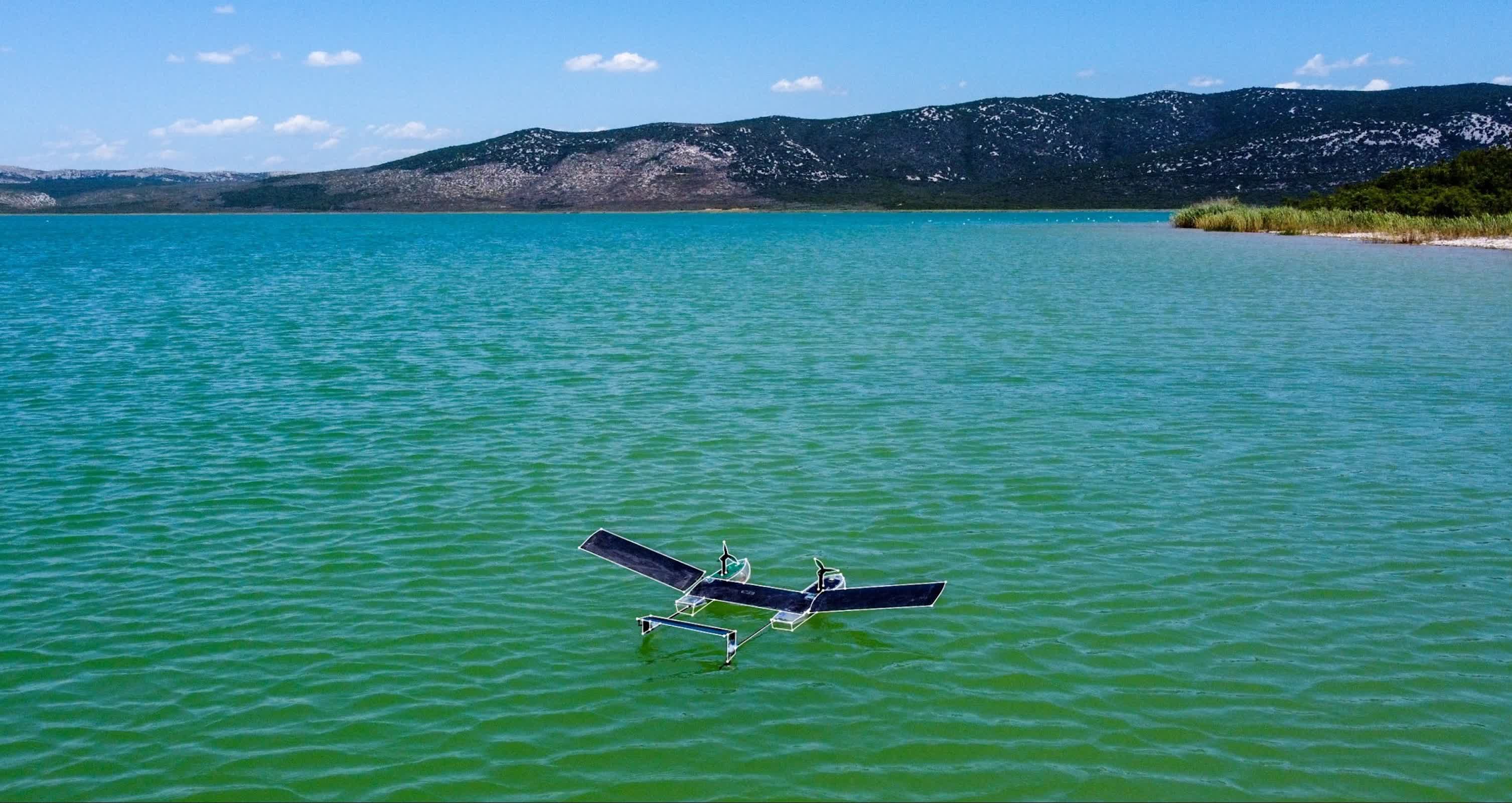
This MIT robot flies through the air then dives underwater using the same wings
Design Inspired by Diving Seabirds
Diving seabirds like puffins use their wings to both fly and swim, even though air and water behave very differently. "Thinking of a wing that could operate in both somewhat efficiently seems implausible," Zufferey tells NPR.
First look: MIT researchers have built a small robot that can move through both air and water using the same wings – and switch between the two without any extra hardware. The work comes out of mechanical engineer Raphael Zufferey's lab, where the team has been trying to replicate something that already exists in nature.
Key Design Decisions
The robot, described in a paper published in Science, weighs about half a pound and has a wingspan just shy of three feet. It's built to function in both environments without adding unnecessary complexity, which shaped several key design decisions.
One of those decisions was to leave out legs entirely. In nature, many birds rely on their legs to help them take off from the water. But in a robot, that would add mechanical challenges the team wanted to avoid. "Instead, we thought, 'can we go from the water straight to the air simply with the wings themselves?'" Zufferey says.
The robot's wings also differ from those of real diving birds. Many diving birds fold their wings underwater, but adding that feature would have meant more joints and motors. "You need to add joints, you need to add motors. So instead we rely on wing flexibility," he says.
Wing and Body Construction
The wings are made from translucent nylon fabric reinforced with carbon fiber struts, giving them enough flexibility to work in both air and water. They flap continuously – about five to six times per second in the air. To break out of the water, the robot ramps that up to about ten flaps per second to generate enough force.
The body design is just as unusual. The central structure is open, with its internal components exposed. Instead of sealing the entire system, each part is waterproofed individually. "So water floods the whole system here," Zufferey explains. That approach keeps the robot light enough to fly and also neutrally buoyant underwater, so it doesn't drift up or down.
Performance and Testing
In testing, the robot can move from water to air in less than a second. Video shot at Lake Geneva shows a slight ripple on the surface before it bursts through and into flight.
Glenna Clifton, an animal movement biologist at the University of Portland who was not involved in the project, says the robot stands out both as an engineering achievement and as a research tool. "This is a beautiful robot," she says. She adds that projects like this help researchers better understand how animals move. "The biology inspires the robotics, but then also the robotics are used to understand the biology."
Practical Applications
The team sees practical uses for the technology as well. A robot that can fly to a remote location, land in the water, and collect data could be useful for monitoring coastal environments. That could include:
- Tracking algal blooms
- Observing marine life
- Studying shoreline changes
On a single charge, the robot is estimated to fly for not quite four miles or swim for a bit more than a mile. Clifton says that level of performance across both environments is significant. "It is light and powerful and a monumental step in the performance at both swimming, flying, and transitioning between the two," she says.
Future Development
The project took about two years to develop, and the team is already working on improvements. Future versions are expected to carry sensors for data collection and continue refining how the robot moves.
For Zufferey, the starting point remains the natural world. "You see that it has already been done in biology," he says. "So that gives you hope as a robotics researcher. It tells you that it should be possible."
Comments
No comments yet. Start the discussion.