The Private Capture of Public Genius
The Private Capture of Public Genius
Essay I of Upstream of Everything
On January 24, 1956, the American Telephone and Telegraph Company was the largest private company in the world. Its revenues amounted to almost 2% of the U.S. gross domestic product. It employed 746,000 people. It owned Bell Labs, the fabled research division that had already produced the transistor, the solar cell, information theory, and radio astronomy, while also actively laying the first transatlantic telephone cable. In the following decades, it would add UNIX, modern cellular telephony, the CCD image sensor, the first active communications satellite, and a long list of other scientific milestones.
This singular stretch of intellectual output paved the way for Bell scientists to eventually collect five Turing Awards and ten Nobel Prizes. By many metrics, life as a regulated monopoly was very good for AT&T. Yet by the end of the day AT&T had signed away exclusive rights to every single one of its 7,820 unexpired patents, royalty-free, to any American firm that asked. AT&T would also license any future patents it filed at "reasonable rates." A bleeding-edge, intellectual property treasure hoard was suddenly and irrevocably opened to the free market.
Antitrust officials initially sold the settlement as a triumph. The Justice Department called it a major victory, with one DOJ lawyer hailing it as "miraculous." Despite AT&T already existing for decades as a regulated monopoly, with its returns constrained to a relatively conservative (by today's standards) ~7% per annum, government regulators had pursued and established a landmark set of additional restrictions to curtail AT&T's monopoly power. Soon, however, public sentiment started to shift. Business Week called the decree "hardly more than a slap on the wrist." A House congressional subcommittee would later deem it "a blot on the enforcement history of antitrust laws" for its perceived lenience on AT&T's exclusive supply chains and vertical integration. Both the ratepayers, who subsidized AT&T's vast research budget through its rate contracts, and many in the federal government believed this unprecedented economic concentration to still be far too dangerous for the Republic to continue unabated.
The now-infamous 1956 patent decree was just one half of a settlement negotiated over seven years between AT&T and the federal government. AT&T wanted to continue manufacturing telephone equipment through its subsidiary Western Electric, but regulators believed the vertical integration was foreclosing competition within the industry. The federal government itself was so conflicted about this issue that Secretary of Defense under President Eisenhower, Charles Wilson, pleaded with litigators that severing AT&T from Western Electric was "contrary to the vital interests of our nation."
The second half of the settlement barred Bell from pursuing any business other than telecommunications. A later analysis of the historical record revealed that 69% of Bell's patents had little to do with telecom. Rather, they ranged from chemistry to semiconductors to metalworking, lighting, optics, and more. The two halves of the settlement combined to ensure that this rich intellectual corpus, roughly 1.3% of all unexpired American patents at the time, became freely available essentially overnight and had a guarantee from Uncle Sam that the big, bad Bell Labs legal wolf would not come knocking.
Within just a few years, these released patents would generate almost $6B in follow-on patent value outside of the telecom industry. About $3.5B of that value came from patents filed by young, startup companies. One famous branch of that startup explosion ran through Shockley Semiconductor, then Fairchild Semiconductor, and eventually into the storied company known as Intel. Intel's co-founder, Gordon Moore (of Moore's Law fame), would later describe this consent-decree-driven innovation cascade as:
"One of the most important developments for the commercial semiconductor industry. [It] allowed the merchant semiconductor industry to really get started in the United States. There is a direct connection between the liberal licensing policies of Bell Labs and people such as Gordon Teal leaving Bell Labs to start Texas Instruments and William Shockley doing the same thing to start Shockley Semiconductor in Palo Alto. This started the growth of Silicon Valley."
Sediment
A generation of brilliant, publicly subsidized scientists built one of the most impactful clusters of technical genius the world has ever seen. Bell generated patents, invented products, and became the undisputed epicenter of American frontier science for decades. But how?
Imagine a carefully crafted rice paddy, terraced by exacting farmers who spent years precisely engineering a fertile environment. It looks like just a flooded field, but it turns out that rice is one of the few major crops that tolerates submerged roots. Since most weeds can't tolerate submersion either, the water does the weeding. The deliberate flooding also cuts off the oxygen required for organic decomposition, so the soil retains more of its nutrients rather than burning them off like a dry, aerated field does. And the warm, waterlogged mud triples as an excellent habitat for nitrogen-fixing microbes. A well-tended paddy largely fertilizes itself, season after season, sometimes for centuries. This humble mud pond is actually one of the most productive growing systems humans ever designed.
AT&T's unique economic position as a monopoly set the conditions for Bell Labs' culture of deliberate experimentation, patient exploration, and delayed harvesting. Bell drew from an enormous and stable nationwide revenue base that didn't have to be re-justified every budget cycle. American regulators set this revenue base through AT&T's prices by using a fixed percentage return calculation on the capital it invested in the network. Here invested capital means switches, cables, buildings, and the like.
At a normal firm, research is a cost you minimize, but not at AT&T. Every dollar spent on research at Bell Labs did two things at once. First and foremost, it was a no-risk, recoverable cost subsidized by U.S. telephone ratepayers under contract. Second, it was a wellspring of new, capital-intensive technology for AT&T to build and deploy. This capital expenditure expanded the very rate base on which its guaranteed return was calculated. The more money spent on these new technologies, the larger the absolute profit gained by the same regulated ~7% return.
This arrangement worked out very well for all parties for decades, but is not necessarily replicable. Nor is it obvious we should even try to recreate it because it came with real costs too. Inefficient over-investment, lack of price discipline, and most importantly an incentive to hoard inventions behind a monopoly wall all hurt ratepayers. But for much of the 20th century, these guaranteed profits did objectively create an expansive paddy field in which one technological innovation after another could flourish.
Frontier science looks different today. It's rooted in model weights and GPUs. It is flooded with token spend and agentic loops. It blooms in data centers. While AI-assisted research is still young as a field, usage statistics show something big is happening in and around the major AI labs. Serious people are using this new technology to solve real problems, sometimes entire classes of problems, that were previously unsolvable. Protein structures, research mathematics, material design, drug discovery, and complex systems analysis are just a few of the fields where AI models are tangibly improving researchers' abilities to clear humanity's scientific roadblocks.
But from where does this rich soil come? It's not really a secret. OpenAI says it "primarily rel[ies] on publicly available information to teach [its] models how to be helpful." Anthropic attempted to build a "central library of 'all the books in the world'" to train its models. Sam Altman himself elaborates that their frontier models are trained on "the collective experience, knowledge [and] learnings of humanity." Strip the euphemisms and you're left with the stark reality that these unprecedented capabilities were assembled out of the self-expression of every person across the globe who ever wrote anything down.
And the product built from this reality is, by the frontier labs' own revenue, projections, and usage numbers, the most valuable thing built in a generation. Anthropic's annualized revenue run-rate rocketed from $87M in January 2024 to $1B by year-end, roughly 10x'd through 2025, and just hit $47B in May 2026. This makes it the fastest-compounding enterprise software company in history. OpenAI isn't that far behind. An estimated 80% of the American workforce now holds a job where some portion of the work is exposed to these models. All of this impact was made possible by multi-week training runs over a data corpus measured in the lifetimes of billions.
This is the private capture of public genius.
A frontier model is the compression of a massive amount of training data into numerical weights. The combined collection of books, forums, code repositories, manuals, papers, chat logs, transcripts, court cases, essays, comment sections, articles, tutorials, and every errant thought scrapeable by the frontier labs' army of spiders crawling across the internet and beyond is staggering. In a way, its incomprehensibility is almost like psychic armor. It's too big to understand directly.
Consider a wild river delta. As water runs from highlands to the sea, it erodes the land it travels through and carries the debris downstream as sediment. Silt, sand, clay, and all manner of organic material, scoured from every inch of tributary and riverbank, from plowed fields to rugged hillsides, end up aggregated in the delta. So does the richness of every life the river supports along the way. A continental watershed, swirling, accumulating, and ultimately settling at its terminus. The vast volume of disparate material combines in the delta to form something lush, strange, and alive.
And what is the sum of all human knowledge if not this? Every cluster of letters scraped from the pages of history (the literal tokens an AI model ingests) is a single grain of silt deposited by the ever-flowing river of man's exploration. Pile enough grains and you understand the movement of the stars. Stare long enough at the mud and you see the structures of logic itself. The large language model's transubstantiation of alluvial soil into answers is the grand harvest of the society that grew it.
But subtract the dirt and there is no delta. Subtract the corpus and there is no harvest. There is nothing. The model did not learn to reason in a vacuum. It absorbed rationality by observing rationality over and over and over again. Its powers of generalization are downstream of every example, correction, and argument it subsumed. A human decision somewhere in the echoes of history, culture, and science set the stage for today's chatbot response.
This cultivated intelligence grows from the sediment of human sensemaking, but there is no sediment here that was not deposited by someone. Many of those someones are dead. They wrote the ancient texts, tested the baseline science, and recorded the history of the world from antiquity for the benefit of all of us still here. But too, many of those someones are alive. They are writing the working code that the model spits out. They're pushing that baseline science past its frontier. They're organizing and investigating and acting upon and reacting to the infinite feed of current events. Any response germane to today is borrowed from somebody.
In fact, you're one of those somebodies. Literally. Your 2am shitpost. That eloquent reply to a stranger's essay. The scathing restaurant review you left. Your captions, comments, inside jokes, and all of your public conversations. Every contribution you ever made to the infinitely branching stream of digital communication, big and small, has settled somewhere in the delta.
Everybody Owns the Internet
The Nile River delta fed Egypt for five thousand years. The Mekong and the Ganges regions still feed hundreds of millions today. It's no coincidence that every cradle of civilization owes its formation in whole or part to the floodplains and deltas of great rivers. These areas supported humanity through our most primitive eras with little more than the inherent richness of their raw materials. This dirt is begging to burst forth with life, yet somehow the richest farmland on earth is, almost without exception, accidental.
So too goes the internet. We myriad digital denizens of the information superhighway did not set out to create a training corpus. We wrote for ourselves and for each other. We joked, argued, taught, complained, flirted, and debugged our way into this aggregated mass of interrelational raw material now harvested by private capital.
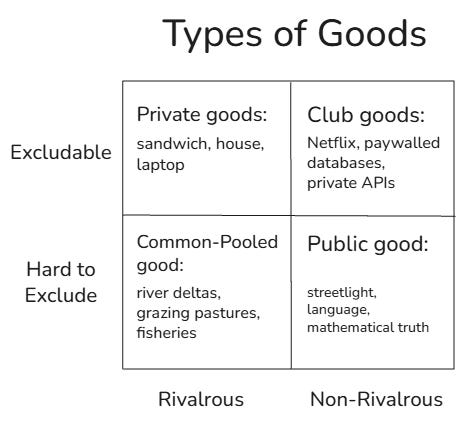
The field of economics (which is also in the corpus) has vocabulary for this. To categorize any resource, economists ask two questions. Is it excludable, and is it rivalrous? More plainly, can you stop people from using it, and does one person using it diminish what's left for everyone else? There are caveats and sub-categories, but this simple test gives us a map.
- If a good is excludable and rivalrous, it is a private good. Think about a sandwich. If I eat it, it is gone, and the law protects me from sandwich thieves.
- If a good is excludable but mostly non-rivalrous, it is a club good. A Netflix subscription is a club good. If I watch a movie, you can still watch it too, but only if we both pay to have access.
- If a good is hard to exclude people from using and rivalrous, it is a common-pool good. A pasture is the classic example. Many farmers can access the pasture, and while one cow grazing does not destroy the field, ad
Comments
No comments yet. Start the discussion.