Starlink from 1984
StarLink from 1984
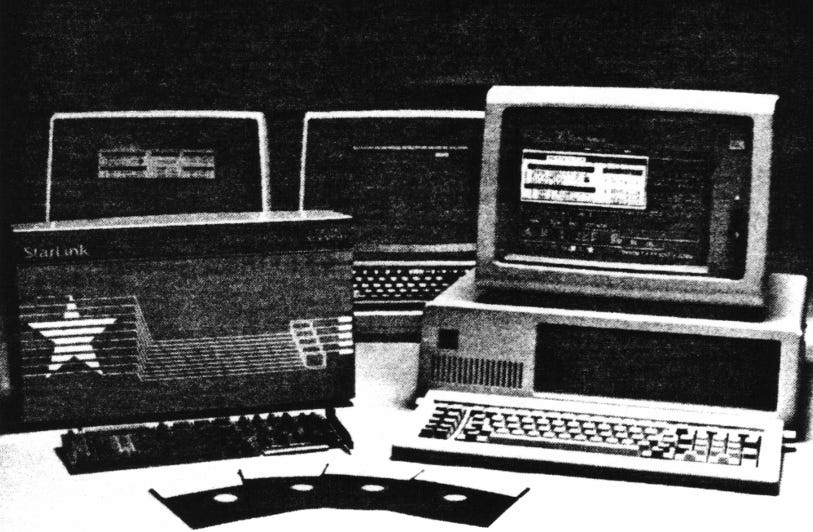
In good old times, StarLink was a board that turned an IBM PC into a multiuser system. In May 1984, Digital Research Inc (DRI) announced a product called StarLink. It was described as a "hardware/software combination to expand the IBM PC into a multiuser system."
The hardware portion was a board containing an Intel 8088 CPU, 64KB of RAM and four RS-232 interfaces for connecting dumb terminals. The software portion was DRI's Concurrent DOS running on the host PC. Such a "multiuser system" could serve up to five users simultaneously - one working at the PC itself, and four via terminals.
The basic idea was to use the multitasking capabilities of Concurrent DOS and replace multiple personal computers with one powerful machine and several "dumb" and hopefully inexpensive terminals. DRI had supported this model for a while. Its MP/M operating system, introduced in 1979, was designed specifically for multiuser 8-bit computers, and Concurrent DOS was the latest evolution of that technology on the Intel 8086 architecture.
Why Additional Hardware Was Needed
So why was additional hardware needed in the first place? MP/M ran on machines built for multiple users. One example was the 8-bit Altos ACS8000-12A, released in 1981. It had all necessary hardware to support multiple users, including six serial ports, four of which could be used to connect terminals. Later models, such as the Altos 586, used the Intel 8086 and could run MP/M-86 or Microsoft XENIX. They were not compatible with the IBM PC but, like their predecessors, they provided built-in hardware support for multiple users.
The IBM PC and XT were designed to be single-user personal computers. Turning them into multiuser servers required additional hardware. StarLink came with the board that contained the necessary serial ports, and also an additional CPU and RAM to boost the performance of the system. Without StarLink, a PC running Concurrent DOS could still support terminals connected to its two standard COM ports, but StarLink increased the number to four, plus the COM ports would remain free.
Production and Pricing
StarLink was produced by DRI's hardware group, formed sometime in 1983 and managed by John Meyer. The group's first product was the CP/M Gold Card, which allowed Apple II computers to run CP/M software. These expansion cards had been popular since 1980 when Microsoft released its SoftCard, but by 1984, both Apple II and CP/M were losing ground in business computing.
StarLink was priced at $1695. The hope was that it would be an attractive option to Altos and similar multiuser systems which started around $8000. However, StarLink required a PC with at least 512KB of RAM and a "recommended" 5MB hard disk. These machines were not cheap - an IBM PC XT with 512KB RAM cost roughly $5000 in 1984. Adding StarLink pushed the total close to the price of an Altos system.
Then again, unlike Altos, a PC with StarLink could run "such applications programs as WordStar, MBA Accounting, and Multiplan." Yes it could, and also others, like SuperCalc and dBase II. What it could not run was the application that made the IBM PC dominant: Lotus 1-2-3. Yes, this was Lotus's fault, but it did not matter. People wanted all software developed for the IBM PC and PC-DOS to run unmodified on their machines, and Concurrent DOS did not provide that level of compatibility.
Aftermath
One way or another, as with other DRI hardware products, StarLink was not a commercial success and was abandoned sometime in 1985 after the bad times hit DRI hard. John Meyer left the company in September 1985, and together with Don Heiskell and Lee Jay Lorenzen started Ventura Software.
The name StarLink got reused. Something called StarLink Plus was advertised in 1987 as a part of ViaNet, by Western Digital. In a Byte Magazine advertisement from January 1990, StarLink is a "service by Galaxy Telecom International in Albuquerque, NM." Nothing to do with SpaceX satellite internet service, except that the latter makes it really hard to search the internet for any information about DRI's product.
Byte, July 1984, pp 46. That's the only mention of DRI StarLink in the magazine as far as I am aware. Apparently, StarLink required a modified version of Concurrent PC-DOS. A copy can be found at The Unofficial CP/M Web Site - search the page content for "StarLink." John Meyer was hired on 8/31/1983 from Sykes Datatronics where he was director of product marketing for telephone management and terminal enhancement systems.
Comments
No comments yet. Start the discussion.