How Kalshi Infects the News
How Kalshi Infects the News
CNN and CNBC are pushing Kalshi on viewers but not telling them the whole story.
This is a special collaboration between Public Notice and Judd Legum of Popular Information. For more news and analysis from Judd and his team, subscribe to Popular Information HERE.
In December 2025, CNN and CNBC struck landmark deals with Kalshi, a leading prediction market. Since then, both networks have promoted Kalshi to viewers extensively, frequently vouching for its accuracy. The existence of a financial relationship between the networks and Kalshi, however, is disclosed to viewers inconsistently.
Since December, CNBC has published 58 articles that do little more than advertise the existence of a Kalshi market related to a news event. The headlines include:
- “Traders predict Michael Jackson hits top Spotify after biopic”
- “Kalshi traders don’t see Hormuz traffic normal until July”
- “Traders say Karen Bass and Spencer Pratt will advance to runoff in high-profile LA mayoral race” (Pratt did not advance.)
Since April, CNBC has employed a dedicated reporter to produce these articles. CNBC also maintains a page on its website featuring Kalshi prediction markets selected by CNBC editors, along with its web coverage.
Some of CNBC’s reporting about Kalshi includes the disclosure, “CNBC and Kalshi have a commercial relationship that includes customer acquisition and a minority investment.” This means CNBC is paid every time it can convert a viewer to a Kalshi user. As an investor, the network also benefits if Kalshi’s overall valuation increases. CNBC is also paid directly by Kalshi for using its data, according to The Wrap.
In at least 22 cases, however, CNBC has written about Kalshi and not disclosed its financial conflict. In recent weeks, CNBC has more frequently failed to include its Kalshi disclosure, including:
- Two pieces on June 10
- One each on June 11, June 15, June 16, and June 23
- Three pieces on June 26
- One each on July 1 and July 2
On air, where CNBC promotes Kalshi nearly every day, disclosure is also spotty. On June 26, during a Squawk Box interview with California Republican gubernatorial candidate Steve Hilton, host Andrew Ross Sorkin brought up the fact that Kalshi gives Hilton a 9.5% chance of winning the election. Producers then cut to a Kalshi graphic depicting those odds while a Kalshi QR code was displayed on the screen. The hosts never acknowledged CNBC’s financial relationship with Kalshi during the segment.
Similarly, during a news rundown on June 23, CNBC correspondent Contessa Brewer claimed that “prediction markets are hot, hot, hot” and mentioned that in recent days Kalshi and Polymarket “handled billions of dollars in trading volume” without disclosing CNBC’s business relationship with Kalshi.
CNBC’s Fast Money and Squawk Box each recently hosted Kalshi co-founder and CEO Tarek Mansour for extended soft-focus interviews. On June 24, for example, Squawk Box host Joe Kernen gave Mansour an open mic to portray Kalshi as a “pro-regulation company” that has kept its hands clean as “our competitors” have been mired in insider trading scandals. While the interview did include the standard CNBC disclosure, Kernen did not ask Mansour about Kalshi’s recent insider trading scandals.
Earlier that month, NPR reported former Congressman George Santos was under Department of Justice investigation for allegedly being involved with insider trading on Kalshi. Other high-profile incidents of insider trading on Kalshi involved political candidates and a MrBeast editor. CNBC did not immediately respond to a request for comment.
CNN Aired at Least 115 Segments Promoting Kalshi
Since December, CNN has featured Kalshi in a segment called “The Odds” at least 115 times. In these segments, Harry Enten, CNN’s chief data analyst, frequently suggests that Kalshi predictions are more accurate than other sources. While polling relies on volunteers, Enten repeatedly reminds CNN viewers that prediction markets are driven by people who “put their money where their mouth is.”
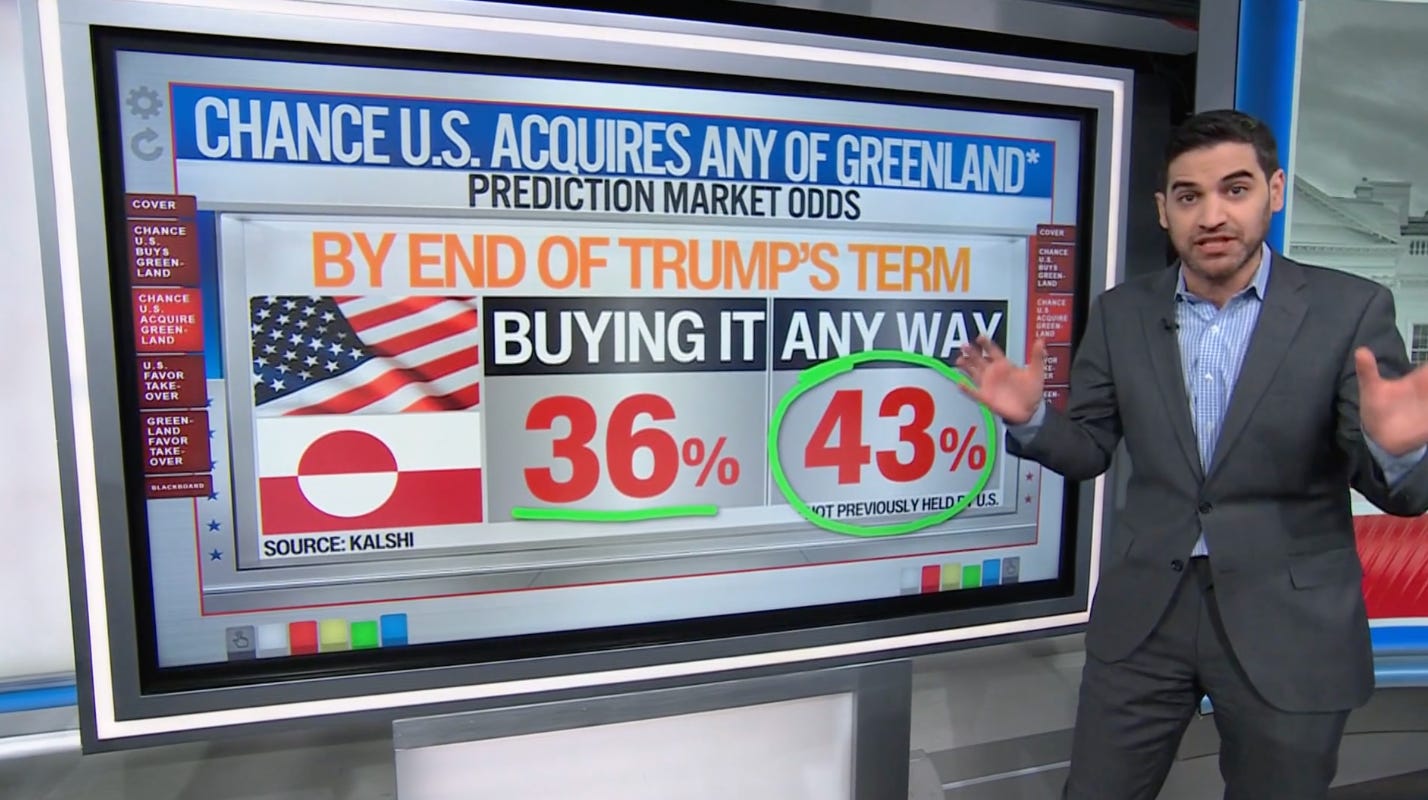
On January 7, Enten highlighted that, in six days, the odds on Kalshi that the United States would buy part of Greenland by the end of Trump’s first term increased from 12% to 36%. Enten said this was proof that “the people putting their money where their mouth is” are “absolutely taking this seriously.” “Whoa… way up there now to 36%,” Enten exclaimed. “A tripling in less than a week. My goodness gracious.”
Enten and his co-host, John Berman, then discussed that another Kalshi market at the time showed a 43% chance that Trump would acquire part of Greenland by any means, including militarily. Berman described it as “a pretty high chance” and said that 43% odds on a Kalshi market meant “a lot of people made bets.” Enten agreed, calling it a “very high chance.” Berman didn’t say how many people made bets because he does not know and that information is not disclosed by Kalshi.
Politics markets represent just 4% of all trading on Kalshi, according to a May 2026 Pew Research study - a fact never mentioned on air. (Sports accounts for 80% of Kalshi trading volume.)
Enten and Berman promoted the 43% chance of Trump acquiring part of Greenland as reflective of people “putting their money where their mouth is.” But an analysis of Kalshi’s own data shows the price increased from 30% to 39% between January 3-5, 2026, on just $24,000 worth of “yes” trades. The market was so thin that, on January 4, the “yes” odds briefly spiked to 60%.
During most segments of “The Odds,” a special ticker scrolls across the bottom of the screen promoting Kalshi markets on a wide variety of topics. According to reporting in The Wrap and The New Yorker, Kalshi pays for CNN to promote its data. The deal is exclusive, meaning that CNN cannot report on Polymarket odds, even though Polymarket has a much more robust market on political topics.
These segments conclude with the tag, “The Odds, brought to you by Kalshi prediction market.” That boilerplate language makes it sound like Kalshi is a typical advertiser, when its relationship with CNN is more extensive. Kalshi regularly clips and promotes CNN’s “The Odds” segments on X, but excludes CNN’s “brought to you by” tagline.
“Prediction markets offer just one source of data that journalists can use in telling a story,” a CNN spokesman said in response to a request for comment. “It is used as a complement to other reporting and data sources, such as polling. It is not a replacement for other sources and has no impact on editorial independence.”
Political Prediction Markets Are Systemically Flawed
Kalshi’s political markets, which dominate the coverage on CNN and are featured prominently on CNBC, are also the least accurate. A February 2026 study by a researcher at the National Economics University in Vietnam analyzed 292 million trades across 327,000 contracts on Kalshi and Polymarket. The study, which has not yet been formally published, found that Kalshi’s political markets “compressed toward 50%,” meaning they systematically overvalue longshots and undervalue favorites.
This is exactly what we saw with the coverage of Greenland, where a Trump pipe dream was promoted as something with a “very high chance” based on the Kalshi odds.
In another recent segment on CNN, Enten, citing Kalshi data, told viewers that Trump has an 8% chance of being featured on a $250 bill. That likely significantly overestimates the actual odds, since featuring a living person on U.S. currency has been illegal for the last 160 years. A bill to amend the law for Trump was introduced in February 2025, and although the Treasury Department has produced a mockup, no congressional action has been taken.
The author of the study theorizes that “political markets attract traders with strong, opposing convictions” which can drive the price “near 50–60% even when the true probability is substantially higher or lower.” The study argues that journalists and news consumers that take prediction market prices “at face value… are systematically misled.”
Updates
UPDATE (7/6, 11:15 am Eastern): CNBC responds: “CNBC discloses commercial relationships when they are directly relevant to the story, as we do across our coverage of exchanges, data providers, and other market participants. Kalshi data is publicly available, and CNBC covers it as part of the broader set of market indicators we report on.”
UPDATE (7/6, 11:30 am Eastern): In a statement, Kalshi says that it is “open about our news partnerships, as have our news partners.” Kalshi, CNN, and CNBC have not disclosed the financial terms of their partnership. Asked for clarity, Kalshi said its deal with CNN involves “featuring our odds on Harry Enten’s show, along with other mentions across their programming” and its deal with CNBC involves “integration across their platforms.” Kalshi added, “People aren’t dumb; they hear and see these disclosures and can choose to use our data as added context or choose not to.” The statement from Kalshi did not address the numerous instances documented by Popular Information and Public Notice where no disclosure was included.
That’s it for today. We’ll be back with more tomorrow. If you appreciate today’s PN, please do your part to keep us free by signing up for a paid subscription. Thanks for reading, and for your support.
Comments
No comments yet. Start the discussion.