Inside Slate’s radical design process to build a $24,950 EV truck you won’t be embarrassed to drive
Inside Slate’s radical design process to build a $24,950 EV truck you won’t be embarrassed to drive
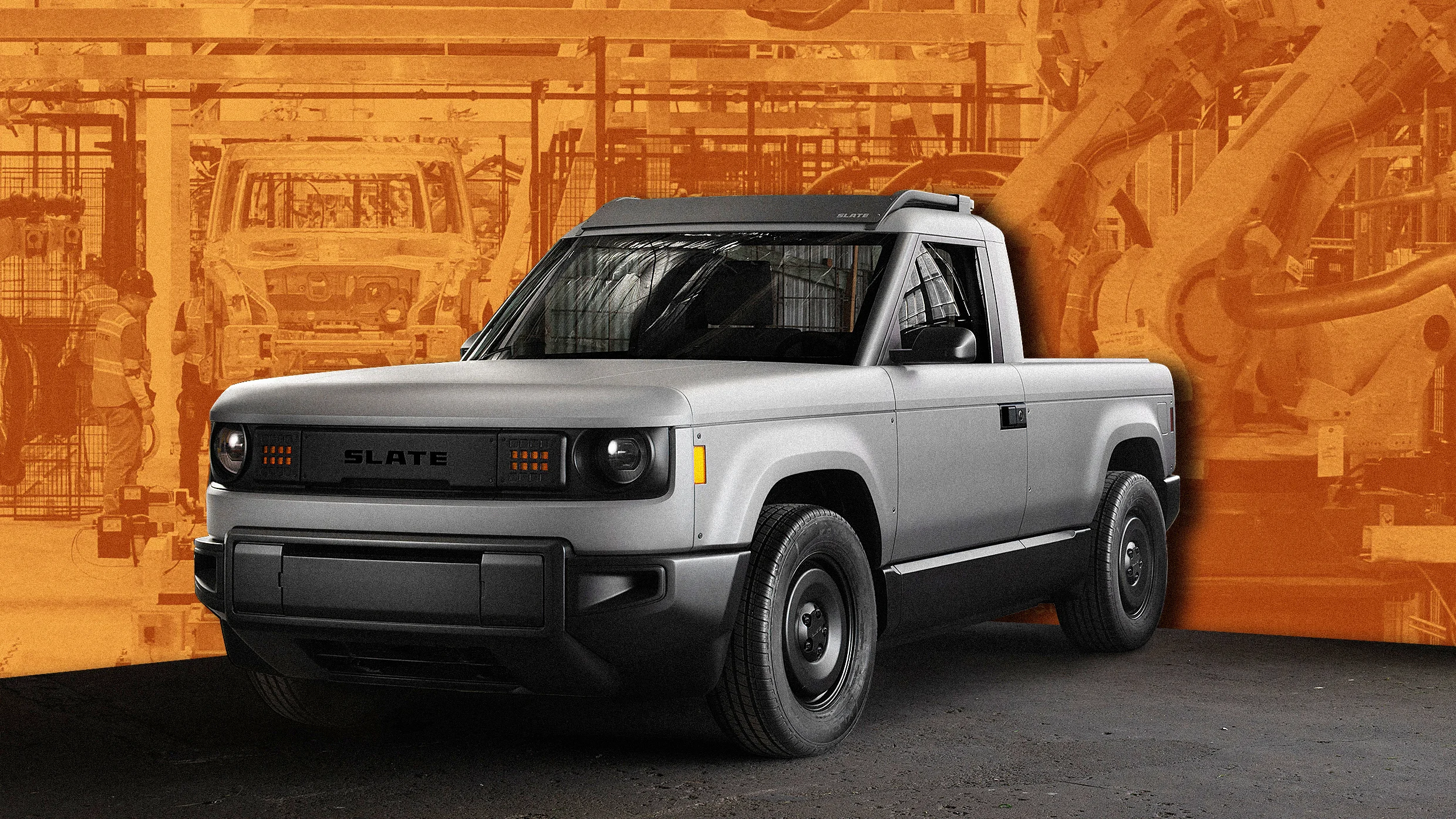
Inside a sprawling former printing plant in Warsaw, Indiana, the new factory for Slate Auto - the affordable, ultra-minimal electric truck backed by Jeff Bezos - doesn’t look like a typical car manufacturing plant.
There’s no paint shop, something that can cost automakers $300 million or more to build. The factory doesn’t have standard stamping equipment to cut out metal parts like doors, which can cost another $100 million. The assembly line is built to make only a single model, and that vehicle is radically stripped down: Apart from the bare minimum and required safety features, there’s little inside. No infotainment screens. No radio or speakers. No carpeting. The windows roll up manually.
“So many of us joined this project early on because we felt the same heartache: What happened to the two-door, affordable, highly useful truck?” says Tisha Johnson, Slate’s head of design, who helped spearhead the disruptive design process that led to the company’s bold new take on what consumers really want from their cars.
Rather than just building a cheaper truck, Slate rethought nearly every assumption in modern automotive design: what features people actually use, who should be able to repair the vehicle, and whether owners should have the ability to fundamentally change it over time. Drivers can customize the EV in multiple ways, from wraps that come in any conceivable color to a kit that turns the truck into an SUV. But the company’s obsessive focus on cost means the base model is just $24,950, making it one of the most affordable EVs on the American market, and less than half the cost of a typical gas-powered truck.
At the factory, workers recently began building design validation vehicles and programming and testing robots that will build the final trucks that roll out later this year. The company, which has raised $1.46 billion to date - including from General Catalyst and Bezos Expeditions, Jeff Bezos’s family office - started taking preorders today, marking the moment when its unconventional vision meets its first market test.
A blank slate
The startup launched in stealth four years ago as vehicle prices were surging; over the past decade, the cost of an average truck has jumped up by more than 50% to around $60,000. (Trucks have also ballooned in size.) The cofounders of Slate Auto saw an opening for a new approach, and built a team to design something completely different from scratch. Manufacturing executive and investor Miles Arnone, former Amazon executive Jeff Wilke, and entrepreneur and investor William Barker spun the project out of Re:Build Manufacturing, their incubator for new American manufacturing businesses.
After raising $111 million a Series A round in 2023, they raised another $700 million in 2025 - again with Bezos Expeditions as an investor - and $650 million this April from TWG Holdings to scale up production.
When the company launched, “you had all the major manufacturers moving towards investing heavily in electrification, in infotainment, and in autonomy, all at the same time, and that started driving up prices very quickly,” says Jeremy Snyder, who previously led Tesla’s global business development and is now Slate’s chief commercial officer. “They also realized that all of the options packages would drive margin. All of that happening at one time created a vacuum in the market for low-cost vehicles. You saw them disappear very rapidly.”
The cofounders had a clear vision, which they laid out in a white paper that hasn’t yet been released publicly. They wanted to bring back the type of small, two-door pickup truck that had once been ubiquitous in models such as the early Ford Ranger or Toyota Tacoma, using a very simplified form so as many people as possible could afford it. And they’d give consumers choices: The vehicle would have a long list of aftermarket options for anyone with more money to spend. Their interest in a two-door truck was driven mostly by the fact that it would be the least expensive option. But it coincided with a growing number of consumers saying they just want to be able to drive a basic truck again.
As Slate’s design team began working in stealth, they drew on their own appreciation for the smaller, older vehicles. “These trucks have a ton of personality. We remember them fondly, and we miss them. And that wasn’t available in the landscape,” says Johnson, the head of design who previously worked at Volvo and Herman Miller. They realized, too, that some standard features were unnecessary: Why do you need a large touchscreen for navigation, for example, when most people are already using their phones?
The team knew that low cost, on its own, wouldn’t be enough. “This has to be something that people love,” Johnson says. “If we were only making a low-cost vehicle, there are plenty of examples where manufacturers attempt to make low cost and make that the priority, and you see time and time again that you have a vehicle that you don’t want. You’re driving and you don’t want to be seen in it. We wanted them to actually feel like they aspire to have the vehicle: that you would spend less, but want it more.”
As a startup, the company had more flexibility than a traditional automaker to rethink what’s possible. “We had a really rich environment in the early days,” says Chris Barman, Slate Auto’s president. Barman, who spent more than 25 years at Chrysler before joining Slate, was initially CEO; in March, the company brought in Peter Faricy, the former VP of Amazon Marketplace, to lead commercial growth, and Barman now focuses on engineering and production. “We were just all shoved in one office space, everybody together, and it forms and forces a lot of creativity,” Barman says. “It was really talking about what could it be, first, and then later you can come back and talk about ‘Okay, but then how can we do it?’”
Stripping down to the essentials
In the design, “every single thing has been scrutinized,” Snyder says. The team even questioned whether air conditioning is necessary. (The answer: Yes. While AC is a complicated electrical system that drivers technically could live without, and eliminating it would have saved cost, comfort ultimately won out.)
Instead of a sound system, they designed a space for a Bluetooth speaker to sit on the dashboard; Slate will sell the accessory, but people can also just use their own. When someone plugs their phone or tablet into the truck’s universal mount, they can use a Slate app that pulls in Spotify or Apple Music and can navigate and find charging stations.
Bringing your own device “eliminates planned obsolescence,” Snyder says. For passengers, it’s likely that they were looking at their own phones or tablets rather than infotainment systems, anyway. “That’s the reality of the world today,” he says. “I think we’re giving people what they actually want, rather than what the perception of ‘want’ is.”
Johnson says listening to what people want became the “greatest filter for decision-making.” And that, she says, led to “a more reductive approach, because people aren’t asking for a bunch of frivolous things. They know what they want. They can articulate it very clearly, but they also show you what they want.” Phones are an obvious example. “People keep their phones with them, and they have all the information that they need daily with them,” Johnson says. “By really just observing normal human behavior, we recognized that we didn’t need to have a whole lot of integrated infotainment and technology in the interior, because people aren’t using it.” (It’s also true that many people actively hate touchscreens in modern cars.)
The car comes in a single color - branded as Slate gray - rather than the standard choice of five or seven colors. A supplier uses injection molding to make the panels, and the gray color is molded in. Drivers can choose to leave it as is, or wrap it in any color with the same type of plastic film used in high-end vehicle wraps. The panels were carefully designed so that wrapping the vehicle can be a DIY job, if someone wants to save money; the color can also easily be changed later, if they get sick of it.
As the company avoided spending hundreds of millions of dollars to build a paint shop in the factory, it also saved on ongoing costs. “It’s not only just the investment to stand it up, it’s all about operating costs to continue to manage those over time,” Barman says. “Paint shops are extremely expensive. They consume a lot of power. And paint is finicky, so it takes a lot of focusing and energy to be able to make sure that it’s running correctly.” In a typical factory, the paint shop also impacts other steps in production, and eliminating it simplified the overall process. By using injection-molded panels attached to a metal frame, rather than stamping doors and other parts out of steel or aluminum, the team also eliminated the need for massive, three-story-tall stamping facilities in the factory.
An average vehicle has more than 2,000 parts. Slate’s has around 250. Everything that’s been taken out of the design, like power windows, helps save costs for customers. But it also means there’s less to break. “We know that the more parts you have, the complexity cascades all the way to the customer experience in terms of potential problems that you have to go fix later,” Johnson says.
Each of the parts that remain were also carefully considered. When possible, the company used off-the-shelf parts. Some of the custom parts are duplicates: The left taillight is the same as the right taillight, for example. That reduces the cost of tooling, and increases the volume that the company can order from its supplier. It streamlined the engineering that was necessary, and made manufacturing simpler. And it also means that if a driver needs to later replace one of the lights, the part will be cheaper for them to buy.
A new level of customization
Some customization, such as custom wraps or wheel packages, is common in Chinese car brands, which have become more innovative than most American automakers. But Slate has gone further.
The biggest change: the ability to turn the truck into an SUV. A shell goes over the back of the truck, attaching to rails built into the original vehicle. A second row of seats attaches to mounting points. The conversion, like most work on the vehicle, is designed for DIYers. Drivers can choose between a square-backed shape and a fastback.
A turning point in the design came in 2023, about a year into the process, when the designers were considering the front of the vehicle. “In this area, you traditionally see a lot of money poured into development,” Johnson says. “It really communicates the identity of the vehicle. They’ll often refer to this as holding the signature of the vehicle.” Slate looked at multiple more traditional designs. But then one designer argued that the front should also be a place for customization. In the final design, Slate is written on the front. But the car owner can easily remove it and 3D-print a plate with their own name.
“That guided our decision-making in a very different direction. We basically threw out the old playbook,” Johnson says. That started with using more approachable materials. “Instead of being precious and something that you just want to look at, these are robust materials that you want to put your hands on,” she says. “We’ve added fasteners and areas that let you know that you can take the nameplate off.” It’s also possible to change the look of the headlights.
On its website, the company will not only sell Slate-branded accessories, but have an Etsy-like selection of accessories made by anyone. Slate’s accessories have been designed with the same attention to affordability as the rest of the vehicle; many are around $500, from the color wraps to roof racks.
Throughout the truck, with the exception of electrical parts that shouldn’t be touched, the fasteners are obvious, encouraging people to take things apart themselves, either to add accessories like roof racks or different wheels, or make repairs. The company encourages DIY repairs and will offer instruction videos. (It has also partnered with RepairPal, a network of thousands of independent repair shops, for anyone who doesn’t want to do the work themselves.)
“I think this is going to encourage a generation of DIYers,” Snyder says. “Products have been designed in such a way that there’s nothing DIY about modern stuff. And we are truly building a vehicle that’s designed to DIY.”
Will it sell?
The truck, which will begin direct-to-consumer deliveries later this year, comes with a projected range of 150 miles on its standard battery, or 240 miles with an extended battery. With a Level 3 charger, it can reach an 80% charge in 30 minutes. At around 14.5 feet long, it’s about 2 feet shorter than the Ford Maverick, the smallest pickup currently on the market; it also can tow only 1,000 pounds, versus the Maverick’s 2,000 pounds. A lockable “frunk” (a storage compartment in the space where a gas truck would have an engine) is big enough to hold two roller bags and a duffel. Unlike a vintage truck, it also has standard modern safety features, from airbags to backup cameras and forward collision warning.
Now comes the test: Is Slate right about an untapped market of buyers who want an EV that’s simpler, cheaper, and more customizable than anything else on the market?
Some analysts argue that a two-door truck is hard to sell in today’s market. “Sometimes when there’s a white space in the market, there’s an opportunity to exploit it,” says Sam Abuelsamid, VP of market research focused on transportation and mobility at Telemetry, a communications agency. “And sometimes the white space is there for a reason.” The two-door pickup, he believes, went away because people liked
Comments
No comments yet. Start the discussion.