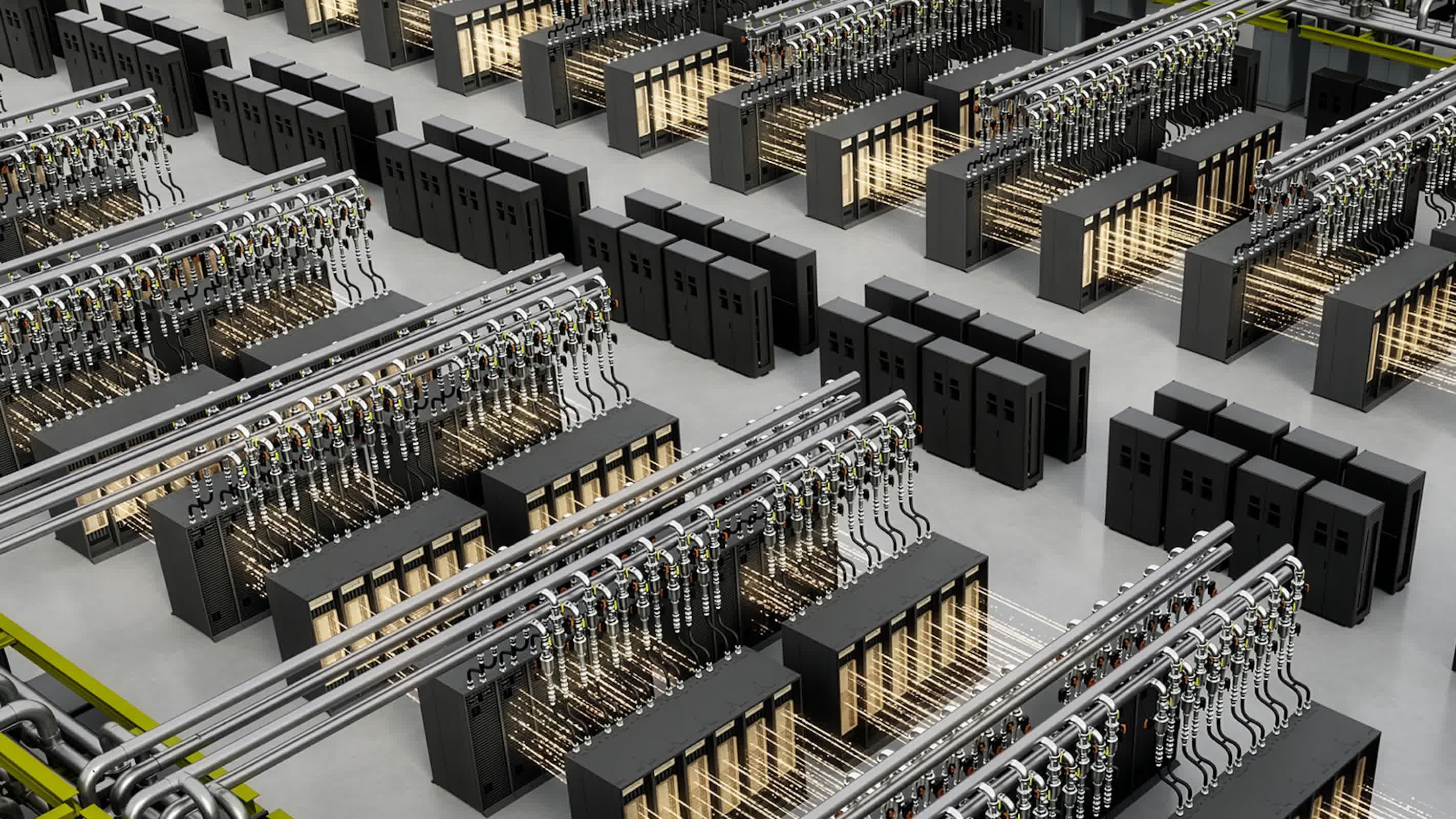
Japan's first national AI factory will use 27,500 GPUs across 382 Vera Rubin racks
Hardware Specifications
In total, the project calls for 27,500 Rubin GPUs and 13,750 Vera CPUs connected through Spectrum-X Ethernet networking. The system is designed to handle the training of trillion-parameter models as capacity ramps up.
Project Overview
Nvidia is working with Japan's newly formed Noetra consortium to build a 140-megawatt AI factory that will serve as the compute backbone for the government's FRONTia program, which focuses on robotics, industrial automation, and digital twins. The facility will run on Nvidia's DSX data center platform and use Vera Rubin NVL72 racks, each combining 72 Rubin GPUs and 36 Vera CPUs.
Nvidia is positioning the Rubin AI factory as a full-stack platform encompassing chips, networking, systems, and software for training and deploying open multimodal foundation models. These models are designed to operate with robots and physical systems, rather than just processing text and images. The plan is to make pretrained weights widely available to developers and companies in Japan so they can fine-tune the models for their own robotics, logistics, and industrial applications.
Hardware Footprint and Cost Estimates
The hardware footprint is substantial even by today's AI data center standards. The component count translates into 382 Vera Rubin NVL72 racks, each a tightly integrated system designed for high-bandwidth NVLink communication within the rack and Spectrum-X networking across the broader fabric.
Industry pricing estimates suggest that VR200 NVL72 systems cost between $5 million and $7 million each, which would put the rack hardware alone in the $1.9 billion to $2.7 billion range before accounting for memory, networking equipment, and cooling infrastructure. Estimates from Morgan Stanley value Rubin GPUs at roughly $55,000 each in volume, implying approximately $1.5 billion in GPU silicon costs alone.
Deployment Timeline
Neither Nvidia nor Noetra has provided a firm deployment timeline, and Rubin systems are only expected to enter volume production in the second half of this year. As a result, the AI factory will likely come online in phases.
Consortium and Funding
Noetra is a newly formed consortium created to bring major Japanese technology and industrial companies together around a shared AI infrastructure effort. The group is led by SoftBank Corp., Sony, NEC, and Honda, with support from 44 companies and organizations.
Noetra, together with the national research institute AIST, won a public tender to operate the FRONTia project from fiscal 2026 through fiscal 2030. Initial funding is set at ¥387.3 billion - about $2.4 billion - with a long-term target of up to ¥1 trillion, or roughly $6.1 billion, over five years. However, that additional funding is subject to annual reviews, meaning the full amount is not guaranteed.
FRONTia Roadmap
The FRONTia roadmap extends beyond simple language models:
- By fiscal 2026: Target a reasoning foundation model.
- By fiscal 2028: Develop an omni-modal model capable of handling text, images, video, and audio.
- By fiscal 2030: Achieve "real-world native AI" with spatial awareness and other capabilities designed for robots and physical systems operating in factories, warehouses, and healthcare environments.
The Rubin AI factory is intended to serve as the compute foundation that enables this progression, providing enough scale to train and retrain very large models while still allowing their weights to be shared for downstream applications.
Related Initiatives
This project joins several other Nvidia-related initiatives in Japan but serves a different purpose. SoftBank has already announced a Blackwell-based DGX supercomputer aimed at enterprise AI workloads. Meanwhile, RIKEN, Fujitsu, and Nvidia are collaborating on FugakuNEXT, a $740 million zetta-scale system planned for around 2030 and designed for scientific computing.
The Rubin AI factory, by contrast, is a state-funded national infrastructure project selected through a public tender and designed specifically for physical AI and robotics applications across multiple industries.
Policy Context
The broader policy direction is clear. Japan's AI Robotics Strategy, released in March, sets a goal of capturing more than 30% of the global AI robotics market by 2040, representing an opportunity the government estimates at roughly $133 billion. The strategy calls for domestic control over the foundation models and data that future robots will rely on.
By investing in a Rubin-based AI factory and connecting it to a consortium led by major Japanese hardware and telecommunications companies, officials are treating large-scale physical AI computing as a national asset rather than simply another private supercomputer project.
Comments
No comments yet. Start the discussion.