Out of the Armchair
Comments
Peter Moore Out of the Armchair
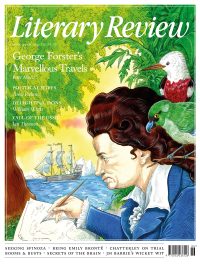
The Traveller: The Revolutionary Life of George Forster and his Search for Humanity By Andrea Wulf Allen Lane 512pp £30
An exemplary tour of the High Enlightenment might go something like this. You’d begin in the streets of 1760s London to feel the pulse of Georgian commerce. You’d then hop aboard one of Captain Cook’s colliers and cruise through the Pacific, having encounters every day. Returning to Europe you might watch Benjamin Franklin in diplomatic action at Passy and dine with Casanova in Vienna, before sailing up the Rhine with Humboldt. Having inspected the Soho Manufactory in Birmingham and admired the picturesque scenery of the Peak District, you’d cross the Channel just in time for the grand and bloody finale in Paris.
Only this isn’t a fantasy. This is the singular and spectacular trajectory of George Forster, subject of Andrea Wulf’s irresistible new biography. ‘George’, as he is called throughout, was an unlikely person to lead what Wulf terms a ‘revolutionary life’. Born in 1754 in a hamlet outside Gdansk, he was a shy and curious child. Long after he won fame as a traveller and naturalist, people described him as calm and tolerant, kind and gentle.
Part of this reserve was due, no doubt, to his overbearing father. Reinhold Forster was an able linguist who gained a reputation as a travelling natural philosopher in the 1760s with a journey into the Russian Empire almost as far as the Caspian Sea. He was also proud, hot-tempered and querulous. Once, in a passionate moment aboard HMS Resolution, he challenged a bemused Captain Cook to a duel. While Cook regarded Reinhold as foolish, many of the common hands aboard simply thought him ludicrous. Tales of his endless threats, in heavily accented German, passed into naval lore. A caricature, made later in the century, pictured Reinhold facing backwards on a donkey, shouting, ‘I vil tel de Kinck of you.’
One thing Reinhold Forster did have going for him was his prodigiously clever son. George, too, had a gift for languages. In time he came to operate with ease in German, English and French – with Dutch, Italian, Spanish, Portuguese and Swedish not far behind. He wrote with flair, drew with expression and thought with subtlety. ‘I enjoy talking,’ he once wrote, ‘but rarely do so; I communicate openly yet maintain self-control.’
When, in May 1772, a Royal Navy surgeon knocked on their London door, wondering whether Reinhold might be persuaded to join Captain Cook’s Resolution, soon to sail for the South Seas, George’s life was transformed. This was the second of Cook’s three voyages to the Pacific, and the captain’s great biographer, J C Beaglehole, argued that ‘for variety of experience it transcends most other voyages ever made’. It included three ‘ice edge’ cruises into the empty high latitudes as Cook searched for the fabled ‘Southern Continent’, and two ‘tropical sweeps’, from bases in New Zealand and Tahiti, that carried the ship’s company to Tonga, New Caledonia and Easter Island.
Having already written so elegantly about Alexander von Humboldt’s travels through South America, Wulf is well equipped to re-create Forster’s experiences aboard the Resolution. There is a briskness to her prose and a simplicity to her structure. The narrative races forward in crisp chronological style. Her own view of this history is in sympathy with George’s. She shares his sense of wonder at the beauty of emerald islands like Tahiti as well as his outrage at the violence perpetrated by the sailors who were taking part in what was clearly a colonial project.
Within this story George Forster has traditionally been assigned a marginal role. The old view is that, while intellectually gifted, he was too weak-willed, superficial and romantic to be considered a serious voice – ‘south German rather than Prussian,’ says Beaglehole, who thought it a shame that his father knocked the stuffing out of him at such an early age.
Reframing George Forster
Wulf’s first purpose in The Traveller is to explode this view and to reframe George, ‘the traveller’, as a quiet but perceptive presence aboard the Resolution. She shows him to be a skilled and reflective observer, weighing the great intellectual and moral questions the voyagers confronted. What, for instance, drove the Māori to cannibalism? How could a seemingly connected people, the Polynesians, have spread themselves over the scattered islands of the Pacific without a knowledge of writing or metal tools? Then, most profound of all, how should these new peoples be understood? What was it that made humans human?
Wulf evaluates George’s responses to each of these conundrums. In contrast to the acerbic views of his father or the clipped practicality of Cook, George emerges as the most sympathetic of the voyagers to the indigenous peoples of the Pacific. Studying similarities among the Polynesian languages and spotting the ubiquitous breadfruit tree for the clue it was, George was among the first to comprehend that the massive region had been settled in a vast migratory wave from Southeast Asia. These people, he further came to believe, were not the fabled ‘noble savages’ Rousseau had described, who existed on some sliding scale between barbarism and civility. The ‘nature of man may differ depending on the climate,’ he would later assert, ‘but in essence all are specifically the same’.
Even, somewhat startlingly, when it came to cannibalism George hesitated to pass moral judgement. To many this was unquestionably a horror, but ‘no matter how gruesome’, Wulf explains, George believed that the ‘Europeans had no right to judge something they didn’t understand’.
After the Resolution
George was still only twenty when the Resolution returned to Britain. He had ‘already seen more of the world than most people ever would’, Wulf writes with considerable understatement. There followed the inevitable honours and book deals as, now a newly minted Enlightenment celebrity, he began his quest for financial security and domestic happiness. While both seemed obtainable, neither would come. For having finally shaken himself clear of his father, George fell into the arms of the thoroughly unsuitable Therese Heyne in Göttingen. An angry father was substituted for an angry wife and, worse still, an angry wife with a wandering eye.
This double misfortune has strongly shaped how George is remembered. But in The Traveller Wulf presents a refreshingly different picture. She shows her subject to be at the centre of intellectual circles, making exhilarating tours across Europe and sparring in the German literary magazines with ignorant practitioners of ‘armchair philosophy’. In one thrilling episode, he squares up to Immanuel Kant, arguing that writers like him ‘should work from observation rather than develop abstruse theories with no foundation in reality’.
This was the power of ‘the traveller’ in the 1780s, as Europe entered a revolutionary age. Where Kant and Rousseau theorised, Forster drew on experience. In this lucent, affectionate retelling of his life, Andrea Wulf makes a convincing case for George as a thinker who has too long been dismissed or ignored. A humanist, moral and kind, he had many of the qualities required when 1789 came. Tragically for George, who lived out his final days in Paris, exhausted and alone, at the height of the Great Terror, he did not quite possess them all.
Comments
No comments yet. Start the discussion.