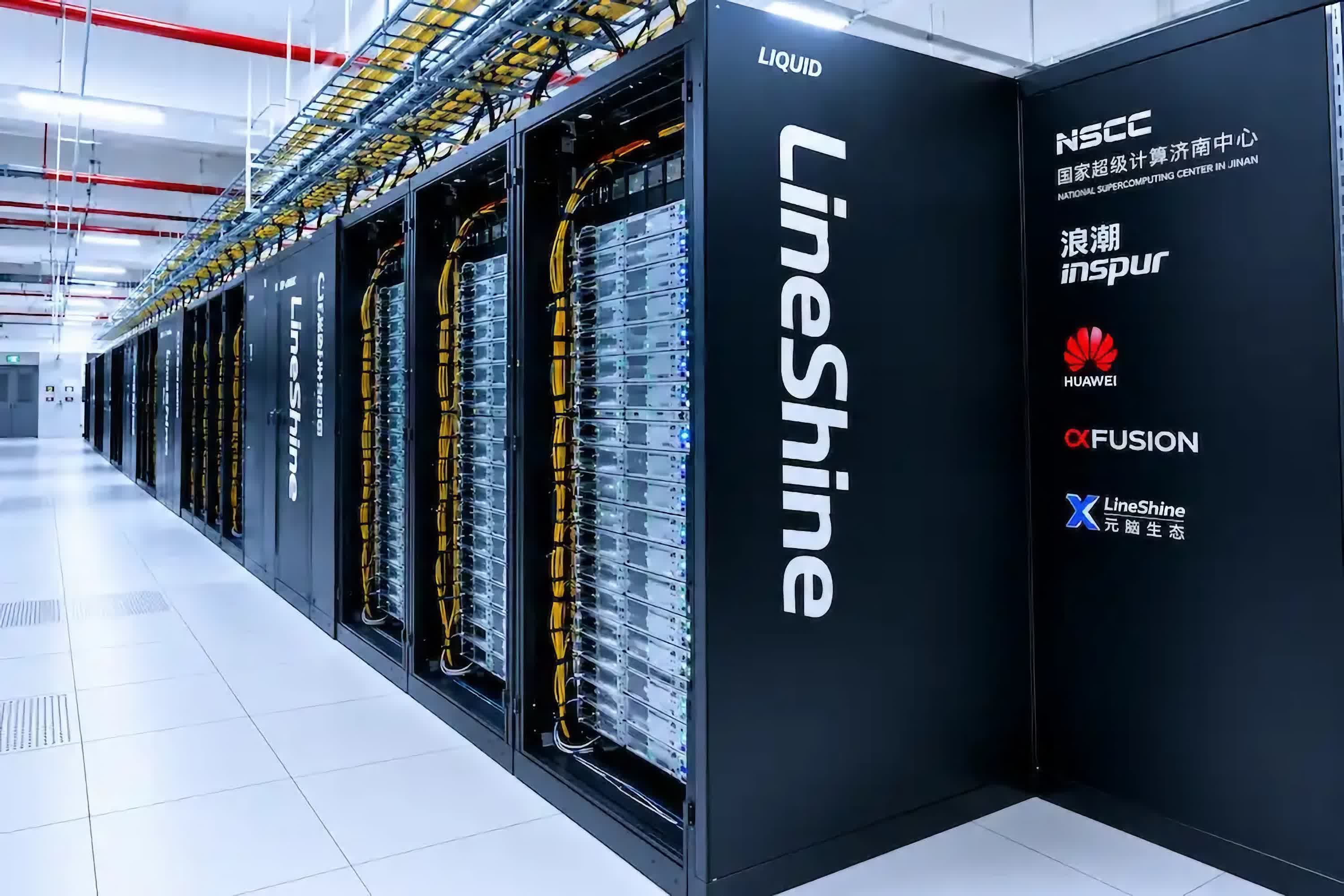
China just built the world's most powerful supercomputer – using Huawei chips and no GPUs
The TOP500 project has unveiled the 67th edition of its biannual ranking of the world's most powerful high-performance computing (HPC) systems.
Announced at the ISC 2026 conference in Hamburg, Germany, the new list marks the surprise debut of LineShine, a previously unannounced Chinese machine that enters straight at No. 1.
LineShine's Architecture
LineShine is built entirely with Chinese-designed chips. The system uses Huawei's Kunpeng 920 processors and does not employ any GPUs. This represents a significant departure from the current trend of GPU-heavy supercomputing architectures.
Key specifications of the LineShine system:
- Peak performance: 1.5 exaflops
- Power consumption: 15 megawatts
- Processor: Huawei Kunpeng 920 (ARM-based)
- Interconnect: Huawei-developed high-speed fabric
- Cooling: Liquid cooling system
Implications for the HPC Landscape
The emergence of LineShine reshapes the competitive dynamics of the supercomputing field. The system's reliance on ARM architecture and absence of GPUs challenges the prevailing assumption that GPU acceleration is necessary for reaching exascale performance.
The TOP500 list also shows:
- The United States retains the No. 2 and No. 3 positions with Frontier and Aurora
- Japan's Fugaku drops to No. 4
- Europe's LUMI system holds at No. 5
- Total combined performance of all 500 systems has grown 15% since the last ranking
Technical Details and Performance Metrics
LineShine achieved its benchmark results using the standard LINPACK benchmark. The system demonstrated strong performance on both dense linear algebra and real-world scientific workloads.
The machine's efficiency ratio of 100 gigaflops per watt places it among the most energy-efficient exascale systems ever built. This efficiency is attributed to the custom-designed Kunpeng processors and the advanced liquid cooling infrastructure.
Comments
No comments yet. Start the discussion.