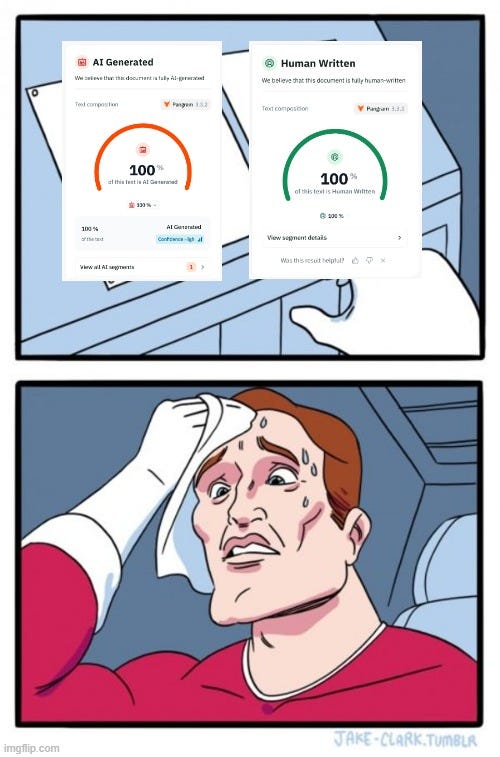
I wouldn't say Pangram is broken, but I would say that it's brittle
It seems way too easy to provoke Pangram into contradicting its own results. So let me get to the nut of this thing before I do my usual meandering.
Recently, someone accused me of using AI to write this old post from about a year ago, specifically highlighting the section about Ta-Nehisi Coates. I replied by saying that the post contained no AI writing; nothing I publish has been written or edited by an LLM. My accuser proceeded to say that the AI detection tool Pangram flagged that portion as 100% AI written with high confidence, a result I replicated. (Pangram report.) As the man who wrote that piece, I knew that I wasn’t guilty, but I also knew that wasn’t going to fly with other people.
I was sufficiently annoyed that I paid for a Pangram license and found that, when I entered the entire essay, Pangram cleared it as 100% human written with high confidence. (Pangram report.) That is to say, the essay of about 5,000 words was declared 100% human written with high confidence even though it contains the section of about 300 words which was declared 100% AI written with high confidence.
Subsequently, I’ve found that I can produce the same sort of inconsistency in the opposite direction - I can break the section that was called 100% AI into pieces that are then called 100% human written. (Pangram report of an example.) So pieces that Pangram call 100% human written are part of a larger piece that Pangram calls 100% AI written which in turn is part of an essay that Pangram calls 100% human written, a Russian doll of contradictory results.
If nothing else, there’s a fundamental inconsistency here: it doesn’t make sense for a system to say that it has high confidence that an essay is 100% human written but also that a piece of that essay is 100% AI-written, again with high confidence, and also to say that the piece itself has subsections that are 100% human written…. These claims are mutually exclusive and must necessarily erode our confidence in the instrument.
Experimenting, I’ve also found that I can pretty reliably get Pangram to declare large sections of text to be AI-written or human-written depending on the larger textual context I place those sections in - that is, I can take AI-generated text and embed it in human-generated text and have Pangram declare it 100% human, and I can take human-generated text and embed it in AI-generated text and have Pangram declare it 100% AI. I’ve also found that it’s pretty easy to induce false positives, that is, to write texts myself that Pangram identifies as AI-written.
All of this makes me hesitant about the Pangram tool, and in particular the way many people use it, as a one-shot gotcha machine. In a purely self-interested sense, the most obvious thing for me to do would be to point to this 100% human written outcome for the whole essay, say “See???,” and get indignant about having been accused. But I think there’s a lot to talk about here, and I think that people who write for a living have to have these conversations. These tools are being used right now, and with consequences, and we have to work this stuff out.
The percentage meter seems clearly broken
One frustration of discussing Pangram results is that many people seem to think that the percentage that’s expressed is the confidence level - that is, that a 100% AI result is saying “we are 100% sure that this text is AI generated.” But that’s not what’s being measured there. The percentage is supposed to indicate what portion of the text is suspected to be LLM written. The degree of confidence is flagged there underneath “AI Generated,” although annoyingly the flag only appears when confidence is high, with no “Confidence Low” flag that ever appears, in my experience.
This is all fine and good - the percentage AI generated and confidence numbers are different things that should be easy to interpret. The first problem is that many, many people are clearly interpreting “100% AI” to mean “100% confidence.” The second problem is that the percentage meter just does not appear to work!
Anecdotally, a really suspiciously high portion of all Pangram outputs are 100%, whether 100% AI or 100% human. This is suspicious not only because a lot of LLM writing that gets published is likely hybrid, integrated with a writer’s own words, but also because the basic processes through which detectors like Pangram function seem likely to produce fewer polar outcomes. And a detector that spits out a lot of 100%s seems easier to break.
So let’s break the percentage meter
This is easy to do. Here’s a paragraph I’ve copy and pasted from a piece I wrote in 2017, which I hope you will accept as given was not written with the help of an LLM. I have appended three sentences to the end of the paragraph that were written by ChatGPT, using the original paragraph as a prompt, highlighted in red. The human-written, pre-LLM section is 239 words, while ChatGPT’s portion is 71 words long.
The gambler's fallacy is when you expect a certain periodicity in outcomes when you have no reason to expect it. That is, you look at events that happened in the recent past, and say "that is an unusually high/low number of times for that event to happen, so therefore what will follow is an unusually low/high number of times for it to happen." The classic case is roulette: you're walking along the casino floor, and you see the electronic sign showing that a roulette table has hit black 10 times in a row. You know the odds of this are very small, so you rush over to place a bet on red. But of course that's not justified: the table doesn't "know" it has come up black 10 times in a row. You've still got the same (bad) odds of hitting red, 47.4%. You're still playing with the same house edge. A coin that's just come up heads 50 times in a row has the same odds of being heads again as being tails again. The expectation that non-periodic random events are governed by some sort of god of reciprocal probabilities is the source of tons of bad human reasoning - and journalism is absolutely stuffed with it. You see it any time people point out that a particular event hasn't happened in a long time, so therefore we've got an increased chance of it happening in the future. But unless the process has some actual mechanism of correction or reversion, the mere passage of time changes nothing. Droughts do not make rain “due,” losing streaks do not create future wins, and a long period without a crisis does not by itself make a crisis more likely tomorrow. The past can tell you something about the underlying probability of an event, but it cannot compel randomness to balance its books.
So, ideally, Pangram would flag this as 23% AI generated; that is, indeed, what the exact percentages are by wordcount. Here’s what actually happens (report):
So, yeah, not great. That passage is three-quarters human written, dominantly human written, and yet Pangram says with high confidence that it’s 100% AI.
I know there are a lot of people who would endorse a “one drop” rule with LLM assistance, but Pangram itself is saying that its technology operates a certain way, and it doesn’t appear to operate that way; certainly you can break it quite consistently. Pangram’s own examples suggest that it can return mixed results with a specific percentage. Look, they even give you human vs robot %: And yet in dozens of trials I’ve never gotten a mixed report like this. They’ve all been either 100% human or 100% AI, even though I’ve been Frankensteining human and LLM writing together constantly for this exercise.
For whatever reason, Pangram seems to want to find 100% results, even though users are clearly trusting it to detect what portion of a text is LLM generated. This all seems quite bad to me! This technology is being used in a way that has severe professional consequences for some people. It should work the way it’s supposed to work; it should offer a “percentage AI written” that’s actually a reflection of how much of the text was LLM generated, and if it can’t do that, they should drop the percentiles and just give a quantitative, numeral confidence figure.
Here’s where we can do a “you try it at home” exercise
If you have a Pangram account, take human written text, append LLM-generated text, and see if you get a 100% AI result. With enough naked ChatGPT text you’ll get there. And if you’d like, you can try and go the other direction - if you have a long enough human-written piece, you can stick LLM-generated text somewhere in it and see what you get back. I think you’ll find that it’s easy to pass such text through as 100% human. This additionally means that you can easily get specific passages into texts flagged as 100% human or 100% AI, again fairly consistently.
I just don’t think that’s ideal, and it disturbs me how cavalier some people are about it.
Conflicting results and what to do
I have no idea what you do with conflicting results like these. I suppose many would say that the much longer overall essay has many more datapoints and the whole-essay analysis should thus be considered more authoritative than the 300-word passage analysis. But I can assure you that this won’t stop people who don’t like me from declaring some sort of victory!
This is what I worry about with this whole controversy - we’re very likely to end up with everybody confirming their priors. People who don’t like me will say that the short passage analysis proves that that portion was LLM written, while people who do like me (I assure you, a few such people exist) will say that the whole-essay analysis has more data and is obviously the right level of perspective. Nobody will be convinced of anything.
The nightmarish possibility is that people will start cutting up essays that pass Pangram’s test into small pieces, looking to find parts that get flagged as AI, so that nobody ever feels confident about anything. If 50 words is not sufficient to have confidence in a result, you shouldn’t be able to put 50 words in the detector.
Several people on Notes said some version of “Well of course nothing is 100%, but the more data that Pangram has, the more accurate it will be, and that 300 word chunk that got flagged just wasn’t long enough.” But the minimum amount of text Pangram will accept is 50 words, so it should work on 50 words. I’m obviously not equipped to discuss the technical specifics here, but since I heard some version of this many times, I want to say clearly: if a particular selection of text provides insufficient data to get accurate results, you shouldn’t be able to use the detector on that selection of text. At the very least, if the confidence in a conclusion is low, that low level of confidence should be prominently displayed in the results.
Even a very small error rate will produce false outcomes regularly
Given enough repetitions. I’ve written more than 5000 blog posts, newsletter entries, and freelance essays in my career; I can’t be sure because my old fredrikdeboer.com blog was lost years ago, but it may be closer to 6000. But let’s narrow down: since ChatGPT was released to the public in 2022, I’ve published about 1200 posts here, and those are the ones that are relevant.
Now, one frustration I have with this discussion is how often people quote error rates that come straight from Pangram, which doesn’t seem particularly rigorous to me. But let’s be generous and use the company’s own numbers. Pangram reports a false positive rate of 0.19%, and claims something closer to one in ten thousand on academic essays. (That is, the kind turned in by college students, presumably Pangram’s most common usage.) At those rates, 1,200 posts of mine yields an expected two or three spurious “AI written” verdicts - small, but not zero.
But! Even that considerably understates the exposure to potential error, because “newsletter post” or “essay” or “document” isn’t the only unit these tools actually operate on. Pangram returns sentence-level “highlights” and a separate AI-assist judgment, so every paragraph becomes its own opportunity to be wrong. There’s thirty paragraphs in the post that got flagged. Let’s say my average is half that. At that rate, my post-ChatGPT archive represents something like 18,000 chances to get flagged, and at one in ten thousand you would expect a few passages in there to come back marked as machine-written no matter what I did or didn’t do.
This is why a “one drop rule” doesn’t work. An accusation should come from a large-scale investigation of a writer’s corpus. But that’s hard and time intensive and, most importantly, doesn’t fit with the desire to own one’s enemies online, which drives a lot of this stuff.
And, of course, “Freddie deBoer” is not the right unit of analysis, but rather the whole community of people who write. That community produces a lot of text, and so even at 1 in 10,000, there will be an immense number of false positives being generated, if you’re testing everybody. And as I suggested above, some people’s natural writing style is more likely to be flagged than that of others, even with no LLM assistance. Whatever Pangram keys on is going to get keyed on over and over again; there’s inevitably a bias against whoever happens to write near the boundary.
My own writing doesn’t appear to have that problem, but other people’s will. Can’t you imagine the outrage if it’s eventually found that, say, Chinese international students are more likely to produce false positives with their writing, thanks to underlying second language consistencies? Those consistencies exist; back when I taught Chinese undergrads at Purdue, they would very often write “now a day” instead of “nowadays,” including when they were writing live and unscripted in the computer lab.
It all worries me. Despite Pangram’s reputation for avoiding false positives, it’s very easy to induce them. A lot of Pangram enthusiasts boast that the system is very unlikely to produce a false positive-
Comments
No comments yet. Start the discussion.