A server within a server: HP packs 81,920 CPU cores, up to 1.28PB RAM into one 42U rack using 80 multi-node motherboards - unannounced Venice is likely to be the fastest x86 CPU ever produced
HPE Demonstrates Cray GX5000 System Using AMD Venice Processors
HPE reveals rack-scale system containing 81,920 CPU cores. AMD Venice processors power HPE’s next-generation Cray infrastructure. One 42U rack delivers unprecedented levels of computing density.
During its recent HPE Discover 2026 event, the company revealed new Cray GX5000 hardware featuring next-generation AMD EPYC Venice processors, with specifications that push server density well beyond current deployments. The system combines multiple compute blades, liquid cooling infrastructure, networking hardware, and memory resources inside a single 42U rack configuration.
HPE revealed a Cray GX5000 configuration designed to deliver up to 81,920 CPU cores in one rack.
Dense Compute Architecture Pushes Rack Capacity Higher
The HPE Cray GX5000 platform follows the AMD EPYC 9965, a 192-core processor that represented one of AMD’s highest-core-count server CPUs before Venice arrived. While the EPYC 9965 increased processor-level density, the Venice-based system takes a broader approach by combining multiple CPUs, memory resources, and cooling infrastructure inside a single rack.
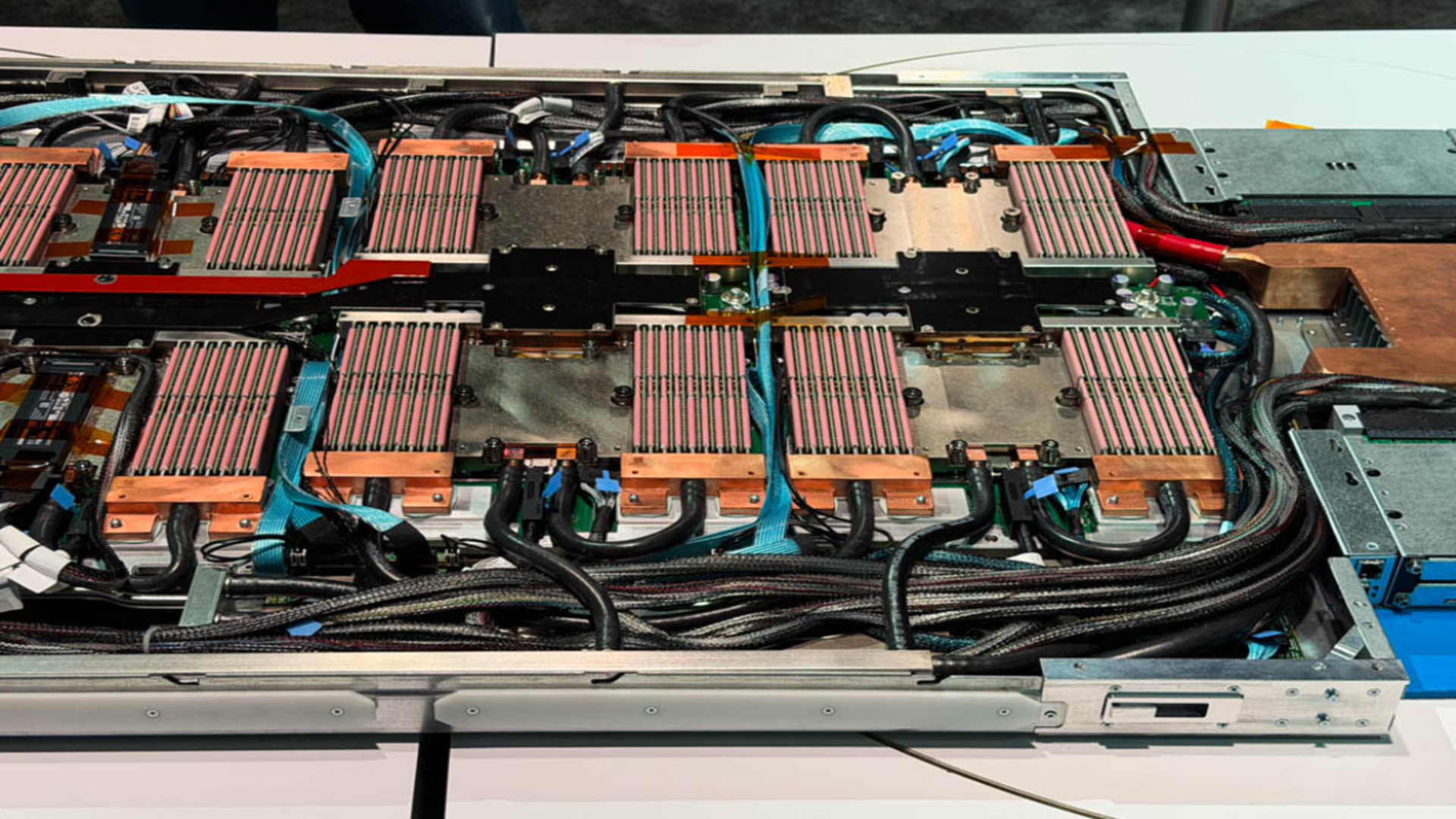
At the center of the system is the HPE Cray GX250a compute blade, which houses eight AMD EPYC Venice processors. The compute blade incorporates power delivery, liquid cooling channels, memory subsystems, storage devices, and networking components within a compact design.
HPE stated that a fully populated rack can deliver 81,920 CPU cores, although exact processor configurations were not disclosed. Based on the rack specifications, the system reportedly uses 80 multi-node motherboards and can support as much as 1.28PB of RAM. Each Venice processor connects to 16 memory channels, creating substantial memory bandwidth for large-scale computing workloads.
The memory modules themselves are liquid-cooled and appear to use standard DIMM form factors. Photographs from the event showed local Samsung E1.S EDSSF SSDs mounted above several processor cold plates. HPE representatives indicated these drives serve as high-speed scratch storage for temporary data processing tasks.
The installed DRAM modules, storage devices, and node identifiers suggest that the displayed hardware was operational rather than a nonfunctional demonstration unit. That distinction is significant because earlier Venice demonstrations appeared closer to prototype systems than production-ready deployments.
Venice CPUs and Networking Define the Platform
The rack incorporates Slingshot 400 networking hardware, with HPE indicating future compatibility with Slingshot 800 technology. Networking modules are mounted within side pods connected to processors through dedicated interfaces designed for high-bandwidth communication. The front-facing networking arrangement also simplifies cable management by changing how optical connections are routed throughout the rack.
HPE also displayed a coolant distribution unit capable of handling 1.6MW of cooling capacity for large installations. Such cooling requirements reflect the growing power densities associated with modern high-performance computing infrastructure and increasingly complex CPU designs.
AI tools, scientific simulations, engineering analysis, and large LLM deployments are among workloads requiring this level of computational density.
The company did not disclose detailed specifications for AMD's unannounced Venice processors, although available figures suggest unusually high core counts. Calculations based on the stated 81,920-core rack capacity imply processor densities exceeding current EPYC generations by a substantial margin.
Although AMD has not released the specs or performance figures for Venice, the projected core density of the HPE system has led to speculation that the processor could become one of the most powerful x86 CPUs produced. A lot could change before the official launch, but the Cray GX5000 platform indicates that AMD and HPE are pursuing higher compute density within the same rack footprint.
Via ServeTheHome
Comments
No comments yet. Start the discussion.