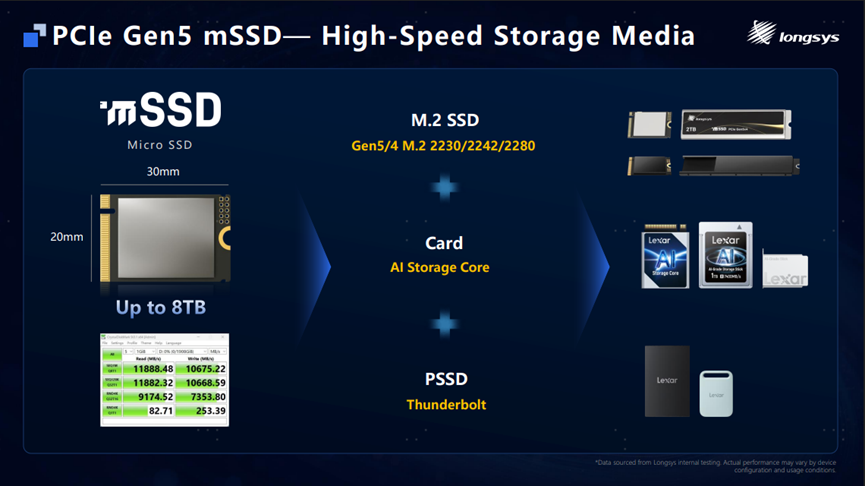
This SIM-card-sized 8TB PCIe 5.0 SSD hits 11GB/s, but AI firms will likely hoard them all - and Longsys's jaw-dropping mSSD also sports VC phase-change liquid cooling
Longsys's latest mSSD builds on Gen 4 by delivering double the maximum capacity and a massive upgrade in read/write speeds, thanks to a new controller under the hood.
Longsys's Latest mSSD: 8TB PCIe 5.0 in a SIM-Card-Sized Package
Longsys's latest mSSD builds on Gen 4 by delivering double the maximum capacity and a massive upgrade in read/write speeds, thanks to a new controller under the hood.
High-capacity Gen 5 SSD storage just got a lot smaller.
Key Specifications
Shenzhen-based storage giant Longsys has been pulling out all the stops in offering a wide range of storage solutions for a world that increasingly relies on AI. The company behind Lexar and FORESEE is releasing several interesting solutions, including:
- A custom chip that enables on-the-fly compression on existing SSDs
- Proprietary caching technology
- Fast, DRAM-less SSDs in the smaller M2 2230 form factor
Longsys's new mSSD builds on the success of its predecessor, offering PCIe 5.0 speeds and twice the maximum capacity while maintaining the same form factor that made its predecessor a breakthrough when it was launched last year.
A Powerful, High-Capacity Option Despite the Size
The Longsys mSSD is, much like the previous model, a DRAM-less SSD, even as the newer Maxio 1802 controller enables read/write speeds of 11GB/s and 10GB/s, respectively.
The SSD, which was also showcased at Computex 2026, demonstrated how Longsys's proprietary VC phase-change liquid cooling, paired with a multi-layer stacked thermal architecture, enabled it to deliver sustained performance compared with most of its DRAM-less competition in the same form factor.
With 8TB of storage, it caters to most AI firms and power users looking to store or cache LLMs locally without contending with the performance limitations of cheaper, larger SSDs.
Design and Manufacturing
The form factor and the relatively large capacity on offer are because of how the SSD is designed. Longsys states that the mSSD is manufactured using an advanced wafer-level SiP (system-in-package) technology with a single die housing NAND flash, the controller, and the PMIC that allows it to retain a compact 2230 form factor without sacrificing performance or reliability.
Target Market and Pricing
Longsys's plans for the SSD are also clear, with it focusing on sustained performance gains when running "intense KV Cache-driven AI workloads."
Given how similarly performing 8TB SSDs can cost upwards of $2,000 on Amazon right now, it might be safe to assume that the mSSD, at least at the highest capacity tier, easily prices out most modern consumers even if it is not marketed as an enterprise SSD.
At a time when NAND shortages continue to break the market, one can easily assume a four-figure asking price for what is essentially a state-of-the-art storage option, at least in its form factor. It is a sign of things to come, even as Longsys has yet to announce a price or a release date for its offering at the time of writing.
Comments
No comments yet. Start the discussion.