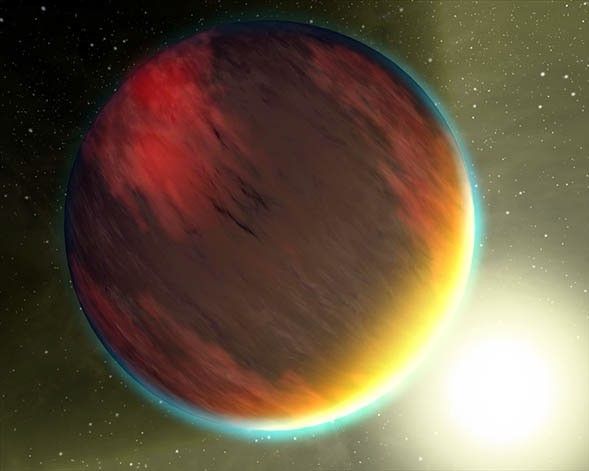
We've seen helium baked off a rocky exoplanet's atmosphere
Helium Loss Observed
If the large, rocky planet is losing helium, then we can infer what is left behind.
Most of the gas in the Universe is a mixture of hydrogen and helium. It’s thought that the initial atmospheres of most planets also start out that way. However, over billions of years, as planets evolve, the composition of their atmospheres may shift. Hydrogen can react with other chemicals, and both it and helium can be lost to space.
Venus, Earth, and Mars are thought to have second atmospheres, with their original hydrogen/helium envelopes having been lost and/or transformed.
Dynamics of Atmospheric Loss
The dynamics of loss are complicated. Lighter elements are lost more easily, but hydrogen can be protected by being incorporated into molecules like methane and ammonia. The gravity of the body can help retain some molecules, and a magnetic field can limit radiation’s ability to blast material out of the atmosphere.
Proximity to a star will matter too, both because of the radiation it produces and because it can heat the atmosphere and expand it to where gravity’s influence is less substantial.
Given all these complications, it can be difficult to know what to expect to find on exoplanets. But a study in Wednesday’s issue of Nature describes observations of helium being lost from the atmosphere of an exoplanet orbiting the star LHS 1140, about 50 light-years away. Based on the rate at which the helium is being lost, we can infer something about the remaining atmosphere.
The LHS 1140 System
LHS 1140a is a red dwarf star with two known planets orbiting it.
- One of them, LHS 1140c, is close to the star, completing an orbit in a bit under four days and receiving about five times more radiation from its host star than the Earth receives from the Sun.
- A second planet, LHS 1140b, is considerably farther out. It takes nearly 25 days to complete an orbit. That places it significantly closer to its host star than Mercury is to the Sun.
Because LHS 1140a is such a dim star, this means it receives less than half as much light from its star as the Earth does.
Comments
No comments yet. Start the discussion.