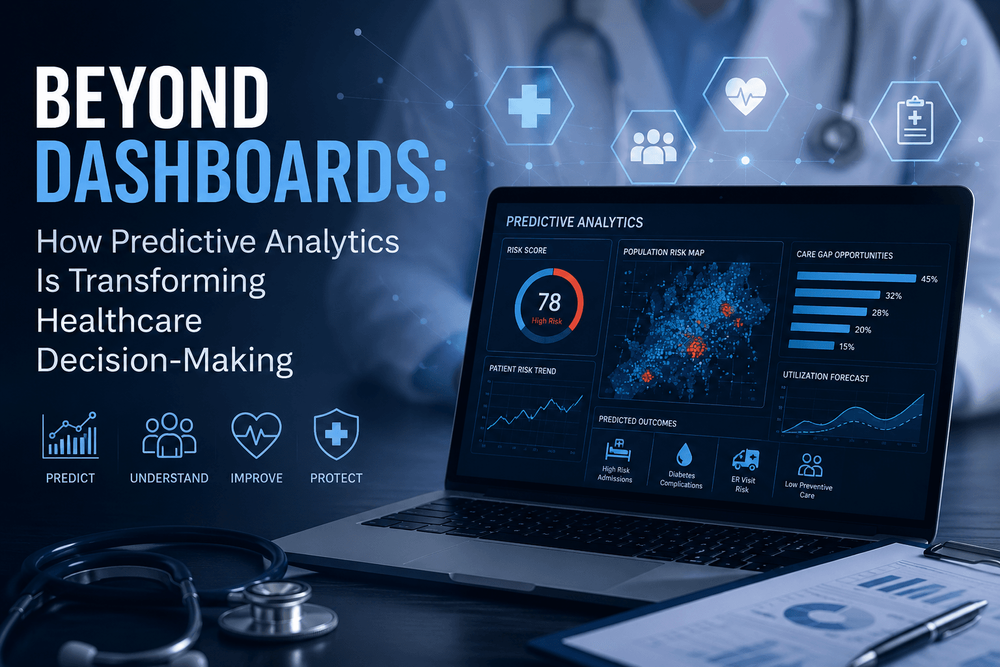
Beyond Dashboards: How Predictive Analytics Is Transforming Healthcare Decision-Making
Introduction
Healthcare organizations generate enormous volumes of data every day. Claims transactions, enrollment records, member interactions, provider encounters, survey responses, pharmacy utilization, and demographic information collectively create one of the largest and most complex datasets in any industry.
Traditionally, healthcare organizations have relied on dashboards and reports to monitor operational performance. These dashboards answer questions such as: How many members enrolled this month? What is the current disenrollment rate? Which counties have the highest healthcare utilization? How many members completed preventive screenings?
While these metrics are valuable, they are inherently retrospective. By the time a dashboard identifies a problem, the opportunity for intervention may already be limited.
Modern healthcare analytics increasingly focuses on predictive capabilities. Rather than asking: What happened? Organizations are asking: What is likely to happen next?
This article demonstrates how developers can build a healthcare predictive analytics platform capable of identifying members at risk of disenrollment before they leave a health plan. The architecture and techniques discussed can also be applied to utilization forecasting, care management prioritization, outreach optimization, and population health initiatives.
System Architecture
A production-grade healthcare predictive analytics platform typically consists of five major layers:
+-----------------------+
|   Source Systems      |
+-----------------------+
| Enrollment Data       |
| Claims Data           |
| CRM Data              |
| Call Center Data      |
| Survey Data           |
+-----------+-----------+
            |
            v
+-----------------------+
|  Data Engineering     |
+-----------------------+
| ETL Pipelines         |
| Data Validation       |
| Feature Engineering   |
+-----------+-----------+
            |
            v
+-----------------------+
|   Feature Store       |
+-----------------------+
| Member Features       |
| Engagement Features   |
| Utilization Features  |
+-----------+-----------+
            |
            v
+-----------------------+
| Machine Learning      |
+-----------------------+
| Training Pipeline     |
| Model Registry        |
| Prediction Service    |
+-----------+-----------+
            |
            v
+-----------------------+
| Business Applications |
+-----------------------+
| Tableau               |
| Power BI              |
| CRM Outreach          |
| Care Management       |
+-----------------------+
Step 1: Data Ingestion
Healthcare organizations typically maintain data across multiple systems. Examples include:
| System | Example Data |
|---|---|
| Enrollment Platform | Effective dates, product information |
| Claims Warehouse | Medical and pharmacy claims |
| CRM | Outreach interactions |
| Call Center | Service requests |
| Survey Platform | Satisfaction and sentiment |
A common approach is to load data into a centralized warehouse. Example SQL extraction:
SELECT member_id, age, gender, county, product_type, enrollment_date
FROM enrollment_members;
Claims aggregation:
SELECT member_id,
       COUNT(*) AS claim_count,
       SUM(paid_amount) AS total_paid
FROM medical_claims
WHERE service_date >= CURRENT_DATE - INTERVAL '12 months'
GROUP BY member_id;
Step 2: Feature Engineering
Feature engineering often contributes more to model performance than algorithm selection. Raw healthcare data rarely provides predictive value without transformation.
Example features:
Member Tenure
import pandas as pd

df["tenure_months"] = (
    (pd.Timestamp.today() - df["enrollment_date"])
    .dt.days / 30
)
Claims Utilization
df["claims_per_month"] = (
    df["claim_count"] / df["tenure_months"]
)
Outreach Engagement
df["engagement_score"] = (
    df["email_opens"] * 0.3 +
    df["call_center_contacts"] * 0.2 +
    df["portal_logins"] * 0.5
)
Sentiment Feature
Using natural language processing:
from transformers import pipeline

sentiment_model = pipeline(
    "sentiment-analysis"
)

result = sentiment_model(
    "I am frustrated with my coverage"
)
Output:
{
    'label':'NEGATIVE',
    'score':0.98
}
These scores can become predictive features.
Step 3: Building a Retention Prediction Model
The objective is to estimate the probability that a member disenrolls within the next enrollment cycle.
Target Variable: disenrolled_next_90_days
Binary classification:
- 0 = retained
- 1 = disenrolled
Prepare data:
from sklearn.model_selection import train_test_split

X = df[[
    "age",
    "tenure_months",
    "claim_count",
    "engagement_score",
    "sentiment_score"
]]
y = df["disenrolled"]
Train/test split:
X_train, X_test, y_train, y_test = train_test_split(
    X, y, test_size=0.2, random_state=42
)
Step 4: Training XGBoost
Tree-based models frequently outperform linear models in healthcare datasets.
Install:
pip install xgboost
Training:
from xgboost import XGBClassifier

model = XGBClassifier(
    max_depth=6,
    learning_rate=0.05,
    n_estimators=300,
    subsample=0.8,
    colsample_bytree=0.8
)

model.fit(X_train, y_train)
Generate probabilities:
risk_scores = model.predict_proba(X_test)[:,1]
Step 5: Model Evaluation
Healthcare predictive models should be evaluated using more than accuracy. Accuracy can be misleading when disenrollment rates are low.
Example:
from sklearn.metrics import roc_auc_score

auc = roc_auc_score(y_test, risk_scores)
print(auc)
Additional metrics:
from sklearn.metrics import (
    precision_score,
    recall_score
)
Important measures:
- ROC-AUC
- Precision
- Recall
- Lift
- Calibration
Healthcare organizations often prioritize recall because identifying high-risk members is more important than minimizing false positives.
Step 6: Explainability with SHAP
Healthcare decisions require transparency. SHAP provides model explainability.
import shap

explainer = shap.TreeExplainer(model)
shap_values = explainer.shap_values(X_test)
Visualization:
shap.summary_plot(shap_values, X_test)
This helps explain:
- Why a member received a high-risk score
- Which variables contributed most
- Whether outreach or utilization factors drove predictions
Step 7: Deploying Predictions
Predictions should be operationalized. Example API using FastAPI:
from fastapi import FastAPI

app = FastAPI()

@app.post("/predict")
def predict(member_features):
    score = model.predict_proba(
        [member_features]
    )[0][1]
    return {"risk_score": score}
Run:
uvicorn app:app
The API can support:
- Care management systems
- CRM platforms
- Outreach tools
- Member engagement applications
Step 8: Integrating with Tableau
Predictions become actionable when combined with business intelligence.
Example output:
| Member ID | Risk Score |
|---|---|
| 1001 | 0.87 |
| 1002 | 0.74 |
| 1003 | 0.69 |
Dashboard users can:
- Filter high-risk populations
- Prioritize outreach
- Monitor intervention outcomes
- Track retention improvements
Instead of reporting who already left, analysts can identify who is likely to leave next.
MLOps Considerations
Production healthcare systems require governance. Recommended stack:
| Layer | Technology |
|---|---|
| Data Warehouse | Snowflake |
| ETL | Airflow |
| Storage | AWS S3 |
| Modeling | Python |
| Deployment | FastAPI |
| Monitoring | MLflow |
| Dashboarding | Tableau |
Key requirements:
- HIPAA compliance
- Model versioning
- Audit logging
- Bias monitoring
- Data quality validation
Conclusion
The future of healthcare analytics extends beyond dashboards. Modern healthcare organizations are building predictive systems that continuously evaluate member behavior, utilization patterns, engagement activity, and population health indicators.
By combining data engineering, machine learning, explainable AI, and operational deployment practices, developers can create systems that help healthcare organizations intervene earlier, allocate resources more effectively, and improve member outcomes.
The next generation of healthcare analytics will not simply describe the past. It will help organizations anticipate the future.
Comments
No comments yet. Start the discussion.