The Great Freakout Over Open-Source AI Has Begun
The Great Freakout Over Open-Source AI Has Begun
There are no heroes here.
Remember when the Chinese open-source AI model DeepSeek was first made public, and everyone freaked out? Welcome to Round Two.
When Chinese AI lab Moonshot AI dropped its latest model, Kimi K3, last week, it caused quite an uproar-including a long-winded meditation on the open-source approach from Dean Ball, the recently hired “Head of Strategic Futures” at OpenAI, in which he called the non-walled-off approach to AI development a risk that makes AI “ungovernable.”
Ball said that Kimi K3 is competitive with the top American models, which appears true: benchmarking reportedly puts it on par with Anthropic’s Claude Fable and OpenAI’s GPT-5.6. But he has doubts about the open-source approach.
“I am personally surprised the Chinese state continues to allow the open sourcing of models this good, given potential risks,” he said. “To be clear, I myself might be fine with models presenting this level of marginal risk being open weight, but I am surprised that China is fine with it.”
Some observations on Kimi:
- It's a very good model! I don't think its performance can be explained away by distillation or anything like that. In agentic coding sessions, it seems pretty much on par with the best public models of Q1 2026. In my fairly limited use, it also…
- Dean W. Ball (@deanwball) July 17, 2026
Saying that he “might be fine” with models like Kimi K3 being open source feels like it’s doing some heavy lifting, given everything else Ball said in the post, including claiming that the only reason Moonshot and other Chinese labs are going open source is that “they are behind, and they know that very few people would pay for sub-frontier models from China,” while implying the hidden reason they’ve chosen this approach is because “they know open-weight models are effectively ungovernable, and they simply like the overall cloak of ungovernability open-weight models create over the whole of AI.”
Dean Ball’s Real Objection
Ball’s real objection seems to be that open-source models put a dent in his company’s bottom line.
Ball called open source “inherently decelerationist”-meaning it’ll slow the development of AI-and claimed, “in the end, open-weight models deter further AI capex.” In the end, that would lead to “full AI communism,” he claimed:
“Rather than a market product, AI is a ‘public good’ which will ultimately be provided by the state as a kind of ‘digital public infrastructure.’ This future strikes me as a dystopian hellscape, but I’ve never met an open-weight models advocate who doesn’t ultimately concede this is where things end.”
Ball’s position seems to be that if we allow open source models to persist (which he’s totally fine with and not at all threatened by, by the way!), it’ll eventually erode the desire of closed-source labs like OpenAI to develop their model by making the technology a public utility instead of a business. How awful! Could you imagine a technology not being a purely profit-driven endeavour? Weird position to take from a company that was founded with a charter that insisted if another company was going to beat it to achieving artificial general intelligence, it would cease operation and lend its resources to assist that company.
Political Reactions
Anyway, Ball theorized that the Trump administration will likely see the development of Chinese models as a threat and seek to ban them-though he advised they wouldn’t need to go that far. Instead, they could just issue a warning that there “may be backdoors in Chinese AI models,” regardless of whether it’s true or not. “You just create enough regulatory risk that every regulated enterprise backs off,” he wrote.
Seems he might be right about that. A recent Axios report implied that the Trump administration may renew efforts to create an effective ban on foreign models. According to the outlet, the admin previously explored placing Chinese AI labs on the Commerce Department’s “Entity List,” which would basically restrict them from operating in the US without a license. Trump also reportedly considered an executive order that would hold US companies accountable for any risks associated with hosting Chinese models, per Axios.
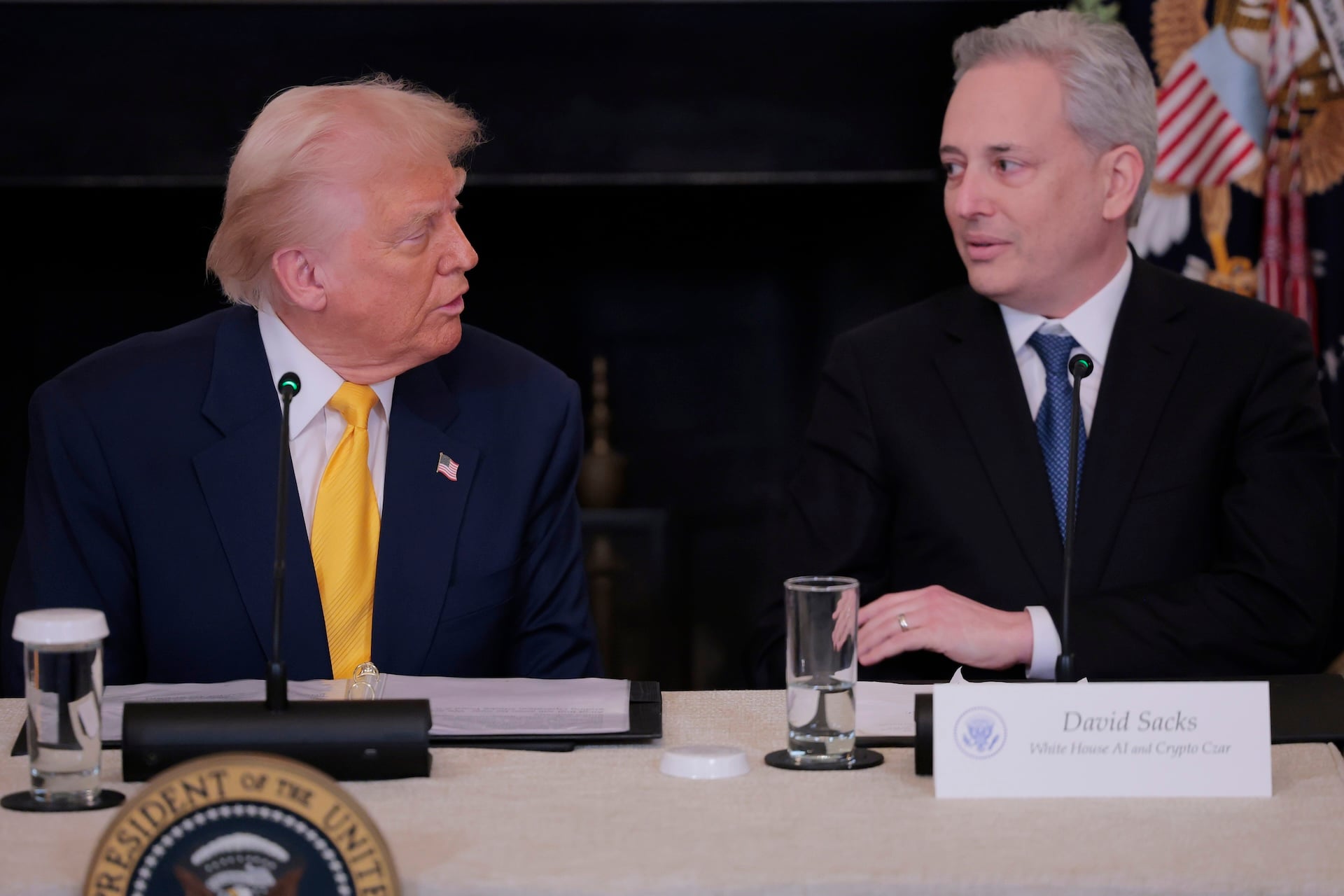
But some folks close to the Trump administration are reportedly pushing back against the idea of such restrictions despite their general hawkishness toward China. David Sacks, the former AI and Crypto Czar to Trump, took aim at Ball over the weekend and said on X, “The leading closed labs, already a duopoly in terms of AI model revenue, want the government to eliminate their open-source competition.”
David Sacks’ Motives
Sacks is an interesting ally to the open-source cause here, given his fearmongering over China in the past-but he’s basically molded his position to fit his true cause: killing regulation. Sacks has long accused Anthropic of trying to run a regulatory-capture campaign-basically locking in strict guardrails that are designed to keep upstart models from knocking the top labs off their thrones. Now he sees OpenAI attempting to do the same, and he’s not having it.
Sacks likely doesn’t really care about open source as an ideological principle, though. He more just wants to tear down the minimal bumpers that have been set up for AI models in the US. Sacks was reportedly the leader in killing federal AI legislation that the industry itself was pushing for, and supported efforts to keep states from implementing their own regulations.
More than open-source models, Sacks wants to open the AI floodgates. Not surprising for a guy who reportedly has nearly 500 stakes in companies with ties to AI. He’s a powerful ally to the open-source movement given his proximity to the Trump administration, but he should be viewed with just as much skepticism, even if he might be aligned in this instance of pushing back against an industry leader pretty blatantly posturing for fear-based restrictions on a competing model because it’s cheaper and “foreign.”
Comments
No comments yet. Start the discussion.