OpenAI Codex – A New Frontier in Application Modernization
Challenges in Application Migration and Modernization
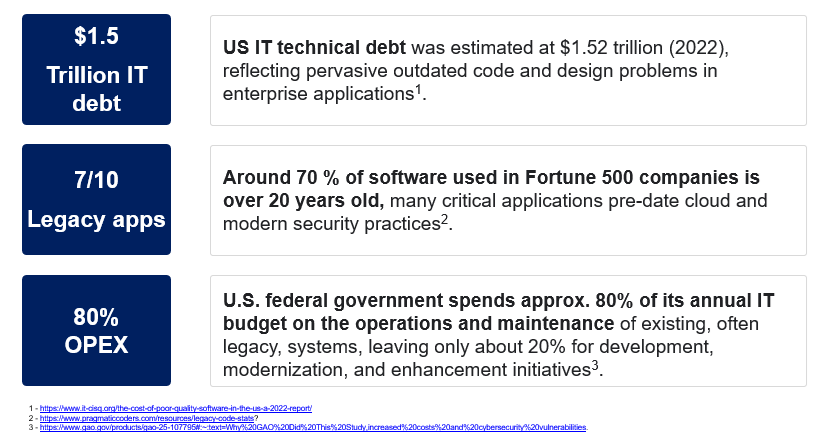
For enterprises, modernizing their legacy applications landscape is a strategic imperative to enable agility, be cost-efficient, and bring innovation. Yet, despite hefty investments, many modernization initiatives fade away. Studies show that 79% of organizations have had at least one modernization project fail, often at great expense.
Traditional modernization efforts are fraught with challenges. The core issues are often not just technical but stem from knowledge gaps and limited understanding of systems, hidden dependencies, undocumented business rules, and lost expertise due to the retiring of veteran developers over time.
Enterprises face the following key challenges when attempting to migrate or modernize legacy applications using traditional approaches:
- Legacy Codebase and Complexity: Legacy applications often consist of millions of lines of code accumulated over decades, written in outdated languages and having complex interdependencies. The sheer size and antiquated structures of such codebases make manual analysis extremely time-consuming, resulting in project teams struggling to understand the codebases, ultimately impacting modernization timelines and efforts.
- Knowledge and Documentation Gaps: As veteran engineers retire or leave, their expertise walks out the door, creating a knowledge vacuum. The result is that many legacy systems lack adequate documentation and skilled support, forcing modernization teams to reverse-engineer code and reconstruct understanding from scratch. This knowledge gap increases the risk of errors and slows down any migration project.
- Technology Constraints and External Pressures: Legacy systems often run on antiquated hardware or operating systems, use databases or languages that are no longer supported, and lack compatibility with cloud or API ecosystems. This makes extracting data or integrating new features difficult without extensive workarounds. Also, external pressures such as cybersecurity threats, regulatory compliance demands, and the need to leverage data for AI/analytics make migration more complex, technically challenging, resource-intensive, and easy to defer.
Given these challenges, AI-assisted approaches such as OpenAI Codex are gaining traction, offering ways to tackle these obstacles in a more efficient and controlled manner.
OpenAI Codex
At its core, Codex is OpenAI's series of AI coding tools that help developers move faster by delegating tasks to powerful cloud and local coding agents. In the context of legacy system modernization, Codex can enable faster understanding of application codebases, quicker implementation of new code, and fewer manual steps for the development team.
Codex can assist at various stages of the modernization cycle, from analyzing a monolithic codebase to transforming it into cloud-native microservices.
- Legacy Code Understanding and Summarization: Codex excels at reading through large codebases, making documentation, identifying key components and dependencies between modules, and describing system functionality even if documentation is missing. Codex provides clear explanations of legacy code behavior and even generates technical documentation such as user stories, design diagrams, and data model descriptions from analyzing the code. This helps modernization teams in understanding current-state functionality much faster and expedites modernization.
- Automated Refactoring: A common modernization pattern is breaking a monolithic application into microservices. Codex can analyze the monolith's codebase, suggest how to slice it, create new functions or classes, and update references, all while aiming to preserve original behavior. This dramatically reduces the effort required to transform a monolith's internal structure or extract microservices, which otherwise is one of the most labor-intensive parts of modernization.
- Language Transformation: Porting an application from a legacy programming language to a modern one is another scenario where Codex offers significant value. It can act as an intelligent code translator, converting code from one language to another while understanding the intent behind it. This language transformation capability can jump-start efforts to retire outdated technology.
- API Enablement: One of the modernization approaches is to expose legacy functionality as APIs or microservices so that it can be reused and extended. Codex can help identify logical service candidates within a legacy codebase, and can produce the API handler code, data transformation logic, and even documentation for the new service. This level of automation drastically reduces the manual effort needed to API-enable legacy systems.
- Test-Case Generation and Automation: Codex can aid QA teams by generating test cases, identifying edge cases, outlining integration test scenarios, or even helping set up parallel run comparisons. By automating test generation and providing a systematic way to verify functional parity, Codex reduces the risk that modernization introduces, such as bugs, saving QA teams a tremendous amount of effort and accelerating the testing cycle.
- Cloud-Native Migration: Codex can facilitate cloud migrations by generating the boilerplate code and configuration needed for cloud environments such as
Dockerfileor KubernetesYAMLmanifest. Codex can ensure that details such as environment variables, container build steps, or cloud function signatures are correctly managed according to the best practices. This helps teams move legacy workloads to modern platforms faster and with fewer errors in configuration, while also expediting migrations.
To fully realize the benefits of Codex in enterprise modernization, enterprises should integrate it into their software development life cycle (SDLC) and toolchains. While Codex is powerful, human oversight is imperative to ensure reliability, security, and alignment with business goals. A governance model for AI-assisted coding in modernization is required so that Codex-driven automations are plan-driven, reviewed, and validated by respective teams.
Business Benefits and Value Realization
Adopting OpenAI Codex in application migration and modernization efforts can yield substantial business benefits, such as:
- Reduced Migration Effort and Timelines: In practice, AI analysis eliminated ~30% of unnecessary code rewriting effort during a COBOL-to-Java migration, accelerating delivery.
- Improved Code Quality and Maintainability: AI-generated tests reduced post-migration downtime by ~40% through early issue detection.
- Cost Savings on Development and Testing: Codex's automation shrinks the need for large developer teams to grind through legacy code, translating into 20–30% lower migration and maintenance expenses.
- Security and Compliance Risk Mitigation: Proactive auditing and testing can shrink security risk remediation effort by an estimated 10–20% and ensure that migrated systems meet compliance requirements from day one.
- Accelerated Time to Market: Faster migrations directly translate into quicker delivery of modernized applications and new features, providing enterprises with a competitive edge.
- Developers' Productivity Gains: Real-world trials show developers completing tasks ~55% faster with AI assistance compared to existing coding methods. Teams using Codex-based tools have reported around 25% increase in overall development velocity.
Future Outlook
The rapid evolution of AI in software engineering suggests that what we see today with OpenAI Codex is just the beginning. While AI-generated code may not be fully production-ready without review, it provides a substantial starting point, often covering 70–80% of the conversion automatically, thereby saving developers countless hours.
Looking ahead, we can envision a future where AI-driven continuous modernization and even autonomous software engineering become part of the standard enterprise IT playbook. The role of Codex in autonomous software engineering is likely to expand from an assistive role to a leading role for well-scoped tasks. However, the best outcomes will be achieved by those who treat AI as a powerful tool, one that amplifies human creativity and decision-making, rather than replacing it.
Comments
No comments yet. Start the discussion.