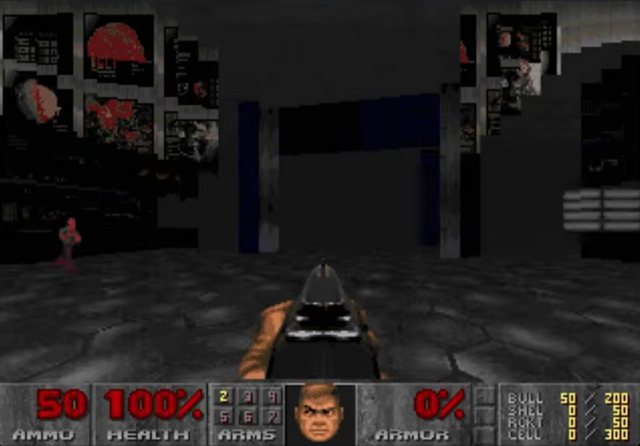
Hackers quickly prove that Neo Geo Doom ports are not "impossible"
Clever coding and graphical compromises get a classic game on more classic hardware
Last month, we passed along Modern Vintage Gamer's (MVG) confident assertion that Doom is functionally impossible to run on the Neo Geo, owing to the console's sprite-based display hardware and lack of a frame buffer.
We all should have known better than to tell a dedicated group of hackers that something is "impossible," though, as two recent projects have made great progress toward functional Doom ports on stock Neo Geo hardware.
Both of these projects have significant graphical compromises that limit how viable they would have been for a marketable, '90s-era console port, as MVG lays out in a new video. Still, they stand as a testament to the surprising results that clever, determined coders can coax out of legacy hardware.
It looks like Doom if you squint
To create the Doom64KB project for the Neo Geo, coder FrenkelS adapted an earlier Doom port they designed to run on 16-bit PC processors like the 8088 and 286.
Using that engine, the Neo Geo code then makes a kind of proto frame buffer out of the console's fix layer, an area of display memory that's usually used to display menus and HUD information on top of gameplay.
By rendering to this fix layer, the Doom64KB engine can animate a relatively smooth version of Doom maps, albeit one that uses:
- Chunky, 8×8 pixel tiles at an effective resolution of 28×32
- Just 16 colors, limiting the "light diminishing" effect as walls recede into the distance
A slight modification of the same idea builds a frame buffer from the Neo Geo's sprite memory, increasing the effective resolution to 80×56 by using 4×4-pixel blocks. While that increase comes at a noticeable cost to frame rate, things could get smoother with further optimization or with overclocked hardware like that on the upcoming Neo Geo AES+.
Comments
No comments yet. Start the discussion.